Home Blog Page 2262

Mpesa and data drive Safaricom to Sh. 32 billion net profit

0

Safaricom has announced full year results for the year ended March 31, 2015 showing a 38 per cent rise in profit after tax from Sh23 billion to Sh31.9 billion, with much of the growth coming from non-voice services.

The largest mobile provider also announced the commercial rollout of a high speed internet connection (4G) in Nairobi and Mombasa. In the last financial year ending March 2014, the telecoms operator generated Sh23 billion in after tax profit.

Total revenue for Safaricom increased 13 per cent to Sh163.4 billion, with the mobile giant’s customer base growing eight per cent to 23.3 million.

Non-voice revenue — which mainly includes income from data and the M-Pesa mobile money service — grew 27 per cent to Sh68.8 billion, accounting for 42 per cent of total revenue. Okoa Jahazi emergency top-ups rose 32 per cent.

Voice income for Safaricom, meanwhile, was only up four per cent to Sh87.4 billion.

“MPesa, now contributing 20 per cent of total revenue, continues to be a significant driving factor in our growth,” CEO Bob Collymore said.

“We continue to strive to deliver the best service to our customers and for that we have been rewarded with strong commercial and financial performance.

“We have delivered on our goal to transform lives by providing unmatched services; improving our network quality; and deepening financial inclusion with the customer uptake of Lipa na MPesa,” Safaricom Chief Executive Bob Collymore said during the investor briefing. Rollout of 4G network, a product of the TV digital migration, is expected to be extend to 13 towns and cities by year end.

Internet usage saw revenue from mobile data grow to SH14.8 billion from Sh9.31 billion while messaging services posted a 15 percent revenue increase to Sh15.6 billion.

“Today we are announcing the launch of Safaricom’s home broadband solution, which is a set-top box that brings the 3G and 4G network into the home, and distributes the superfast connectivity via Wi-Fi to any existing Wi-Fi enabled devices,” he said.

“This is a first for Kenya and will enable our customers to experience superfast home broadband and mobile data offerings,” he added.

Mr Collymore stated that voice services revenue contributed 54 percent of the total revenue. M-Pesa contributed 20 percent of the company’s total revenue.

“Since its launch, the Lipa na MPesa service has enabled cashless merchant payments and facilitated trade between businesses and their customers while improving business efficiency,” he said.

Safaricom customers also grew by 8 per cent to 23.3 million from 21.6 million. Safaricom’s share price on Wednesday rose to an all-time high of Sh17.9 apiece on the back of strong investor sentiment of record profits to be announced today.

KCB overtakes Equity as most profitable bank

0

KCB regained its position as Kenya’s most profitable bank after posting a 12 per cent net profit growth in the first quarter. The lender’s net profit in the period stood at Sh4.4 billion, overtaking the Sh4.3 billion announced by its top rival Equity Group that had relegated KCB to second place in 2014 full year earnings table.

Equity closed 2014 as the most profitable bank in the country with a net profit of Sh17.5 billion, outpacing KCB which returned a profit of Sh16.8 billion in the same period. KCB’s performance in the first quarter was driven by increased interest and transaction-based income, recording a relatively faster net profit growth than Equity’s which rose 10.7 per cent from Sh3.9 billion a year earlier.

“The performance is a confirmation that the catalytic investments we have been putting into the business through partnerships are increasingly bearing fruit,” said KCB chief executive Joshua Oigara yesterday when releasing the results in Nairobi.

“The 12 per cent increase in net profit is slightly below our internal target of 15 per cent, but the bank is still in a strong position to beat the target for the full year.”

Co-operative Bank, which recorded quarter one net profit of Sh3.17 billion last week, posted the highest net profit growth of 29 per cent among top-tier lenders that have announced their first quarter performance. The bank’s net earnings in the period stood at Sh3.1 billion compared to Sh2.4 billion in the first three months of last year.

Equity’s record profit of Sh17.5 billion in the whole of last year was partly helped by the sale of its 24.7 per cent stake in Housing Finance to Britam for Sh2.8 billion, a deal that saw it book a gain of Sh1 billion.

Excluding this transaction, KCB would have remained the most profitable lender in absolute terms as it had done since 2011 when its Sh10.9 billion net profit saw the bank replace Barclays Kenya at the top of the earnings table.

KCB and Equity are arguably the fastest growing banks, blazing the trail in regional expansion in a battle for supremacy that has left investors assessing which institution offers higher returns and a more efficient operation than the other.

While KCB has a head start in the form of a larger asset base and loan book, various metrics have painted a mixed picture for investors seeking to choose one institution over the other.

Standard Investment Bank noted that KCB could record growth by simply changing its mix of loan assets and correctly pricing additional risks, observing that the bank has signalled an intention to increase the share of credit to the more lucrative SME borrowers.

Local hotels unable to repay bank loans as earnings fall

A drop in the number of tourists visiting Kenya has taken its toll on hoteliers’ ability to service bank loans, the central bank has reported. Further, according to a survey of commercial banks carried out by CBK, many more hospitality facilities are projected to default on loan repayments. “The current spate of insecurity in the country, travel advisories and heightened political activity may support the expected increase in NPLs (non-performing loans) in the tourism sector,” the banking regulator’s Credit Officer Survey for the first quarter of this year notes.

Among the respondents who provided feedback in the survey, 17 per cent informed CBK that demand for loans from the tourism sector had shrunk in the January to March quarter.

Further, the credit officers CBK talked to said they would be more cautious in approving loan applications from the tourism sector, and interestingly, construction. Unlike tourism that is exposed to external threats, lenders said they would be reluctant to give loans to contractors due to delayed payments from the Government for public sector works.

For the tourism sector, the slowing demand for credit has been attributed to travel advisories issued by a number of foreign governments, cautioning against travel to Kenya over heightened threats of terror attacks in the country.

The CBK survey uses information collected from credit officers in commercial banks to compile crucial sector-by-sector information on demand for credit and repayments. The findings on hoteliers’ sluggish demand for loans suggests a decline in new investments in the hospitality industry, which has been severely affected by the recent terror attacks that have hit the country.

Already, as many as 40 hotels at the Coast have closed down, and about 21,000 workers have lost their jobs following capacity cut-backs. Easing demand for credit from the sector is only one of the facets illustrating the dimming prospects of the country’s second-most important foreign currency earner, which also supported over half a million jobs.


Philip Muthangya beats Ukambani’s dry spell to make Sh. 40,000 from horticultural farming

When you mention Ukambani, one of the thoughts that come to mind is perennial water problems. This reality is a nightmare for most farmers. But one Philip Muthangya from Mboru Location, Mwingi South constituency in Kitui County has devised smart ways to beat the water problems and is thriving despite the many odds around him.

His four-acre farm is an ‘oasis’ dotted with healthy looking fruits and vegetables from mangoes, to onions, carrots, maize, oranges, passion fruits, spinach, kales, tomatoes and pawpaws. So how does he do all that despite the water issues? “Farming in a dry area is not for the faint-hearted. Over the years, I have been forced to dig several wells in my compound where I get water. Sometimes they dry up and I have to dig up more to sustain my venture,” says Muthangya.

Muthangya inter-crops and rotates crops in different segments to ensure they get sufficient nutrients. He says, “When l harvest maize from one section of the land, l replace it with another crop, say carrots or tomatoes and move maize to another area next time.” Born in 1974, Muthangya started farming in 1988, after completing Class Eight at Tyaa primary. He explains, “After primary school, l stayed at home for a year for lack of fees. Since going back to school was not an option, I ventured into small scale farming to earn a living.”

To start off his venture, he sold his father’s three goats and raised Sh5,000, which he used to purchase tomato seedlings and fertiliser. As expected, he faced several hurdles before he broke even. “During my first planting, almost half of the seedlings dried up because of lack of enough water. My neighbours laughed at me. But I never gave up,” he recalls. “It was a stressful period because every well l dug, dried up, and therefore I could not get enough water to irrigate the whole farm.” By the time he got his first harvest, around seven months later, only a quarter of the vegetables he planted were left. Some were destroyed by birds and rodents like mice and monkeys.

But that quarter harvest got ready market from locals because vegetables were on high demand. He made around Sh2,000. That encouraged him to go on. Muthangya then invested Sh1,000 in expanding the farm, replacing those that had weathered.

The farm picked up well after two years. Muthangya is now making good money from farming. He supplies his vegetables to local schools, churches, Mwingi market and to individuals. In a week, Muthangya harvests at least five crates of tomatoes with each crate fetching Sh1,500.

From tomatoes alone, he pockets Sh7,500 or more in a week. And, in total plus sales from other vegetables and fruits, takes home over Sh40,000 in a month. Since he irrigates his crops, his farm is ever green. He says, “I cultivate crops throughout the year. You can find crops at farm at anytime of the year.”

Today, he inspires even those who ridiculed him when he started farming. He now donates the surplus harvest to his neigbours who are widows and orphans. At the beginning of his farming activities, Muthangya relied on agricultural knowledge he studied in primary. But to manage his crops more, he’s been reading a lot of farming from magazines, books and newspapers.

Esther Mawia, his wife, manages the farm when he ferries the produce to the market. One of the biggest challenges he still faces is that sometimes he is forced to use a generator, which is expensive, to pump water to the farm.

He would also wish to have frequent visits by agricultural extension officers to help him on pest control. The farmer also has to deal with wild animals like monkeys that destroy his maize and thieves who steal his crops at night. He says, “I have lost a lot of my produce to thieves. At times, l am forced to guard the farm at night, which is risky.”

He also cites high fertiliser prices, seeds and pesticides which increases his overall expenditure. In future, Muthangya plans to invest in several green houses and become a major commercial exporter of vegetables and other farm produce.

Ndindi Nyoro: KQ is an example of corporate mediocrity

1

Kenya Airways (KQ) will be announcing their end of year results soon. With the release of these financial results, the country will be hit by the fact that we no longer have a National carrier but a National Example of mismanagement and corporate failure.

KQ is expected to make a loss big enough to construct and complete a new dual carriage from Nairobi to Nakuru. This means anything between Ksh. 14 billion to Ksh. 20 billion.

For starters, the decision by KQ board to hire a CEO from inside after Titus Naikuni’s exit was one of the biggest blunders in corporate Kenya!! The government must take a decisive role in KQ since it will be the last straw the company will rely on for a bail out.

Still on this, I don’t get it why many of Kenya’s corporate CEO don’t know when to quit. Naikuni ought to have left KQ long ago than he did. Currently, Jonathan Ciano of Uchumi has done well for the supermarket and will be judged fairly by history… but only if he leaves now!

Linus Gitahi of Nation Media Group has set a trend that should be followed; giving another perspective to a business always serves well. Take Tim Cook. He has grown Apple into a bigger and better company from where the legendary Steve Jobs left.

Just like Bob Collymore after Michael Jospeh. We should therefore refrain from the deceitful obsession that ‘we’ are the only people who can lead these companies. We must know when to go to other things and give fresh minds a chance to take companies to the next level.

I struggled to find the right business, but now I’m successful

“My love for fashion was ignited when I came to Nairobi to work for the government.

Here I found that women paid attention to the way they dressed and I soon followed suit and got compliments for my sense of style. I particularly loved West African fabric and I dreamed of starting a business designing and selling clothes. I even bought two sewing machines to that end, but my dream to be a designer never took off. I settled into my administration job and stayed at it for 15 years.

Nevertheless, I still dreamt of starting a business.I got an opportunity to do so when I started a side hustle, going to Dubai to import household goods, clothes and shoes for sale in 2000. Those days there were not as many people in that business, so business was so good that I thought to myself that if I left employment to concentrate on it, my business would thrive.

I quit my last job as an administrator at a non-governmental organisation in 2008 to focus on my Dubai hustle. I did it for four years, and initially things were good, but soon many other people got into it, and because they were importing truckloads of goods, they were able to flood the market with what I was offering and at a cheaper price. I was selling from my car boot, so I couldn’t compete and soon I had to hang my boots and get something else to do.

I decided to try my hand at organising events. However, that proved challenging because most events happen on Saturdays, which happens to be the day I go church, so I had to abandon that idea too.

Next I tried a dance school to teach children ballet and ballroom dance. Most people I asked welcomed the idea, so I thought I had finally found my niche. However, when I started the classes, the clients were hard to come by and I had to close the school after a year.

BACK TO BASICS

“I was back to square one. I started toying with different business ideas. Then one day by chance, someone asked me if I could supply football uniforms for a school team and I said yes. After that I also supplied uniforms for a hotel. It occurred to me that this was it, so I started telling people that I do uniforms. I would get an order, get someone to produce the uniforms and then hand them over to the client. It soon occurred to me that I could be the producer.

That is when I remembered my two miserable sewing machines that I had once wanted to start a fashion business with. I dusted them off and went into the uniform business full throttle.

I decided to focus on upcountry clients who are left out by the big uniform makers, who prefer to focus on the major towns.

I also realised that the small jua kali producers did not have good quality uniforms so I decided to capitalise on quality. That was in August last year. The lessons came hard and fast. First, nobody knew me except my friends and family, who didn’t need uniforms.

I knew the big names have all corners covered so I was trying to hustle for small jobs, but even those were hard to come by.  You find that people either want to go with the big names, or with the jua kali producers who make uniforms at a cheap price.

I remember waking up on some days wondering if this would work, especially in the first few months when I was paying rent and utilities from my pocket. But I learnt that nothing comes easy; you just have to keep pushing and with time it gets better, especially as you build your network and learn how to get around in business.

Moreover, every undertaking has its challenges; you just have to persevere as you work on carving out your niche.

TOUGH BEGINNING

“Our first job came at a time when every job we tried to get was slipping through our fingers. Sometimes I felt as if I was the most competitive bidder but then I would end up not getting it. I got the feeling that many of these deals are not clean, top-of-the table deals.

However, five months after we started operating, after two months of pushing, my persistence paid off and I got a tender to supply two schools with uniforms. That encouraged me to keep going.

My other challenge has been maintaining my team of 15. I often have to deal with the turnover of employees and look for replacements.

But by and by business has grown, though there is still room for more growth. I am still waiting for my big break, which would be if I got a tender to supply the uniformed forces or even a big public hospital.

Moreover, in the next few years I want to push over the big fish and create as much employment as I can. In the meantime I am happy doing the best I can and working on my goals without focusing too much on my competitors.”

HOW SHE DID IT:


  •                 Do something that you like because it makes it easier to hang in there during the hard times, but keep in mind that the things you like are not necessarily the things that will work.
  •                 Do your homework well. Find out who else is doing it, their challenges and prepare yourself. Don’t go into something because everyone is doing it.
  •                 Have a good relationship with the people you work with and have a mutual understanding about the way the work should be done.
  •                 You can never be too ready to go into business; just plunge  in and learn as you go.
  •                 Leverage your network and use it to get business deals.

One family making Sh. 320,000 profit from farming

54-year-old Kenneth Macharia has seen River Thika swell and shrink since 1995 after he bought half-an-acre next to it and established a farm. The river has become his source of inspiration as he enjoys his retirement after working as a technician in the Ministry of Transport from 1978 to 1995. However, despite being next to a stable water source, he does not grow crops.

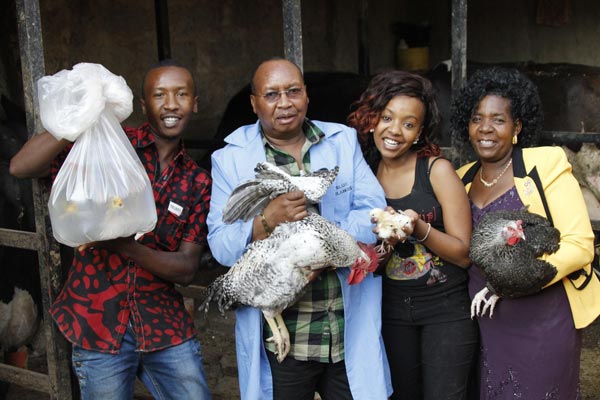
On one corner of the farm are two ponds, where Macharia, his wife and children keep ornamental fish and other breeds like catfish. Away from the ponds, there is a poultry coop with 3,000 chickens, mainly the Kuroiler breed. The Macharias hatch and sell chicks and eggs.

A dairy unit is not far from both the fish ponds and the poultry coop. The family keeps 19 dairy cows that produce 100 litres of milk every day. However, it is not the proximity to the river or the three agribusinesses that make the family’s farm unique.

It is the way they manage it. Each family member manages a unit of the business, with Macharia handling the dairy farm, his wife Margaret (50) and son Kevin (27) handling the poultry unit while one of his daughters Maureen Nyambura (23) the fish business. The lastborn Diana Wambui (16), who is in secondary school, helps across the farms.

“When we moved into this farm as a family, we had one thing in mind; to start farming. We discussed and settled on the name Sky Blue Farm ,” says Macharia, adding that as parents, they considered themselves as a river, where their children, the tributaries can flow from and have their own life.

Each family member is responsible for what happens in their business and must ensure they bring in profit. They tell explain how it all works.

Margaret: I fell in love with the kuroiler breed

I manage the farm with my son Kevin Macharia, who is our first born and a fourth year Environmental Science student at Kenyatta University.

I have been rearing chickens since 1989 when I was still a young mother to supplement my husband’s income. I was keeping both layers and broilers until 2010 when I switched to kienyeji chicken after visiting Kenya Agricultural and Livestock Research Organisation stand in Thika Agricultural Show.

I was impressed with the chickens and I decided to give them a try. This saw me expand my brood to over 1,000 and start hatching my own chicks.

It is then that I brought my son on board because the number of birds increased.

After rearing the breed for about three years, we learnt of kuroilers early last year and my son got interested. We invested Sh200,000 as starting capital in buying the chicks from Uganda.

He bought 500 kuroiler chickens. We are now rearing over 3,000 chickens on our farm. We collect over 10 crates of eggs every day, which we supply to several shops in Thika town. This gives us an income of between Sh100,000 and 150,000 every month, with a crate going for Sh300.

On my son’s advice, we recently bought an incubator that holds over 3,000 eggs. We hatch both kienyeji and kuroiler chicks, but farmers mainly love the latter because they are hardy.

Overall, my husband oversees the project and handles the finances while I deal with purchasing feeds and other necessities. I also ensure each animal is vaccinated to prevent disease outbreak.

Maureen: I love ornamental fish and aquariums

My work is to ensure that everything at the fish farm goes well, including looking for market. I balance the work with my studies at Kenyatta University, where I am a third year film student.

The fish farm mainly comprises two fish ponds that host catfish and various species of ornamental fish.

My father started the business in 2012 with 1,000 tilapia and catfish. We then diversified to ornamental fish which led to aquarium business. In a good month, we make a profit of about Sh100,000 from this.

One of the 8 by 9ft fish ponds hosts catfish while the other houses gold fish, yellow comet, fantail, sword fish, shubunkin fish, sword fish and koi cup fish that we sell to ornamental fish lovers.

We normally harvest catfish after it attains about 1kg at eight months. A kilo goes for Sh200 while we sell the ornamental fish per inch. It depends on the type but prices range from Sh200 to Sh300.

We also make different types of aquariums. So far, we have four types namely wall mount, tank, coffee table and TV trolley.

We sell to people according to the design, with the lowest going for between Sh35,000 and Sh40,000, exclusive of the ornamental fish.

This is our newest business and I am the one who proposed it after doing some research on the internet. We started by outsourcing the construction of the aquariums but we are now making our own under the name Sky Blue Production, which has employed two people.

So far we have constructed and sold more than 35 indoor and outdoor aquariums. The raw materials include special glass, silicon, lighting system, aeration system, heater, water treatments, sand, beautifications like castles and plants.

We get our fees and pocket money from the business based on how they perform. If my brother or I make more money, we are given more university upkeep cash. Also, at the end of the year, we have a family outing to help us bond, evaluate the strides we have made and focus on what to do the following year.

Kenneth: Milk is my business

I started this project in 1995 with two Friesian cows that I bought at Sh40,000 each. I have been upgrading the quality of my cows using both imported and local semen. We now have seven lactating cows and produce an average of 100 litres a day. We have 13 heifers, four in-calf; very soon we will start getting more than 150 litres of milk a day.

From the milk we get, we take 70 litres to a shop we own in Thika where 40 is used to make yoghurt and the rest mala. The other 30 we sell to our neighbours at Sh50 a litre. The milk business fetches us a net profit of Sh70,000 a month.

One of the things we do not compromise about is hygiene. We clean the dairy unit each day and use the dung to make biogas for our home use. The most challenging part is when our children return to school.

This forces myself and their mother to oversee everything, which is demanding. Sometimes we have to hire more people to help us.

But they come at least twice or once a month and see how things are faring. The best thing about this is that it has brought us together as a family. It is motivating us to work together and achieve a common goal. I am now confident that if I retire or my age does not allow me to work on the farm, my children will steer it to the next level.


Ferdinand Waititu is new Kabete MP

0

Ferdinand Waititu is the new MP for Kabete. Mr. Ferdinand Waititu commanded a great marging throughout the vote tally in Kabete constitucency.

By the time of going to press at around quarter to 9pm, Ferdinand Waititu had garnered over 20,000 votes against his closest rival who had less than 300 votes.

Mr. Ferdinand Waititu will step into the shoes of the late Kabete MP George Muchai who was murdered in a Nairobi street in what later turned out to have been a robbery attempt.

Mr. Ferdinand Waititu will be making a return to parliament, in which he formerly represented Embakasi constituency in Nairobi. Mr. Waititu becomes the first MP under the newly formed Jubilee Alliance Party (JAP) that brings together TNA and URP parties under President Uhuru Kenyatta and deputy president William Ruto.

Mr. Ferdinand Waititu had contested for the Nairobi gubernatorial seat under TNA and lost to the incumbent Evans Kidero of ODM.

More to follow…

Former manager thrives in car wash business

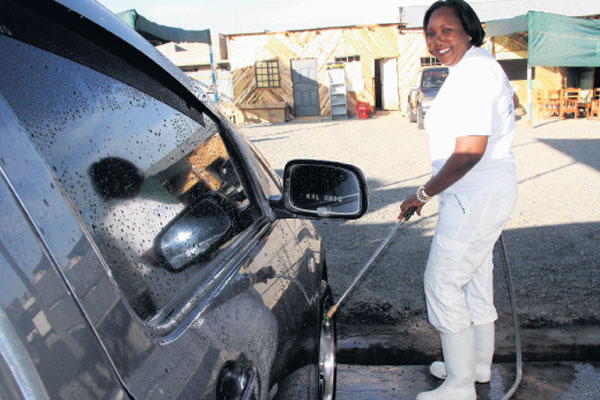
After being declared redundant from her top management job, Wacu Gatoto did something that she never imagined she would ever do: She opened Washoo’s Washer, a car wash, in Nkoroi in Kajiado County, and it is growing from strength to strength.

“I never imagined I would be washing cars for a living. But looking back at the spark of events that brought me here, I am amazed at what I have achieved.

“My undergraduate degree was in procurement. I remember an interview after my graduation in November 2001, where one of the gentlemen in the panel told me something that would shape the course of my career. He said, ‘Your personality doesn’t match your degree. You are too confident for it.’

Well, I worked for two years as a procurement officer anyway. But it wasn’t until I stumbled into the hospitality industry, in 2004 – and quickly rose up the ranks to management – that I realised where my strengths lay: in my personality and how I managed people.

The gentleman was right. I worked in this industry for six years, then worked my way into property management, then a security firm.

 Career crumbles

“It was while at the security firm that everything I had achieved in my career thus far crumbled. The firm was new to the market and was struggling financially. In early September 2013 – seven months in and two promotions later – the CEO called me into his office to tell me my position had been declared redundant.

I laughed. A long hard laugh. Was this a joke? No, the CEO was dead serious. He summoned HR to explain things. I don’t recall what she said because I was in deep thought: What was I to tell my family, my kids? Had I been foolish to be content and comfortable with the promotions? It was now all gone.  I picked up my things and left.

“I spent the next several days at the poolside of a local club switching between reading, swimming and thinking things through.

I was lost – I was too old to apply for other jobs, too distraught to get back into employment. I wasn’t warm to the idea of business yet. What now?

 Time to regroup

“A small security firm in Nkoroi invited me buy shares in their company and pioneer their new products. This had been my niche.

But the six months as their sales director were the least inspiring period I ever had in my working life. So I quit. Then I returned to the poolside to regroup.

“Running my own business was the next option. My first idea was to run a male spa. I got space in Nkoroi, but banks wouldn’t lend me the money for capital. ‘We don’t finance start-ups,’ they said.

My next idea was a carwash – it would be less capital-intensive and bring in more steady returns than a male spa. I got a shed right off the highway.

I booked it then waited for the end of the month to settle my deposit. But by the time it was end of the month, the landlady had already given it away. ‘You delayed,’ she yelled into the phone.

“Now here I was again, stuck – I wanted to run a business but there was no business to run. I wanted to give up, but a close friend advised me against it. ‘Now is the best time to start because you are on fire. You are angry and afraid. You cannot give up now,’ she said.

“So I went back to the ground. I got yet another carwash that was letting. It was a strip of land, no bigger than a corridor.

And the rent was far too high for the area. But I knew I needed to start. With the pooled resources from my husband and my savings, I built a temporary mabati structure as the washing bay and upgraded the equipment.  Washoo’s Washer opened shop in May 2014.

“In the first five months of business, I grew a clientele which kept coming back for the excellent service – both the customer service and the carwash service.

I wanted more women to wash the cars but the few I got lacked the passion and patience to grow with me. Either way, my team of four guys and I managed to pull over 900 carwashes and 300 loyalty-card customers.

“I invested all I was making back into the business. I invested in my staff by having professional car experts and engineers train them often. I invested in high-end machinery and equipment. I invested in research for products. My staff was on salary, I wasn’t. “The banks still wouldn’t finance my working capital because they considered me a start-up.

I relied on shylocks – the beauty about my business is that it returns cash to me on a daily basis; so I could settle with the shylocks on time, and earn a good credit rating for me to return to them for more money. Product suppliers were also of great support; the trainings and trade discounts were good.

“The business was growing, but my corridor of a washing bay was far too small to expand our services and clientele as I envisioned. I had to hit the ground again.

I got another place right off the highway. Not an ideal location but it was a much bigger space for less money – I had room for a wider washing bay, a customer lounge and a few extra spaces to rent out.  But I didn’t have the capital to expand. Shylocks couldn’t finance me to that extent. The banks were out of question.

My husband said he could support me with only a fraction of what I needed. The only solution to fill the gap was to part with my car, something I had vowed not to sell ever since I got laid off.

“We started construction in early November 2014. Our first wash was in December. I achieved my goal for the New Year – to move to a bigger space – before we closed the year. That’s a huge plus. We are up and running, but still a long way off from calling it done.”

HOW SHE DID IT:

  • Start a business which will return cash on a daily basis. Even on the quietest day of business, I know I will still take something to the bank.
  • Shylocks are the financing solution for the short-term and for start-ups, not banks. So find a shylock and build your credit rating with him.
  • Run your business yourself. At least for the first six months, be there to run the show yourself – manage your staff and build your client relationships. Let your customers feel your presence.
  • Involve your partner in what you are doing: My husband has given me the financial and moral support to keep me going.
  • Don’t give up on whatever you envision for yourself or your business: Try and keep trying. Read the story about WD-40 – it wasn’t until the fortieth try they got the formula right.

Former plastic-shoes hawker making Sh. 300,000 from fish farming

Thinking outside the box and patience have worked for Njoro fish farmer Peter Njuguna. He first ventured into fish farming after 12 long years of savings, reviews, and endless education. “I do not have acres but a three-quarter piece of land and I had to think long-term to make good money. That required making informed calculations,” says Mr Njuguna.

He sold plastic shoes for five years, earning a nickname of ‘Chunga Mguu,’ which means “take care of your feet.” By the time he started commercial fish farming, he had more than Sh300,000 in his piggy bank.

Another hurdle was access to a reliable source of water. He comes from a dry region but water is part and parcel of aquaculture. He turned to water harvesting after he bought containers whose total capacity is 50,500 litres.

“This is one area where water is a major problem. And, therefore, for a farmer who wants to start a fish pond, it is a hurdle that he must overcome,” says Mr Njuguna.

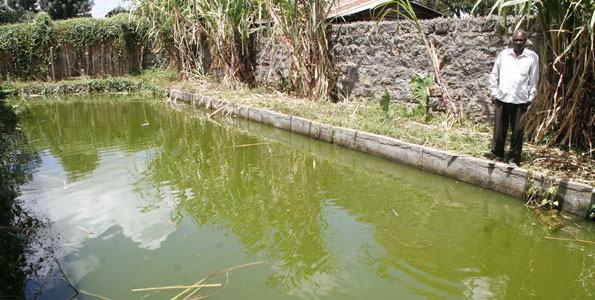
“I constructed an 80 by 26 feet fish pond, five feet deep, and acquired two septic tanks and constructed an underground one which enabled me to store enough rain water. Then I bought fingerlings. All these cost me Sh300,000.”

He started with 1,000 golden fish fingerlings which he approximates have multiplied to more than 40,000 in the 12 years of the business.

Cost of feeds, he says, is the other challenge that has been giving the farmer sleepless nights, explaining it would be a tough climb for small players to break even. “If you want to construct my size of the fish pond, you must be thinking of using about more than Sh1 million because the cost of construction materials is high,” he says.

However, Mr Njuguna has found an uncommon way to lower the feeding costs. He feeds the fish with bread and mandazi with scoops of the manufactured fish pellets.

“A 50kg of the fish pellets currently goes for Sh1,500 which till recently was sold at around Sh900 and this can last for two weeks. This translates to Sh3,000,” he says. Aquaculture is steadily gaining ground in Kenya after the Government marked it as one of the economic stimulus programme projects.

The hyacinth menace in Lake Victoria has meant that even people from the lake region venture into fish farming as opposed to fishing. Last year, the fish output rose by 5.1 per cent to 161.8 thousand metric tonnes, mainly due to “more catches from Lake Victoria and fish farming,” says the Economic Survey 2014.

Every three months Mr Njuguna harvests a maximum of 500 fish, selling each at Sh150. Last year he made Sh300,000, which he pumped into his property investments.

Fish farming requires high level of cleanliness, so Mr Njuguna keeps intruders at bay, constantly harvests water and ensures algae are afloat for oxygen circulation as well as supplement food droppings.

There is a huge fish market, he says, but adds that “consumers require a ready supplier channel so that they do not get spoilt as fish is a highly perishable commodity that requires refrigeration.”

Common courtesy and dependability are some of the qualities that has seen him get loyal customers, who speak well about him and collect the fish from his farm. “I started with fish traders who spread the word about me to others and before long I got an order from one of the supermarkets in Nakuru town, which I did not expect,” he says. “Slowly I became popular and received more orders.”

What matters most, he says, is how you deal with the customers. “Are you honest? Can they trust you with their deposit? If you are the kind that short-changes them just because you have a high demand, they will go and never return.”

He supplies schools, universities, colleges, supermarkets, wholesale fish traders, and individuals. “Usually I harvest on prior orders. I cannot remember when I ever harvested and they got spoilt because they were not bought,” he says.

Apart from fish, he grows strawberry, cassava, cabbages, and kales and keeps indigenous poultry. It is this mixed farming that has earned him the prestige of being a trainer.

Weekly, he receives farmers from across Kenya, Uganda and Tanzania, who want to break into commercial farming. He charges every farmer Sh200 for tips.