Home Blog Page 2264

Kenya embraces a research programme to drive R&D

0

Source: scidev
Kenya has embraced the University Research Chairs (URC) programme, a model which has already been adopted by countries such as Canada and South Africa.

Under the URC programme, the government of Kenya’s National Commission for Science, Technology and Innovation (NACOSTI) is partnering with Canada’s International Development and Research Centre (IDRC) to fund research programmes.

“We have identified seven priority areas which will be rolled out in the coming ten years, starting this year with health systems and biotechnology research.”Jasper Rugut, Kenya, National Commission for Science, Technology and Innovation (NACOSTI)

“We have identified seven priority areas which will be rolled out in the coming ten years, starting this year with health systems and biotechnology research,” said Jasper Rugut, NACOSTI CEO, at the launch of the programme in Kenya last month (31 March).

To support the URC programme in the two thematic areas of research, NACOSTI and IDRC are each contributing US$1 million for a period of five years. Moi University has been appointed to lead research on health systems.

Unlike in other forms of research, URC mainly focuses on innovation and production of new technologies, with an emphasis on uptake to solve pressing social-economic problems by closely involving government and industry actors, according to Rugut. It also seeks to strengthen the role of universities in public innovation systems.

Man sentenced for killing, eating heart of girlfriends lover

0

Source: Reuters

A man who ate his victim’s heart after stabbing him to death was sentenced to 18 years in prison by a South African court on Wednesday.

Andrew Chimboza, a 35-year-old Zimbabwean national, killed his girlfriend’s lover Mbuyiselo Manona on June 2014 in Cape Town’s Gugulethu township.

Judge Ashley Bins-Ward said that Chimboza had shown no remorse and refused to acknowledge his “unpredictable and uncontrollable rage”, the Rand Daily Mail reported.

He was found to have no mental illness after being placed under psychiatric evaluation.

Psychiatrist Tuviah Zabow told the court that Chimboza said the woman coerced him to kill Manona and that “she also demanded that he present her with the deceased’s heart”, news website News24 reported.

“His memory of the period of the offense was good but he declined to explain why he had sliced up the heart and was found eating it,” Zabow said.

5 Behaviours of Smart People

0

source:entrepreneur

Smarts are ridiculously important and I’ll tell you why. Smart people make smart decisions and that’s the most important factor in how things turn out for you. Since we don’t have smart meters built into our foreheads, here’s how to tell if someone’s smart, starting with the obvious:

They make smart decisions.
Smart people know their actions have consequences. They also know that they have to earn business results one decision at a time. In other words, a few smart calls won’t make you omnipotent. Consistently making good decisions takes discipline and focus.
They learn from their mistakes.
From our first steps to our last, we learn everything in life by trial and error. We all make mistakes because that’s how we learn. Smart people learn from theirs. After all, if you don’t face reality and judge yourself honestly, you’ll never do better next time.

They don’t have all the answers.
There’s an old saying, “Those of you who think you know everything are annoying to those of us who do.” It’s a funny line but if you say it in earnest, that’s pretty annoying. Smart people don’t need to constantly reinforce the fact by acting like know-it-alls. They’re smart enough to know how much they don’t know.

They surround themselves with smart people.
No man is an island. Individuals may be smart but small teams do the best work. Steve Jobs may have been a control freak, but he made sure the eight or nine people on his leadership team were the most talented he could find and taught them to do the same with their teams. That’s smart.

They are resourceful.
Since human intelligence is an evolutionary advantage — we didn’t evolve an enormous neocortex for no reason – intelligent people are generally more adaptable and creative in the way they make use of their surroundings to achieve results.


Joyce Nyingi: I lost my clerical job, now I make Sh. 350,000 every three months from farming

0

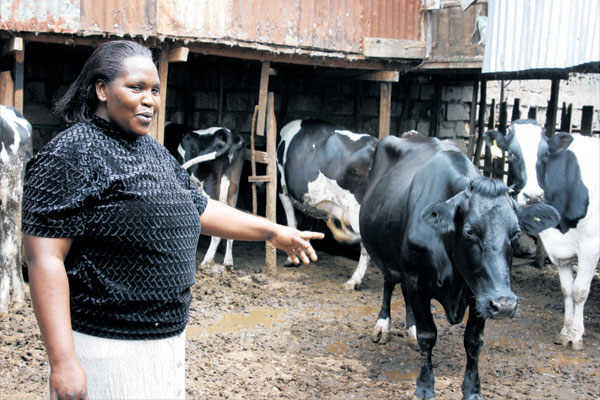
A black steel gate ushers you into Joyce Nyingi’s 50 by 200 feet compound, which is situated about a kilometer from Kamiti Maximum Prison in Kahawa. In it stands her three-bedroom bungalow. But that is not all. The mother of five keeps 15 Friesian dairy cows and a bull, 350 broilers, 50 kienyeji layers, five dairy goats and some ducks.

Have you read this? Farmer Stanley Lagat earns Sh. 12,000 from his official clerical job but makes Sh. 140,000 farming!

The agribusiness has earned her many admirers. Most wonder how the former clerk farms on such a small piece of land. Nyingi has constructed a one storey pen that hosts her cows, goats, chickens and ducks.

The cowshed takes the entire ground floor while the chicken, goats and ducks occupy the upper floor. “I went for the storey structure because of the size of my land. I was passionate about farming but I did not have money to buy a bigger piece of land. This, however, did not stop me.” The farmer used iron sheets, wire mesh, wood and cement to construct the structure that measures about 27 by 40 feet.

“I hired an experienced carpenter who constructed the entire structure that cost me Sh130,000, including labour and materials,” says Joyce, adding the artisan does repairs, extensions and other maintenance works.

THOROUGH CLEANING

She keeps both the cows and goats under zero-grazing. “The pen has enough space that allows them to exercise. There is also a milking shed for the cows.”

Every morning, Nyingi thoroughly cleans her cowshed with water and detergent to maintain cleanliness as well as minimise chances of her cows being infected with diseases such as mastitis.

The farmer says she keeps the bull to serve some of the cows. “I do not allow the bull to mate with its mother or sister. I, thus, use artificial insemination where I get Friesian semen from Central Artificial Insemination Station in lower Kabete, Nairobi.”

She used to feed her cows on napier grass that she obtained from farms in Kiambu. But after attending farmers’ field days, she has been improving on feeds.

“I now feed them on maize germ, which I make by grinding and mixing dry maize and maize cobs. I also give them hay and napier grass.”

She has planted maize at a neighbouring farm from which she will start making silage after picking the knowledge from a fellow farmer. “I learned about making silage from a farm in Mukurwe-ini. I am ready to start in about a month’s time when my maize crop will be ready.”

For 13 years, the farmer worked as a clerk at Mboi-Kamiti Land-Buying Company earning Sh32,000. She lost her job in 2008 and tried getting employed in vain. It is then that she went into farming.

NOT CONVINCED          

She started with one Friesian cow as she was not convinced that agribusiness would earn her enough money.

Then she soon noticed that there was a ready market for milk in the neighbourhood. She gradually increased her herd to the current 15. She says she still has space for four more cows as her shed can host up to 20 animals.

She milks six cows getting at least 80 litres a day. The farmer delivers the produce to Ndumberi Dairy Cooperative Society selling a litre at between Sh30 and Sh37 earning Sh90,000 a month.
She is yet to start earning from the goats that she feeds sweet potato vines as well as hay.

Away from the animals, Nyingi keeps an average of 350 broilers at any time making Sh52,000 every three months. She sells the birds to hotel operators and traders in Nairobi at between Sh400 and Sh800 each. She also has a small vegetable garden where she grows spinach, sukuma wiki (collard green) and capsicum that she sells to neighbours earning Sh500 daily.

While she uses waste from her animals to grow vegetables, the bulk goes to generate biogas that she uses for cooking and lighting her home saving up to Sh5,000 a month in electricity bills.
The biogas is located at a section of the farm and is called Blu Frame and comprises of two plastic tanks, an inlet and an outlet. However, farming on a small plot comes with different challenges.

“I keep the goats in a storey house which means when I want to let them out, I must carry them physically from the structure, but this is a small price to pay. Then one must maintain high standard of hygiene to avoid diseases.”

HOW TO UTILISE SPACE

Geoffrey Kahuho of Participatory Ecological Land Use Management, Kenya says a small piece of land should never be a hindrance to urban dwellers who want to farm. “What farmers need to know is how to arrange the structures to fully utilise space. Building storey structures helps to maximise land use.”

According to him, people who own small pieces of land but use every inch of them are more likely to earn more from agribusiness than those who own huge chunks of land.

Pauline Mbondo, Chief Officer In-Charge of Agriculture and Livestock in Machakos County, says urban dwellers have taken a backseat waiting to be fed by rural residents yet they can generate food and wealth from their tiny parcels of land.

However, she advises that one should ensure their animals are comfortable in the sheds they construct to keep diseases at bay and make them more productive.

“The best way to farm in urban areas is to concentrate on what one is passionate about. If it is livestock, keep cows or chicken. This will help you plan your farm better but there is no harm in diversifying to earn more.” She advises farmers keeping goats in urban areas to give them space to exercise as they are generally playful. “Livestock, like humans need some movements for physical fitness.”

Amos Ndung’u: chicken and rabbits are the backbone of my farm

Amos Ndung’u, the owner of Sigona Rabbit and Poultry Farm, has resisted attempts to follow in the footsteps of his neighbours, who have switched to housing development. His eighth-acre farm lies about one kilometre from the Nakuru-Nairobi highway.

Have you read this? How I make Sh. 120,000 per month from my Kienyeji chicken

He keeps rabbits, poultry and grows various crops, including strawberry in plastic pipes. His three workers who help in construction of poultry and rabbit pens that he sells at Sh5,000 each are also dressed in green overcoats with the name of the farm inscribed at the back as Ndung’u builds a brand.

The farmer keeps more than 200 rabbits of various breeds, including New Zealand, California White, Angora, Chinchilla Earlops, Fransk vender, American brown and Martin Sable.

His birds, which number more than 300, include kienyeji chickens, kuroiler, guinea fowls, bantams, doves and ornamental birds such as peacocks. “I went for rabbits and poultry because they take less space. It is easier to domesticate rabbits and chickens than cows.”

Ndung’u has established a hydroponics fodder unit through which he grows wheat and barley to cut his costs of production. The farmer recounts that he started the agribusiness in 2008 with a rabbit a friend gave him.

“I brought the doe home and started to domesticate it. I then looked for a buck and soon the numbers increased fast.” The former telecommunications technician at Zain (now Airtel) has turned his venture into a model farm that attracts visitors from within the country and outside.

Some of the visitors come from institutions of higher learning, including the University of Nairobi and Kenyatta University, and from foreign countries like Japan and Britain, according to his guestbook.

Ndung’u has built simple but comfortable structures for his birds and rabbits. He has a one-storey cage that hosts his rabbits. The cage is raised about a metre from the ground to keep the animals warm and rodents and mites at bay.

“Cages are key in the success of any rabbit venture. They must be constructed in such a way that they will not expose the animals to harsh weather that include direct sunlight, heavy winds or rain.”

Between the upper and lower floors, there is a slanting polythene paper which drains urine into a container. The urine is later collected for sale. “The paper guards the rabbits that are on the lower floor against the toxic waste excreted by those on the top floor.”

“I researched before I invested Sh100,000 in constructing the structure that measures 10 by 15 feet and is made of iron sheets, wiremesh, wood and cement,” adds the 40-year-old alumni of Kenya Polytechnic, now Technical University of Kenya. He sells an average of 10 rabbits in a good month at between Sh3,500 and Sh4,000, depending on the breed, fetching him between Sh30,000 and Sh40,000.

His biggest customers are hotel operators in Zambezi and Kikuyu township. A kilo of rabbit meat in the area goes for between Sh500 and Sh600. Rabbit manure goes for Sh300 per 50kg bag. In a good month, he sells 30 bags. The farmer also sells rabbit urine and skin.

“For rabbits, one must follow strictly the feeding regime. Rabbits should be fed at most twice a day and must also be supplied with clean water twice a day.” For mature rabbits, he advises that each animal should be fed 100g of pellets per day.

He sells chickens at between Sh800 and Sh1,000 while a tray of 30 egg goes for Sh500. Fertilised eggs for hatching go for Sh1,000 a tray. “I collect three trays a day which earn me Sh1,500. In a month I pocket Sh45,000.”

He says apart from maintaining high standards of hygiene by cleaning pens daily to avoid diseases, a farmer must know basic treatment techniques. “Diseases like Newcastle should be kept at bay by following strictly the vaccine schedule.”

“Poultry also needs to be supplied with clean water, and have mandatory check-up at least once in a month,” adds the farmer who also keeps the birds in storey units. He calls in a veterinary officer once in two weeks to check the birds and rabbits even if they are not sick.

He has a small vegetable garden where he grows spinach, sukuma wiki (collard green), onions and strawberry seedlings in plastic pipes. The pipes are six-feet long. One fills soil mixed with fertiliser in them then waters it and plants seedlings.

He sells the strawberry seedlings at Sh50 each to neighbours earning about Sh2,000 per month. On the other hand, a kilo of onions go for Sh100 while a bag of spinach and sukuma wiki goes for between Sh200 to Sh300. The vegetables fetch him about Sh20,000 in a good month.

StarTimes reduces decoder and subscription fees

0

Digital television company StarTimes Media has revised the product cost and monthly subscription fees for its satellite TV service, making it increasingly affordable for Kenyans to access digital television through its satellite service.

Kenyans with existing dish kits can now access the StarTimes satellite TV service by acquiring a full High Definition (HD) decoder at Sh999 upon subscribing to a bouquet of choice for Sh1,500. It has also introduced a more affordable bouquet to be known as Nova retailing at Sh299 with access to over 35 local and international channels.

StarTimes has also dropped the cost of its Super bouquet which will now retail at Sh1,799 per month, down from Sh2,499 with access to over 95 local and international channels. Smart bouquet will now retail at Sh899 per month, down from Sh1,799 with access to over 67 local and international channels.

Other StarTimes bouquets will include Chinese and Indian to retail at Sh1,799 and Sh899 respectively. StarTimes Sales Director Anderson Gichuru noted the company is keen to ensure Kenyans can afford and access digital television both in urban and rural areas.

Dubai firm sues Mumias Sugar over Sh. 415 million debt

0

A Dubai-based firm has sued Mumias Sugar Company over an outstanding debt of $4.4 million (Sh415 million) due to it for constructing the miller’s ethanol distillery.

Peeraj General Trading and Construction Company says Mumias had undertaken to settle the debt in two equal instalments between November and December last year.

The multinational says Mumias has ignored several demands for the outstanding debt.

The Dubai firm joins a long list of creditors that have come calling on the struggling miller since President Uhuru Kenyatta negotiated a bailout plan for the Nairobi Securities Exchange-listed firm.

Mumias owes Kenya Power Sh1.1 billion and G4S Sh. 45 million, among other suppliers and service providers.

“Mumias’ inordinate delay in effecting the final payment to the amount claimed has occasioned Peeraj enormous strain from its bankers and creditors thus hampering its operations,” Peeraj says in court papers.

“Despite demand and notice of intention to sue, Mumias has neglected to pay the sums.”

Peeraj was awarded the tender for construction of the distillery in 2010, and was to complete the project in 10 months.

Weather conditions and other delays saw the construction firm finish the project in 22 months. The distillery’s construction was completed on April 11, 2011. The delays also saw the project cost an additional $1.8 million (Sh169 million) which the miller agreed to pay through a letter sent to Peeraj in March last year.

Kenyan economy creates 800,000 jobs despite slow down

0

Kenya’s economy grew by 5.3 per cent last year according to the Economic Survey 2015 released Wednesday. This is a slow-down from the 5.7 per cent in 2013.

According to the survey, the growth from the demand side was mainly driven by an increase in private consumption and an increase in private final consumption and a rapid growth in capital investment.

“From the supply side, the major drivers of the economy were agriculture, forestry and fishing, construction, wholesale and retail trade, education and finance and insurance. However, accommodation and food services–hotels and restaurants–sector contracted for second year in a row. The number of persons employed outside small-scale agriculture and pastoralist activities rose from 13.5 million to 14.3 million.

The economy gave rise to 799,700 new jobs, representing a 5.9 per cent growth. However, new jobs created in the modern sector declined from 134,200 to 106,300 in 2014. “This deceleration was mainly due to the decreased activities in the agricultural sector and reduced absorption of employees in the counties,” the report adds.

The Economic Survey is an annual publication by Kenya National Bureau of Statistics ( KNBS). The report provides details on the state of the country’s economy and highlights the economic performance and key social and governance statistics over a period of five years with emphasis on the last two years.

This publication provides the necessary evidence in support of progress made by the country in facilitating the population to access Government services. In addition, the report informs the budgeting, planning, monitoring and policy formulation process.

Kinyanjui Kombani: Kenya’s finest contemporary author penning his own legacy

0

He has been described as one of the finest writers of our times, a rising entrepreneur and business mentor. Well, meet Kinyanjui Kombani, the author of the highly acclaimed novel, The Last Villains of Molo.


You are one of the finest writers in Kenya, when and how did your literary journey begin?


Thank you for the compliment. I consider myself a work-in-progress. I started off as a comic artist back in primary school, inspired by the works of Frank Odoi and Paul Kelemba. I am a pretty good artist too! In between college holidays, I used to go round shops in December painting Christmas decorations and messages. Later on I tried my hand in prose fiction. My first attempt at prose was a story I wrote in high school, which got lost. During my second year at Kenyatta University, I wrote a couple of short stories that received much acclaim amongst my course mates, so I decided to write more.


Which book would you single out as your most profound work? Why?


The Last Villains of Molo is what I would consider my most profound work. It took a lot of time to bring the ideas together, and also to research. It was more difficult to write because (1) as a writer with Kikuyu blood in me, I had to be careful writing about a conflict with majorly pitted the Kikuyu against the Kalenjin. I had to balance my story and stick to the facts. (2). The issue of ethnic violence has never been resolved. We still have a lot of tribal animosity. My challenge was how to end the story, with a glimmer of hope and reconciliation, yet knowing that in real life the issue remains unresolved.

 

Kombani

How many books have you written so far?


So far I have done 6 books. The Last Villains of Molo was my first novel, and is so far my most critically acclaimed piece of work. It has been a study text at Universities in Kenya and Germany, and has been mentioned at Postgraduate work in Harvard and University of Sussex. I have also written four children’s books; Wangari Maathai, Mother of Trees, We Can Be Friends, and Lost but Found (I say four because We Can Be Friends has two versions, Ugandan and Rwandan). ‘Carcasses’, a play I wrote for the Born Free Foundation, has since been shot to film as ‘Mizoga’ which has screened in five African countries to over 60,000 rural communities. ‘Den of Inequities’ is my most recent novel, is a study text at Daystar University.


Have you ever been rejected by a publisher?


Yes, I have been rejected by publishers. This is not a phenomenon in Kenya only. Even JK Rowling’s manuscript for the Harry Porter story was rejected more than 10 times. Alex Hailey is well known for the ‘Roots’ story, but before it was a success it was rejected very many times. All over the world, stories abound of rejection. As a writer, you have to live with it; you dust yourself up and move on to the next publisher. Even at my current level, my publisher will still reject my manuscript if it does not meet the standards.


Young writers say it is never easy to get published locally; local publishers take too long and hardly evaluate submitted works of fiction. Is this something you have faced as a writer?


A local publisher once told me they receive more than 30 unsolicited manuscripts every week. Hence the reason it takes very long to have their work evaluated. My advice to unpublished writers is to ensure their work is free of errors before submission. I do this by giving it to my peers and readers to read first and give me feedback before I submit. By the time it arrives at the publisher’s desk, it is pretty cleaned up and almost ready to go to press.


What are you working on now?


I am currently working on two novels and a personal development book. Soon to be released, also, is a series of reader aids for Standard Six Science pupils.


How profitable is writing books in Kenya?


If you are into writing books for the profit, you should look for another career. This is one industry where you venture because you have a story to tell, not for the money. Money comes later. There are many avenues for making money as a writer. You could venture into motivational talks, coaching other writers for money, charging appearance fees for events, and so on.


Do you agree that local publishers offer poor royalties to fiction writers?


This is a long drawn out debate. A reputable publisher will not ask the writer to chip in a single coin to the publication process. This means that publishers take 100% of the risk; there is a risk that after editing, typesetting, designing, storing, marketing, distributing, administration (paying salaries, machinery, staff etc.), your book may not sell a single copy. Publishers average royalties of 10-12%, after considering all the above mentioned processes.


Do you own any other businesses on the side?


My wife and I co-own a company called Old Gold Solutions, which provides plastic ID cards and branding solutions to schools, colleges, event organisers and small companies.


How long have you been running it?


This is our fifth year running.


What major challenges have you been facing as an entrepreneur?


One of the challenges I have faced as an entrepreneur is staffing. We work with very young staff, and there are the famous challenges of working with Gen Y – most of them are restless, overly ambitious (they want to be CEO in a year), and have the attention span that gives rise to errors. We also face other challenges like too much regulation; the number of licenses and taxes one has to pay is not conducive for business.


Talking of your career as banker, for how long have you been a banker? How did you begin and how have you risen through the ranks?


2015 is my tenth year in the bank. I joined as a Graduate Clerk. I have served in many capacities; as a Personal Financial Consultant, Business Financial Consultant, Relationship Manager, Team Leader for SME Banking and Learning Facilitator. I am currently a Learning Facilitator for East Africa


You recently won a ‘Top 5 Under 35’ at Standard Chartered Bank. What was it all about?


Last Year the bank ran a campaign to identify the Top 5 Gen Y (under 35). I was honoured to be nominated by my colleagues, considering that there are hundreds of staff in that age bracket.


Tell us about Molo Academy?


Over the last seven years, my friends and I have been involved in a project to raise the education standards at Molo Academy, our alma mater. Every year, we bring the top performers in KCPE/KCSE to a five star hotel, where we get various leaders to talk to them and inspire them. We have had Julie Gichuru, Caroline Mutoko, Ian Mbugua, George Adulu and the late Ben Muchemi speak with them. The result is that the school’s performance has been steadily rising.


What inspires to help make a change?


I come from a very humble family. I was brought up by a single mother who suffered from asthma. She was almost always in hospital. My school fees were paid by a family friend, without whom I would not be who or where I am today. Because of this background, I always feel the need to help when and where I can.


Looking back, what can you single out as your milestones and, or major accomplishments? Any awards?


In 2014, I was awarded Outstanding Young Alumni Award by Kenyatta University. This was a great accomplishment. In 2012, I was given the honour to address graduands at Kenyatta University’s Graduation ceremony. This again, was a great honour. In 2010, I won the Enablis Business Launchpad competition in the Best Business Plan in Business and Professional Services category, and was the 1st Runners Up, Overall Best Business Plan).


What drives you?


As my boss once said, we have all being chosen for a reason. We have to decide what legacy we will leave behind. That is what drives me.


What would you say to young people starting out in business or career?


As Steve Jobs said: Stay Hungry, Stay Foolish.

OPPO R5 shown smashing watermelons, cracking nuts, and even driving in nails

0

https://www.youtube.com/watch?v=Ah0A_0cDPpU

While it’s now only the second thinnest smartphone in the world, you’d think the 4.9 mm OPPOR5 would be flimsy, delicate and brittle. In an attempt to show that the phone is none of these, OPPO takes to some rigidity tests in a new promotional video for the R5.

The OPPO R5 is tough. How tough, you ask? It’s able to cut watermelons and apples in half, crack nuts, and even drive in a nail – all while keeping its shape and showing no dents whatsoever. If that wasn’t enough to make their point clear, OPPO also ran over the R5 with a car. Right after the car test, they pick up the phone to show a completely crack-free screen. We’re unsure if the phone really stays crack and dent-free after all of these tests, but the video sure looks like the phone can hold its own.

In our full review, the R5’s hardware was one of our favourite aspects of the device. It’s mostly made of metal, aside from a couple of plastic inserts on the back, which gives the R5 an extremely premium feel. We can’t vouch for OPPO’s strength tests, but we do know that the phone feels great, and isn’t lacking in hardware quality in any way.