


Home Blog Page 2266

Get your household items by paying Sh. 200 per month!!

0

With many middle-income Kenyans’ appetite for designer household furniture growing, some retailers have introduced credit facilities to allow them to acquire items in installments of as little as Sh300 a month.

For instance, household accessories and furniture sellers Victoria Courts have introduced credit facilitates to cater for the growing number of people who want to buy their high-end products but cannot pay for them at a go. In partnership with three financial institutions — Housing Finance of Kenya, Equity bank and Letshego Kenya Limited (formerly Micro Africa Ltd) — Victoria Courts allows its clients to take an item and pay for it within three years.

The store stocks premium furniture from dealers like the renowned French firm, Gautier. Mr Teddy Kilonzi, the store’s marketing manager based at their Westlands branch, said that many clients who would have normally avoid the store because of its prohibitive prices now throng the shop to buy furniture.

“Our shop mainly accommodates Class A people, the kind of people who would not mind spending Sh1 million at a go, but we can offer the same pieces of furniture to a person who can only pay Sh5,000 a month for it through this credit facility,” he says.

Mr Kilonzi says that any item  that costs  Sh3,000 and above can be bought on credit, meaning a client can pay as little as Sh200 a month.

While the facility has been in available for two years on a pilot basis, it was revealed to the public only early this year, and the response has been remarkable. Mr Kilonzi says that, while he has not a counted the number of clients to get exact figures, the stores’ marketing department has reported an upsurge in sales, particularly of seats.

Mr Kilonzi has observed a trend that might explain the increased interest in their products. “I have seen people come to buy chair,  coffee table,  bed and wall hanging at  go, then calculate the required instalment for each, so that they they  pay Sh5,000 monthly installments for the lot. For instance, the monthly instalment for a table  might be Sh245, that for a bed Sh3,000, and the one for a chair Sh1,800, which enables them to get all the pieces at once,” he explained.

The shops stocks very environmentally friendly products made of recycled material, perhaps an indication  that consumers want to conserve the environment.

The procedure for applying for the credit facility is simple. Salaried customers provide a copy of identification, three months’ certified bank statements and three current payslips.

They are also required to produce an introduction letter from the employer and a recent passport-size photo.

In addition to the documents listed above, Equity bank requires a copy of the utility bill from  salaried people while Letshego requires two guarantors, whose identification the customer must provide.

Self-employed clients provide all the aforementioned documents, with additional information on business registration or permit, the enterprise’s history, as well as a book of accounts.

Nakumatt Supermarket also has a similar programme but had not responded to our requests by the time we went to press.
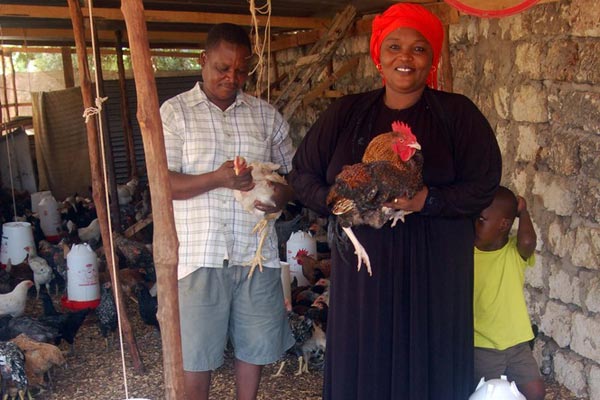

Fake chicken feeds killed my chicks

Farida Almasi ventured into poultry farming last year in July. She started with 150 Kari Improved Kienyeji chickens that she bought from a seller in Siaya at Sh120 each.

“I got them from far after a friend referred me to the farm, but the move turned out to be expensive. I lost 34 of the chicks due to the long distance.”

Her trouble, however, did not stop there. Other chicks died later after Almasi put them in the brooder and started offering them chick mash.

“At first I thought it was the weather because they had not acclimatised to it. They were dying one or two each day,” says Almasi, who consulted a veterinary officer only to be informed the problem was the feeds.

“I used to buy the mash from an agrovet at an affordable price but the vet informed me the feeds were contaminated with mould. I talked to the agrovet and he advised me to return the feeds only to offer others that had similar problems,” says Almasi, who lost 36 chicks to poor feeds.

Despite losing the birds, the farmer did not give up. She changed her source of feeds and later increased her brood by 500 kuroiler chicks in September, which she bought at Sh120 each.

Almasi has 480 birds in total, but with most of her first brood having died and having sold others at between Sh800 and Sh1,200, only 20 are laying eggs.

She supplements the commercial feeds she offers her chickens with leucaena, a local plant, and moringa leaves, which she mixes with maize bran, cutting down on feeding costs.

Almasi is working on hatching chicks for sale. “A lot of cheap eggs are coming from Uganda and the rest of the country into Mombasa making it hard for us to sell. That is why I am working on buying chicks since the imports cannot do very well here.”

Kilifi County Veterinary Services Director Donald Mwachiru Kiti says that poultry farmers should ensure that the pens are airy and placed in a direction that is against the wind. Kiti says the floor should have sawdust and fumigated regularly to keep diseases at bay.

“Chicks need to be vaccinated against Newcastle disease, fowl pox and gumboro as soon as they are hatched. After three weeks, they require fowl typhoid vaccination.” The vet says farmers should watch out for fake feeds by buying from registered suppliers only.

“In the event that they doubt the quality, the farmers have a right to report to the nearest vet office, the association of feeds manufacturers, Kenya Bureau of Standards and the Veterinary Board for assistance and action to be taken.”

Tabitha Mwiwawi: I make Sh. 20,000 from farming on my rooftop

0

42-year-old Tabitha Mwiwawi has taken her interior design skills to her 4 by 5ft balcony and rooftop where she farms different vegetables for domestic and commercial use. She grows sukuma wiki (collard green), spinach, amaranthus, tomatoes, dania (coriander), pepper, cabbages, cowpeas, capsicum, brinjals and onions, all under drip irrigation. Leafy cabbages grown in black plastic bags are on the stairway leading to her two-storey house.

Read More: How ex-soldier is making Sh. 360,000 from farming sukuma wiki

At her balcony, used water bottles are filled with soil mixed with charcoal dust and manure to improve fertility. They are neatly arranged on a wire mesh rack in what is known as hanging gardens. Inside the bottles are young flourishing seedlings enjoying the ocean breeze.

“This is my seedbed,” says Mwiwawi as she picks off tiny weeds growing next to the amaranthus seedlings. “I start by growing them here and then transfer them to the main garden made of sacks.” The garden is on the concrete rooftop, where there is plenty of space.

“I will harvest the sukuma wiki and spinach in few days. Tomatoes, brinjals and dania will be ready for harvest in about a month,” says Mwiwawi as she examines the crops in the sacks. Mwiwawi credits her lush crops to constant watering and good management.

“I water the crops up to three times a day to ensure they do not suffer from the hot weather,” says the farmer. She has over 1,100 different plants in the 4m by 5m rooftop. She started in 2012 with Sh10,000. Part of the money went to buying sacks.

She gets a minimum of Sh20,000 a month mainly from vegetables, tomatoes and coriander that she sells to neighbours. It is a tidy sum considering that she eats part of her produce and the farming is part time.

She starts her day by watering the garden between 6am and 9am with the help of her gardener, Douglas Wamwandu. Wamwandu regularly applies foliar fertiliser to the crops.

“We weed weekly individual crops to avoid transmission of diseases and pests. The onions also help to control pests in the garden,” says Wamwandu. Besides farming, she makes curtains and cushions, among other items for interior decoration. She also makes briquettes for commercial use to supplement her income.

Mombasa district crop director Martin Mbinga says soil is mixed with charcoal dust for aeration and water retention.

“Charcoal has many tiny pores, which allow air in the soil. The tiny pores will further hold water and nutrients for the plants.” Mbinga says there are good prospects in urban farming and people should embrace it.

“The Ministry of Agriculture has been encouraging urban farming since 2011 by training people to grow food in towns.” Mwiwawi’s major challenges are heavy rains, water shortage and strong winds that frequently blow from the sea. She controls the winds by placing a barrier near her garden.

Mauritius to take over shares held by Britam’s ‘Ponzi’ shareholder

0

Britam has been handed a major reprieve after the Mauritius government said it would join the financial services firm’s board and take up the directorships held by fugitive billionaire Dawood Rawat. Among the options Mauritius is weighing is disposing of the stake valued at nearly Sh14 billion to settle benefits for policyholders of Mr Rawat’s insurance firms back home.

Shareholders of Britam, the Nairobi Securities Exchange-listed firm, have endured deep anxiety this month following claims that Rawat, the single-largest shareholder, had been indicted for running a Ponzi scheme, which could have far-reaching ramifications for their company.

Read More: Britam’s free fall on NSE

Rawat holds just over a 23 per cent stake in Britam. Britam shares shed nearly 11 per cent last week as news of the alleged financial impropriety trickled into Kenya, with the stock closing trading at Sh22.50 on Friday.

But now, the tiny Indian Ocean country has effectively taken over most of the wealth and companies owned by its richest citizen, amid fears the government could be cracking down on the wealthy Rawat family that owns hundreds of businesses across the world, including a 50 per cent stake in a furniture store in Nairobi.

Read More: Britam and Equity Bank rise on NSE after free fall

Minister for Financial Services Sudarshan Bhadain said that his government was keen on keeping the Britam stake owned by its 71-year-old citizen. “Through the National Insurance Company, it is the Mauritius government that will hold these shares, and so there would be no reason for panic in Kenya,” he said. “We must assure all shareholders in Britam that there is no risk at all.”

New customers’ premiums were channelled to settle older policies that had matured and were due, the minister said, citing findings of a preliminary probe. “It had all the hallmarks of a Ponzi, but really what we are dealing with is a huge fraud.” A Sh40 billion (13 billion rupees) hole was discovered in Rawat’s insurance business, Mr Bhadain said.

In the suspected fraud, Rawat is accused of collecting customer one-time premiums on an investment product called SuperCashBack Plan Gold on the promise of repaying an interest or bonus of between 10 and 14 per cent, the probe revealed.

According to Bhadain, 14,570 customers signed up for the product. However, a clear investment plan was not available to show how returns would be generated to pay the bonuses, and the entire scheme soon collapsed.

Most of the funds have been shipped out of the company and Mauritius through Rawat’s extensive and complex businesses, which include a top-end hospital, “a hundred” insurance companies and Bramer — Mauritius’ biggest bank, which was taken over by the state on illiquidity and charges of suspect transactions.

A big concern for local shareholders was how exposed Britam was to the Ponzi scheme, with its management struggling to shake off any possibility of a downside. The Mauritius government and the conservator appointed to manage Rawat’s insurance companies held under British-American Investment (Mauritius) have made it clear that their interest in Kenya was limited to the 23 per cent stake.

Andre Bonieux, the State-appointed conservator of Rawat’s British American Insurance, said that Rawat’s stake in Britam was the “jewel in the crown”, and he had no option but find a buyer for it. “I have liabilities to settle when they fall due, so yes, we may have to dispose of it,” said Mr Bonieux, who is also the director, advisory services at PWC Mauritius. Bhadain, however, was non-committal about an outright sale.

As an alternative, the minister said, policyholders could be compensated by the state when their policies mature. Bonieux’s proposal would be more significant for Kenya since it would set the ground for the entry of another major shareholder in Britam.

Already, besieged Rawat and his nephew Moussa Rawat have resigned as directors, paving way for the entry of the Mauritian government. Critics have, however, argued that Mauritius’ four-month-old government was cracking down on Rawat because of his close ties to the previous president, who lost in the country’s general elections last year.

Rawat, who is said to have fled Mauritius in March, is thought to be in London. His vast wealth has been traced to Malta, the UK, the US and several African countries. He is among the earliest investors in Britam.

Women’s only car clinic launched to solve your car problems

0

Kenya Orient Insurance Limited has launched first women-only auto clinic. Dubbed ‘KOIL Lady Auto Clinic’, the clinic was launched at Parklands Sports Club grounds and attracted in excess of 500 women drivers. In partnership with Auto Xpress, the insurer held sessions that enabled beneficiaries to learn more about their cars.

The women were trained on, among other things, car related and preventive maintenance tips such as how to check vehicle fluids, how to change a tire, understanding car diagnostics and what to look out for when you take your car for servicing.

“Some of us leave the matters related to our cars to the mechanic. When service is due, I call my mechanic and he takes care of it and I pay whatever he quotes. Today, I have learnt quite a lot and I now know my car needs wheel balancing and why,” says Susan Kagiri.

According to Kenya Orient Insurance General Manager Mercy Kiana, the company is keen of giving its customers service beyond car insurance hence the reason they will be holding the KOIL Lady Auto Clinic twice a year.

“Kenya Orient Insurance strives to change the way the industry views and markets to women on issues surrounding their cars while also changing the beliefs that women have towards their cars through education and niche marketing,” adds Ms Kiana.

Their ‘Orient Motor Pack’ has been enhanced for the woman driver. It offers women excess free insurance, air and ground through AMREF Maisha, covers baby car seat in case of any incident as well as for hand bag in the unfortunate event that they are car jacked.

8 questions you should always ask yourself before accepting a job offer

0

This article was originally posted on themuse 

Job offers come with so many emotions. You’re excited, happy, and — likely — quite relieved. This relief, while so very sweet after a long job search, can actually be kind of dangerous.

You don’t want to let your desire to be done with the whole process prevent you from asking yourself some important questions about the job.

Obviously, you’ll want to ask your potential new employer some questions about the role, but then it’s time to sit down with yourself and consider what this means for you. Before you say yes to a job offer, go to a quiet place and ask yourself these eight questions.

1. Am I Comfortable With This Job — and Do I Actually Want to Do It?
Clearly, the hiring manager thinks you can do this job, but now it’s time to see if you agree. Review your day-to-day responsibilities, and see if there is there anything you just don’t feel good about. You can obviously do the job skill-wise — it’s about whether you want to or not.

2. Is This Position Interesting and Challenging?
Taking a position and then getting bored in a month is a bit of a waste. Make sure you’re not only able to do the job, you also find it difficult (in a good way) at times. Otherwise you’ll probably lose interest a lot faster than you think.

3. Do I Like My Boss and Co-workers?
Ideally, you’ll have competent, fun, and thoughtful colleagues. But one thing you might feel guilty about thinking about is whether you, you know, actually like them. This is not something to take lightly: Is this a group of people you can feel at home around?

4. Is the Work Environment Somewhere I Can Be Productive?
In other words, is the office space a place that helps you stay focused and happy? And, do you have the resources necessary for success? It can be a really wonderful job, but if you’re more productive on your commute to work than you are at work, that’s a problem.

5. Does This Job Allow for the Lifestyle I Want?
Speaking of commuting, is your commute awful? Do the hours freak you out? Is the vacation package paltry? More importantly, does the job pay well enough (or at least eventually pay well enough) for you to afford a lifestyle that makes you happy? These will all make a difference in how you feel about your job.

6. Will I Feel Professionally Satisfied?
This is evaluated differently for everyone — so it might make sense to think about or clarify your career values before answering — but consider whether your position allows you to create value for the company and if the company in turn invests in your professional development.

7. Is This a Company I’ll Be Proud to Work At?
Whether you want to evaluate this based on your values or on the company brand, think about how you’ll feel to be associated with this company. Having pride for the work your company does is one of the intangible things that can make a surprising difference in how much you end up liking your job.

8. Does This Job Fit Into My Career Narrative?
In other words, is this a short-term or long-term career move? You want to make sure you’re not taking a job just to run away from another job. Does this new position allow you to work toward a professional goal? If not, you may want to reconsider.

4 Steps for Dealing With Someone Who’s Really Made You Mad

0

this article first appeared on themuse 

At some point during the week, it’s going to happen. It might come from that one negative team member or that awful (but deep-pocketed) client, but someone is going to march into your once-tranquil world and do something that really, really gets your blood boiling.

1. Inform
The first step is to simply inform the person how he or she has offended you while keeping your voice even and neutral. For example : “Do you realize you’re yelling at me?” or “Do you realize you’re 15 minutes late?” For many people, this one step will get you pretty far. If the person quickly realizes his or her error and apologizes, you can pretty much stop here. The observant ones will even file this knowledge away and learn from the experience.

2. Request
Of course, there are the repeat offenders or the ones who can’t catch a hint. If the person starts acting defensive or angry, make a specific request next. Something like, “Can I request that you lower your voice?” or “I’d like to make a request that, in the future, you respect my time,” is considerate—but shows that you’re serious.

3. Insist
Stage three is when you introduce an actual consequence. This is for serial offenders or people who continue to escalate the situation despite informing or requesting. The consequence that Miedaner uses is getting up and leaving: For example, “If you do not lower your voice, I will leave,” or “Next time, I will wait 10 minutes and if you do not show up by then, I will leave.”

4. Leave
As a last resort, you have to actually follow through on the consequence you’ve introduced and leave. Some situations (and people) are easier to walk away from than others, but not setting the boundaries allows for difficult situations to continue creeping into your work. So, when the time comes, you have to leave. Make sure that you clearly explain that you welcome contact again once the behavior is corrected, then go.

This kind of thing is never easy, but following Miedaner’s steps gives you a strategy for dealing and, with any luck, a chance that the expectation is now in place to prevent difficult situations in the future.

How can I be as great as Manu Chandaria, Atul Sha, Naushud Merali and Chris Kirubi?

0

Extreme success results from an extreme personality and comes at the cost of many other things.

Extreme success is different from what I suppose you could just consider ‘success,’ so know that you don’t have to be Merali or Kirubi to be affluent and accomplished and maintain a great lifestyle. Your odds of happiness are better that way. But if you’re extreme, you must be what you are, which means that happiness is more or less beside the point.

These people tend to be freaks and misfits who were forced to experience the world in an unusually challenging way. They developed strategies to survive, and as they grow older they find ways to apply these strategies to other things, and create for themselves a distinct and powerful advantage. They don’t think the way other people think. They see things from angles that unlock new ideas and insights. Other people consider them to be somewhat insane.

Be obsessed. Be obsessed. Be obsessed.

If you’re not obsessed, then stop what you’re doing and find whatever does obsess you. It helps to have an ego, but you must be in service to something bigger if you are to inspire the people you need to help you (and make no mistake, you will need them). That ‘something bigger’ prevents you from going off into the ether when people flock round you and tell you how fabulous you are when you aren’t and how great your stuff is when it isn’t. Don’t pursue something because you “want to be great.” Pursue something because it fascinates you, because the pursuit itself engages and compels you. Extreme people combine brilliance and talent with an *insane* work ethic, so if the work itself doesn’t drive you, you will burn out or fall by the wayside or your extreme competitors will crush you and make you cry.

Follow your obsessions until a problem starts to emerge, a big meaty challenging problem that impacts as many people as possible, that you feel hell-bent to solve or die trying. It might take years to find that problem, because you have to explore different bodies of knowledge, collect the dots, and then connect and complete them.

They do not fear failure—or they do, but they move ahead anyway. They will experience heroic, spectacular, humiliating, very public failure but find a way to reframe until it isn’t failure at all. When they fail in ways that other people won’t, they learn things that other people don’t and never will. They have incredible grit and resilience.

President Uhuru’s Dubai-bound plane forced to turn back

0

A plane carrying President Uhuru Kenyatta to Dubai was forced to turn back home after navigation challenges caused by military activity in Yemen, the State House in Nairobi has said.

According to State House Spokesman Manoah Esipisu, President Uhuru left Nairobi Thursday evening on board his official Kenya Airforce aircraft destined for Dubai, the United Arab Emirates, where he was due to connect to a commercial flight to Los Angeles.

However, President Uhuru Kenyatta’s plane did not make it to Dubai.

“Following reports of increased military activity in Yemen, there was a challenge on the routing leading to a decision to turn back. President Uhuru touched the ground at Jomo Kenyatta International Airport at 11.42 pm” Esipisu said in a statement.

President Uhuru is expected to attend the annual Milken Institute Global Conference in Los Angeles .


Housing prices up in first three months of 2015

0

House prices in Kenya increased by 2.75 per cent during the first Quarter of 2015 compared to the previous Quarter’s 2.18 per cent increase. According to the Kenya Bankers Association Housing Price Index (KBA-HPI), although this increase is mild, it represents an upward trajectory.
According to KBA Director of Research and Policy, Jared Osoro, the price movements were characterised by the softening of the price movements for bungalows and maisonettes, with demand and supply dynamics pointing towards apartments significantly accounting for price movements during the quarter.
The price movements during the quarter represents a reversal of the previous quarter’s state where bungalows were the main drivers of price movements and prices maisonettes and apartments being stable.
According to the KBA-HPI released yesterday, the house price movements reveal the underlying demand-supply market conditions, with instances of price increase implying increased effective demand for the given units available in the market. They also reveal linkages between bungalows and apartments especially in the high end of the market where the demand for bungalows hinges on the desire to redevelop the property into apartments.
During the first quarter of 2015, the size of the house was a key price driver. This can be inferred from demand for the houses offered in the market that was influenced by a significant extent on number of bedrooms, bathrooms, and whether a house has a backyard and domestic staff quarters.
The same attributes featured prominently in influencing house prices during the fourth quarter of 2014, except that demand for houses available in the market then revealed a preference of fewer bathrooms if that will result in an additional bedroom.
Other factors that influenced the price of the houses include the size of the land the house was sitting on, social amenities in the neighbourhood, amenability of the house to re-development and security.