


The Shift Toward Productive Agricultural Assets
Across Kenya and globally, a quiet shift is underway. Investors are reassessing traditional asset classes—stocks, savings accounts, and real estate—as volatility, inflation, and management burdens erode returns.
Agriculture, long overlooked by urban professionals, is re-emerging as a credible investment class. Not because it is trendy, but because it is fundamentally productive. Crops grow. Livestock reproduce. Demand for food remains constant.
The constraint has always been execution. Most investors lack the time, expertise, or operational capacity to run farms efficiently. Baobab Land Consult positions itself precisely at this intersection—bridging capital and agricultural production through a managed model.

A Managed Agriculture Investment Model
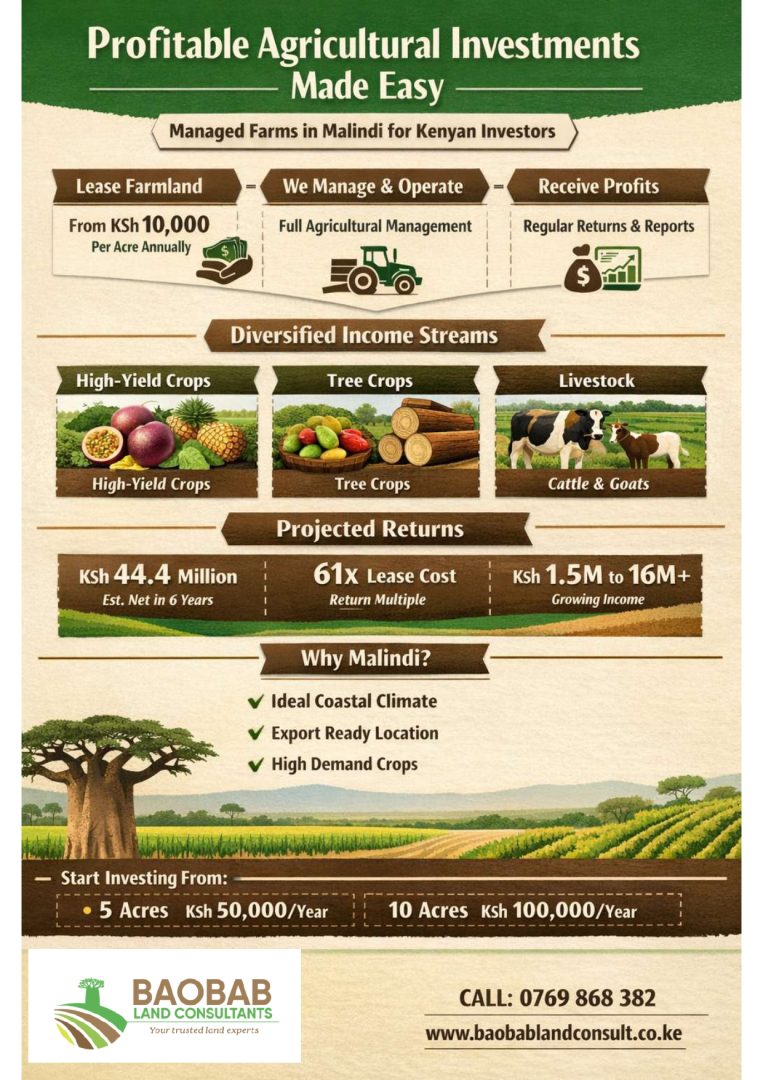
Baobab Land Consult operates in Malindi’s coastal region, offering investors leased farmland combined with full operational management.
The structure is straightforward:
- Investors lease land at approximately KSh 10,000 per acre annually
- The company manages all agricultural activities—from land preparation to harvesting
- Investors receive production reports without direct involvement
This model converts agriculture from a labour-intensive activity into a passive, portfolio-based investment.
From a strategic standpoint, this mirrors trends seen in more developed markets, where farmland funds and agribusiness platforms institutionalize agricultural returns.
Youth Fund and Savannah Honey Partner to Empower Kenyan Youth in the Beekeeping Value Chain
Why Traditional Capital Preservation is Failing
A typical Kenyan investor holding KSh 1 million in a savings account earning 6% annually generates about KSh 60,000 before tax. With inflation averaging 7–8%, real returns are negative.
In contrast, allocating even a portion of capital into productive farmland introduces:
- Inflation-linked returns (food prices adjust upward)
- Biological growth is independent of financial markets
- Multiple revenue cycles within a year
The distinction is critical: one approach preserves nominal value; the other compounds real value.
Diversification Through Multi-Stream Agricultural Production
A defining feature of Baobab’s model is diversification across crops and livestock. Instead of relying on a single commodity, the platform integrates seven revenue streams:
1. High-Yield Crops
- Yellow passion fruit (short maturity, strong processing demand)
- Pineapple (dual fresh and processing markets)
- Cassava (drought-resistant, multiple cycles)
2. Long-Term Tree Crops
- Cashew nuts (multi-decade productivity)
- Casuarina (timber with strong six-year harvest returns)
- Cocoa (export-oriented, supported by an intercropping strategy)
3. Livestock Operations
- Sahiwal cattle (milk production and breeding value)
- Galla goats (low-input meat production with seasonal demand spikes)
This portfolio approach mitigates risk. When one crop underperforms, others compensate. Livestock ensures a continuous cash flow, balancing the cyclical nature of crop harvests.
The Story of Kenya Nut Company and the coffee farmer who brought it into existence
Financial Performance: A Six-Year View
Based on conservative projections:
- Total net returns (10 acres): ~KSh 44.4 million over six years
- Total lease cost: KSh 720,000
- Return multiple: ~61x lease cost
Revenue builds progressively:
- Year 1: Establishment phase (~KSh 1.5M net)
- Year 3–4: Peak productivity (~KSh 7–8M annually)
- Year 6: Timber harvest drives significant upside (~KSh 16M+)
These figures highlight a key principle: agricultural investments reward patience and structured execution, not short-term speculation.

Why Most Agricultural Investments Fail—and This Model Doesn’t
Agricultural ventures often fail due to three structural weaknesses:
i) Poor execution
Farming is timing-sensitive. Input quality, pest control, and operational discipline determine yields.
ii) Low-quality inputs
Substandard seedlings or livestock genetics reduce productivity from the outset.
iii) Lack of diversification
Single-crop strategies expose investors to price and climate shocks.
Baobab’s model addresses all three through centralized management, certified inputs, and diversified production systems.
Low-cost agribusiness ideas that will make you rich
Strategic Advantage: Why Malindi Matters
Location is not incidental. Malindi offers:
- Favorable coastal climate for year-round production
- Proximity to export infrastructure
- Suitability for drought-resistant crops and livestock
- Established local and international market linkages
This positioning enhances both yield reliability and market access.
A Practical Entry Strategy for Investors
The model allows phased entry:
- 5 acres: KSh 60,000 annually
- 10 acres: KSh 120,000 annually
- Scale progressively based on performance
This reduces risk while enabling evidence-based expansion—an approach consistent with disciplined capital allocation.
Portfolio Implications for Kenyan Investors
For a diversified investor, agriculture should not replace existing assets but complement them:
- Equities: Liquidity and growth
- Real estate: Capital preservation and rental yield
- Agriculture: Biological production and inflation protection
What makes agriculture distinct is its independence from financial market sentiment. Production continues regardless of market cycles.
Final Reflection
The long-term investor does not chase trends. They allocate capital to systems that produce enduring value.
Agriculture, when professionally managed, is one of those systems. It converts time, biology, and demand into predictable output.
The question is not whether agriculture works—it has for centuries. The question is whether the structure allows modern investors to participate without an operational burden.
That is where models like Baobab Land Consult become relevant. They translate a traditionally complex sector into an investable, scalable opportunity.
In leadership and capital allocation alike, discipline matters. The strongest portfolios are not built on noise, but on assets that quietly compound over time.
Contact Savannah Honey
📞 0769 868 382
Website: www.baobablandconsult.co.ke