KCB Group Plc strong Q1 2026 performance signals resilience
KCB Group Plc has reported a pre-tax profit of KShs. 24.4 billion for the first quarter ending March 31, 2026, representing a 15.3% year-on-year increase from KShs. 21.2 billion recorded in a similar period in 2025.
The performance reflects the strength of the Group’s diversified business model, supported by sustained growth across subsidiaries, disciplined cost management, and expansion in interest-earning assets.
Total operating income grew by 8.5% to KShs. 53.6 billion, largely driven by increased lending activity, even as declining Net Interest Margins weighed on yields due to ongoing regulatory rate cuts across regional markets.
Balance sheet expansion and deposit growth
KCB’s balance sheet closed the quarter at KShs. 2.3 trillion, marking a 10.8% expansion. This growth was anchored on rising customer activity and a 15.7% increase in customer deposits, which reached KShs. 1.7 trillion.
The Group’s gross loan book expanded to KShs. 1.32 trillion, up from KShs. 1.21 trillion in Q1 2025, reflecting sustained credit uptake across corporate and retail segments.
Notably, excluding the divested NBK business (May 2025), pre-tax profit and operating income would have grown by 17% and 16% respectively—an indicator of underlying operational strength.
KCB Group in Sh68.4bn full year 2025 net profit, pays Sh3 additional dividend
Subsidiaries drive earnings diversification
Regional subsidiaries and non-banking units continue to play a growing role in earnings contribution. Subsidiaries accounted for 29.5% of total profit before tax and 31.5% of the Group’s balance sheet.
Non-banking subsidiaries posted steady contributions:
- KCB Bancassurance Intermediary: KShs. 209 million
- KCB Investment Bank: KShs. 274 million
- KCB Asset Management: KShs. 64 million
This diversification reduces reliance on traditional banking income and strengthens resilience across economic cycles.
Profitability, efficiency, and asset quality
Operating costs rose by 7.3% to KShs. 24.3 billion, driven by workforce expansion, technology investments, and regional growth initiatives.
Non-funded income increased by 8.3% to KShs. 17 billion, supported by digital lending growth and higher foreign exchange activity.
Asset quality showed measurable improvement:
- NPL ratio declined to 16.6% from 19.3%
- Non-performing loans reduced to KShs. 217.8 billion from KShs. 233.3 billion
The Group maintained a prudent provisioning stance, setting aside KShs. 4.9 billion to cover potential credit losses amid macroeconomic uncertainty.
Capital strength and shareholder value
KCB continues to maintain strong capital buffers:
- Core capital ratio: 18.2% (vs. 10.5% minimum)
- Total capital ratio: 21.6% (vs. 14.5% minimum)
- Liquidity ratio: 51.1%
Shareholder returns remain robust:
- Return on Equity (ROE): 21.5%
- Earnings Per Share (EPS): KShs. 22.18 (up from KShs. 20.03)
- Total equity: KShs. 352.2 billion (up 18.5%)
Historic dividend unlocks new era of wealth for KCB Group shareholders
Leadership perspective on market conditions
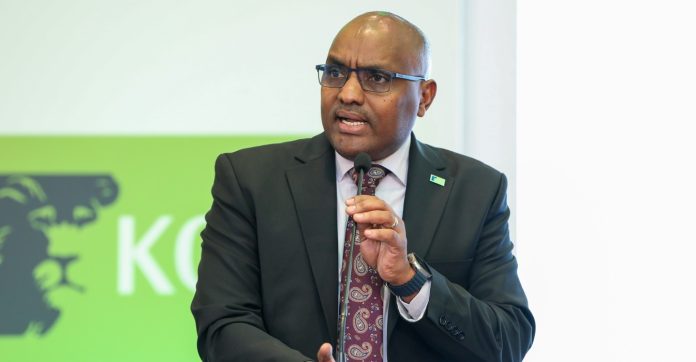
According to Group CEO Paul Russo, the results reflect disciplined execution and strategic investments:
“Despite the challenging operating environment, we delivered solid growth driven by disciplined execution, continued investment in digital innovation, and our commitment to financing economic transformation.”
He also noted the impact of the Middle East conflict, citing potential risks including reduced credit demand, higher credit risk, and lower remittance flows.
Group Chairman Joseph Kinyua emphasized long-term strategic alignment:
“The Group’s strong start affirms the effectiveness of our long-term strategy and our ability to navigate evolving market dynamics.”
Strategic developments and partnerships
KCB advanced several strategic initiatives during the quarter:
- Partnered with UNHCR to drive financial inclusion for refugees and host communities
- Secured $96.9 million financing from the Green Climate Fund to support green MSME and agricultural projects
- Sponsored the WRC Safari Rally 2026 with KShs. 227 million, boosting brand visibility
- Awarded a housing prize at Tatu City in partnership with Unity Homes
- Collaborated with the Ministry of Education, Kenya, to finance clean energy solutions for schools
Additionally, KCB introduced a KShs. 20 flat fee on Pesalink transfers, aligning with industry efforts to lower transaction costs and enhance digital payment adoption.
Outlook: Growth with caution
KCB enters the remainder of 2026 with strong momentum but remains exposed to global macroeconomic pressures, particularly geopolitical tensions affecting commodity prices, inflation, and financial conditions.
The Group’s regional diversification, digital banking investments, and strong capital position provide a buffer against volatility while positioning it to capture growth in trade, MSME financing, and financial inclusion.
Strategic interpretation for business leaders
KCB’s Q1 performance reinforces three structural lessons relevant to African enterprises:
First, diversification across markets and products is no longer optional—it is a core risk management strategy.
Second, balance sheet discipline and liquidity strength are competitive advantages in uncertain environments.
Third, digital infrastructure is now central to revenue growth, not just operational efficiency.
The deeper implication is this: sustainable growth in Africa will increasingly come from institutions that combine scale with adaptability. Leadership, in this context, is less about expansion and more about precision—allocating capital, managing risk, and executing consistently across cycles.