

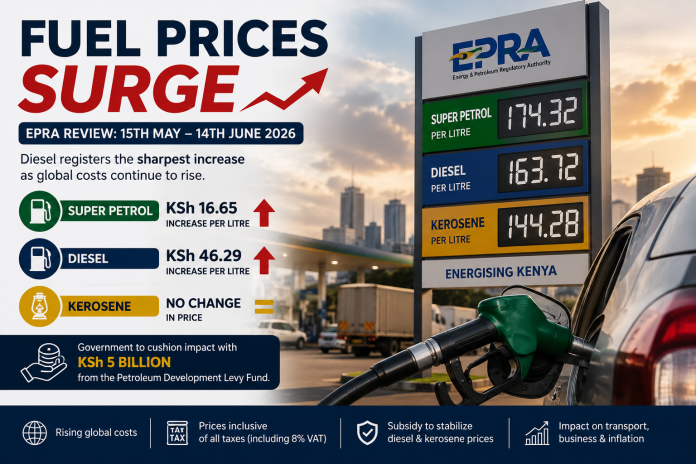
EPRA: Kenyan motorists and businesses are set to face higher fuel costs following the latest pricing review by the Energy and Petroleum Regulatory Authority (EPRA) for the period between May 15 and June 14, 2026.
In its official release, EPRA announced significant increases in the maximum retail pump prices for key petroleum products, with diesel registering the steepest rise.
Diesel records sharpest increase
Under the new EPRA pricing cycle, the cost of diesel has increased by KSh 46.29 per litre, marking one of the most notable adjustments in recent months. Super petrol prices have also risen by KSh 16.65 per litre, while kerosene prices remain unchanged.

The EPRA adjustments reflect shifts in global oil market dynamics and rising import costs, which continue to exert pressure on domestic fuel pricing.
Businesses likely to suffer most under new fuel prices
Rising global costs are driving local prices
EPRA attributes the price increases primarily to a surge in the landed cost of imported petroleum products.
- Super petrol recorded a 10.00% increase, rising from $823.27 to $906.23 per cubic metre
- Diesel saw a sharper 20.32% jump, climbing from $1,073.82 to $1,291.98 per cubic metre
- Kerosene increased marginally by 1.59%, from $1,311.93 to $1,332.73 per cubic metre
These figures underscore the continued volatility in international oil markets, where pricing benchmarks directly influence Kenya’s import-dependent fuel supply chain.
Government steps in with a partial subsidy
To cushion consumers from the full impact of rising fuel costs, the government will deploy approximately KSh 5 billion from the Petroleum Development Levy (PDL) Fund. The subsidy is targeted at stabilizing diesel and kerosene prices, which are critical for transport and household energy use.
However, the magnitude of the global price increase—particularly for diesel—means that consumers will still experience a substantial upward adjustment at the pump.
Tax structure remains a key component
The new prices by EPRA remain inclusive of all applicable taxes, including the 8% Value Added Tax (VAT) on petroleum products. This is in line with the VAT Act, Finance Act provisions, and inflation-adjusted excise duties.
Costly fuel looms as two local firms import petrol at 3 times cost of G-to-G deal
Taxation continues to form a significant portion of pump prices, reinforcing the structural cost burden on fuel consumers and businesses.
Implications for the economy
The sharp rise in diesel prices carries broader economic consequences. Diesel is the backbone of Kenya’s logistics, agriculture, and manufacturing sectors. A steep increase typically translates into higher transport costs, which cascade into food prices and overall inflation.
For businesses, especially SMEs and logistics operators, the cost escalation will likely compress margins or force price adjustments, further straining consumer purchasing power.
Strategic outlook
This pricing cycle reinforces a recurring structural reality: Kenya’s near-total reliance on imported refined petroleum products exposes the economy to external shocks. While short-term subsidies provide relief, they are fiscally costly and not sustainable over the long term.
The more durable response lies in diversifying energy sources, improving fuel efficiency, and accelerating investment in alternative energy systems, including electric mobility and local refining capacity.
Leadership reflection
Moments like this test both policy discipline and business resilience. Leaders—whether in government or enterprise—must confront the underlying vulnerabilities, not just the symptoms. Sustainable competitiveness will come from reducing exposure to external volatility, building operational efficiency, and making long-horizon decisions that prioritize stability over short-term relief.