

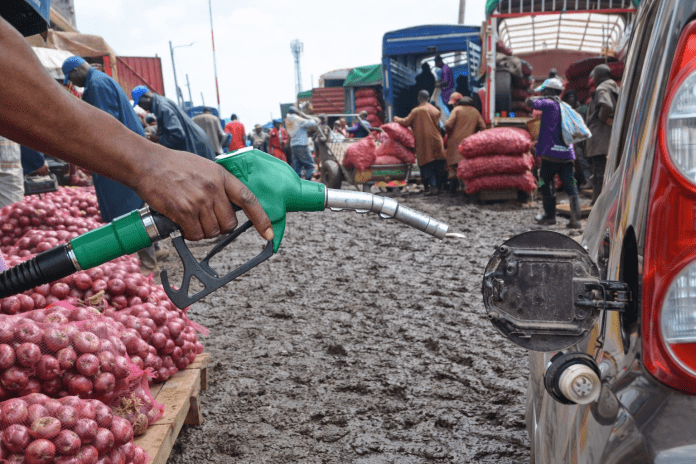
Kenya’s economy is poised for intensified cost pressures following the latest Energy and Petroleum Regulatory Authority (EPRA) fuel price review, which ushers in substantial hikes in petrol and diesel prices for the April to May 2026 cycle.
In its latest fuel review released on Tuesday, April 14, 2026, EPRA announced a Sh40.30 increase in the price of a litre of diesel to Sh206.84 in Nairobi.
Petrol increased by Sh28.69 and will now retail at Sh206.97 per litre in Nairobi, while a litre of kerosene will continue to retail at Sh152.78 per litre.

The regulator attributed the spike largely to surging global oil prices, which have significantly pushed up the landed cost of imported petroleum products. Kenya imports all its refined fuel, making local prices highly sensitive to movements in the international market.
According to EPRA, the average landed cost of imported Super Petrol increased by 41.53 percent from Sh75,266.82 per cubic metre in December last year to Sh106,526.39 in January 2026.
Similarly, the landed cost of Diesel increased by Sh68.72 percent from Sh82,292.99 per cubic metre to Sh138,764.76 per cubic metre while Kerosene increased by 105.15 percent from Sh82,684.76 per cubic metre to Sh169,632.55 per cubic metre over the same period.
To cushion consumers from the rising costs, the government has reduced Value Added Tax (VAT) on petroleum products from 16 percent to 13 percent.
While the average motorist will feel the pinch at the pump, the costly fuel impact is expected to extend across multiple economic sectors, amplifying inflationary pressures already evident in key components of the consumer price index.
Some of the sectors likely to be hardly hit by the development are:
Transport and Logistics
Transport operators are among the hardest hit. Diesel accounts for a significant proportion of costs in freight and passenger transport. Sources indicate that fuel can constitute up to 55 percent of total operating expenses for some fleets.
Matatu associations and haulage firms have already signalled intentions to adjust fares and freight charges to offset rising fuel outlays.
In a statement on Tuesday, April 14 night, the Kenya Transporters Association Ltd (KTA) said that fuel accounts for 55 percent of transport operating expenses, adding that the latest price hike would result in an increase of approximately 13 to 14 percent in transport operating costs.
The move is likely to strain household budgets and increase the cost of goods transported over long distances. Elevated transport costs historically feed directly into consumer prices, particularly for rural-to-urban supply chains.
Agriculture
Agriculture, central to Kenya’s economy and food security, faces a dual blow. Diesel-powered machinery and transport services are critical for planting, harvesting and distributing produce to markets.
With heightened fuel costs, farmers expect to confront increased expenses in logistics and mechanisation, potentially leading to higher market prices for staples and perishables.
According to the latest Consumer Price Index (CPI) and Inflation Report from the Kenya National Bureau of Statistics (KNBS), food price inflation remains the largest contributor to overall inflation, with staples such as vegetables and livestock products recording year-on-year increases.
Between February and March 2026, tomato prices surged by 13.3 percent, while beef with bones rose by 1.8 percent.
KNBS notes that over the past year, the cost of food and non-alcoholic beverages recorded the highest increase by 7.7 percent.
Manufacturing and Industrial Output
Manufacturers dependent on diesel for power generation, heavy machinery, and logistics are expected to absorb heightened costs or pass them on to consumers.
For energy-intensive industries that operate on thin margins, increased fuel tariffs is expected to significantly impact profitability.
Consumer Goods and Services
The combined effect of higher transport, agricultural and manufacturing costs is likely to translate into rising prices across a broad array of goods and services.
Basic commodities, household essentials, and service sectors such as hospitality and retail could experience significant upward pricing pressure.
This is likely to push inflation further above current levels, tightening disposable incomes and reducing real household consumption capacity.
Projections indicate that inflation could rise further above 4 percent, potentially reducing household incomes by up to 2.6 percent.
Also Read: 60,000 tonnes of bad petrol already released into market, says KPC