


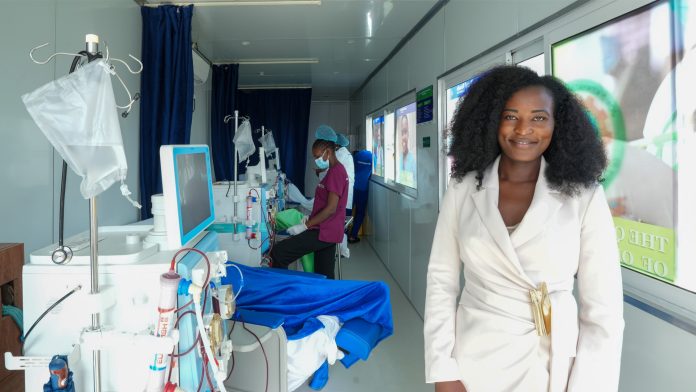
Naom Monari trained as a nurse and experienced early in her career within Kenya’s public health system how difficult it was for patients with long-term conditions to access care outside major cities.
In 2017, she founded Bena Care to provide home-based nursing services, aiming to reduce the financial and emotional strain of hospital-based treatment.
After the 2019 global pandemic, her team noticed a sharp rise in patients needing dialysis. To understand why, Naom secured a research grant from the International Development Research Centre (IDRC) and partnered with a local university to run a year-long study between 2022 and 2023 in a county heavily burdened by kidney disease.
The findings were stark: many patients were travelling up to 200 kilometres twice a week for dialysis, work commitments and caregiving responsibilities led to missed sessions, and missed dialysis can quickly become fatal. For Naom Monari, the conclusion was clear: distance should not determine survival.

Renal Roads is a mobile dialysis facility designed and built in Kenya. Working with biomedical engineers, medical statisticians, university partners, and local Jua Kali fabricators (informal sector of self-employed artisans, traders, and technicians such as metalworkers, carpenters, and mechanics), Naom Monari converted a used 40-foot shipping container into a fully operational dialysis clinic.
The unit houses four dialysis machines, reclining dialysis chairs, and a dedicated emergency area with clinical-grade walls and epoxy flooring to meet infection control standards. Dialysis depends on large volumes of purified water, so the unit also includes a reverse osmosis water treatment system, integrated plumbing and controlled drainage, plus solar power and backup systems to ensure continuity in off-grid locations.
While dialysis machines themselves are commercially manufactured, the engineering breakthrough lies in making a traditionally fixed, hospital-based system safely mobile. The machines are secured to operate during transport, and the entire configuration is protected under a utility patent.
See More: Why cases of kidney disease are more rampant in poor neighbourhoods
The truck operates on a predictable rotational schedule, typically serving three communities per week. Each site hosts two four-hour dialysis sessions per patient per week, allowing up to 12 sessions per day. Clinical oversight is provided by a county nephrologist, while trained renal or critical care nurses deliver treatment on site.
Renal Roads has already transformed dialysis access in parts of rural Kenya. Following launch in Murang’a County, evaluation results showed a 76.6 percent reduction in travel distance and 100 percent improvement in adherence, measured by patients attending sessions and completing the full four-hour treatment.
Patients and families report significant improvements to their daily life. One 26-year-old mother of two, who previously travelled 70 kilometres each way for dialysis, described the mobile unit as an answered prayer when it arrived near her home.
The service is also financially accessible, with sessions reimbursed through national health insurance. With one unit operational, and a second ready for deployment, Naom’s ambition is to expand across additional counties and refine the design further.
“Our goal is simple: bring life-saving care closer to people who need it. The first version has worked, but three years from now it will be more compact and efficient,” says Naom Monari.
Quick Takeaway…
- Across Kenya, most dialysis centres are concentrated in major towns and cities, leaving patients with chronic kidney disease without close access to treatment.
- For those in need of regular and frequent dialysis, this can mean travelling up to 200 kilometres each way, twice a week, for years. The cost, time and physical strain often lead to missed sessions and life-threatening complications.
- Chronic kidney disease is a long term disease that affects kidneys and leads to renal failure.
- The disease can be tricky to spot without a medical test because not all patients show symptoms. Symptoms develop slowly as the kidneys fail. In Kenya, kidney disease is now becoming one of the most deadly diseases.