


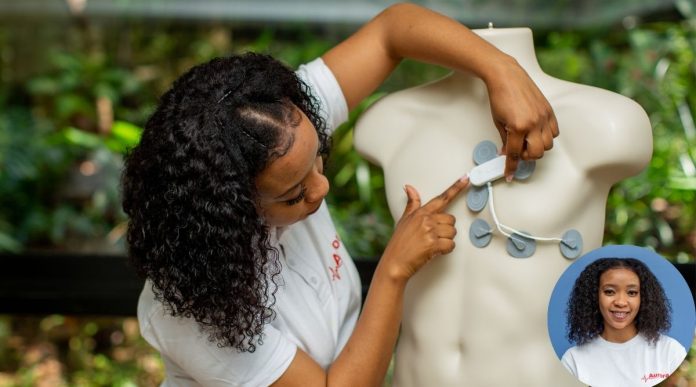
Alice Muhuhu’s motivation is deeply personal. Growing up in Nairobi, she experienced the devastating consequences of delayed medical care after losing her father following a road accident. That loss exposed her early to how fragile life can be when timely treatment is unavailable.
Years later, while training as a medical doctor at one of Africa’s largest public hospitals, she witnessed similar delays on a much wider scale. Patients frequently arrived with advanced disease simply because diagnosis had come too late.
During her medical education, Alice Muhuhu trained across several countries, including Kenya, Poland, Grenada, Egypt and South Africa. Experiencing medicine in very different healthcare systems revealed how strongly access to diagnostic technology shapes outcomes, often determining whether patients receive care early enough to prevent serious complications.
While training in Poland, she saw how technology could support proactive care when a woman arrived at the hospital after receiving an alert that she was at high risk of arrhythmia.

Back in Kenya during the 2019 pandemic, Alice Muhuhu saw the opposite: patients missing follow-up appointments, and arriving critically ill when it was already too late for early intervention. The contrast made clear how often healthcare in Kenya remained reactive rather than preventive.
Kenya’s healthcare system remains heavily centralized, with specialist services concentrated in major cities. Rural clinics often lack ECG equipment entirely, and where machines exist, interpretation depends on scarce cardiologists.
Late diagnosis of cardiac conditions can lead to stroke, heart failure and preventable deaths. Maternal cardiac complications, an often overlooked contributor to maternal mortality, also frequently go undetected.
Determined to address these challenges, Alice founded Aurora Health Systems to develop medical technologies tailored to the realities of healthcare delivery in Africa.
The result is MoyoECG, a wearable device designed to expand access to cardiac screening in low-resource environments. The device captures electrical signals from the heart from multiple angles and helps healthcare providers detect abnormal heart rhythms and other cardiac conditions earlier.
“Moyo” means “heart” in Swahili, reflecting the mission behind the technology: bringing life-saving cardiac care closer to the communities that need it most.
The platform uses embedded artificial intelligence to assist healthcare workers in interpreting cardiac signals more quickly, helping identify high-risk patients who require urgent referral for specialist care.
Designed for real-world conditions, the technology enables cardiac screening to take place directly at the point of care, even in clinics where connectivity and infrastructure are limited. The device can operate without reliable internet connectivity or stable electricity, allowing diagnostic services to reach communities that previously had little or no access to cardiac testing.
MoyoECG primarily serves rural and lower-tier health facilities where access to ECG diagnostics is minimal. Clinical pilots have demonstrated strong diagnostic performance while significantly reducing the time required for cardiac interpretation by frontline healthcare workers. The work has been recognized by the Kenya Cardiac Society and published in the Cardiovascular Journal of Africa (CVJA).
The innovation has also received international recognition, including being named Top African Winner by Qualcomm in 2024 and winning the HealthTech Hub Africa Innovation Challenge. The project has attracted support from organizations including the Novartis Foundation, the Global Fund and Standard Chartered Bank.
Beyond improving access to diagnosis, the platform is also contributing to the development of one of the largest ECG datasets from African populations, helping address global disparities in medical data and improving the accuracy of future diagnostic tools.
With support from the Africa Prize, the team aims to secure regulatory approvals, strengthen intellectual property protection, refine its AI pipeline and scale deployment beyond East Africa. Aurora Health Systems also plans to expand from its current network to more than 200 facilities, while continuing to develop new applications for maternal and neonatal cardiac monitoring.
For Alice Muhuhu, the mission goes beyond building a device. It is about proving that world-class medical innovation can emerge from Africa and be designed for the realities of the communities it serves.
Naom Monari: Kenyan nurse bringing dialysis machines closer to patients
Quick Takeaway
- Cardiovascular disease is the leading cause of death worldwide, and across sub-Saharan Africa non-communicable diseases are rising rapidly and projected to overtake infectious diseases as the leading cause of death by 2030.
- Access to cardiac diagnostics across the continent remains severely limited.
- In Kenya, fewer than 6% of health facilities have specialized cardiac diagnostic equipment, and only around 35 cardiologists serve a population of more than 50 million people. For millions of patients, life-saving diagnosis remains out of reach.