
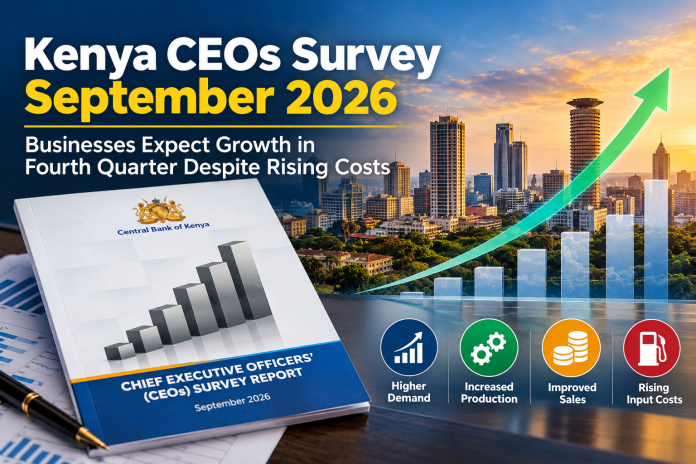
Kenyan businesses are cautiously optimistic about growth in the final quarter of 2026, with companies expecting higher demand, increased sales and improved production despite rising operating costs and pressure on household purchasing power.
The outlook is contained in the September 2026 Chief Executive Officers’ (CEOs) Survey released by the Central Bank of Kenya (CBK), which assessed private-sector business conditions, growth expectations, access to financing and the risks facing companies over the next 12 months.
The survey, conducted between September 7 and 18, 2026, found that business activity improved modestly in the third quarter compared with the second quarter. Respondents anticipate stronger performance in the fourth quarter, supported by festive-season spending, hotel bookings, social events and increased agricultural output.

However, higher fuel, transport, shipping and other input costs remain a significant concern for businesses, while subdued consumer purchasing power and difficulties accessing credit continue to constrain expansion.
CBK July 2026 CEOs Survey: Kenyan businesses remain optimistic amid rising costs and global risks
CBK Survey Shows Improved Business Confidence
The September survey indicates that business confidence improved compared with the previous assessment conducted in July 2026.
Chief executives expressed greater optimism about the growth prospects of their companies and the Kenyan economy over the next 12 months. Resilient domestic demand, increased customer orders, seasonal spending, lower borrowing costs, improved liquidity and a stable exchange rate were identified as factors supporting the outlook.
Expected foreign investment and greater adoption of technology were also cited as potential drivers of economic activity.
Nevertheless, the survey identified several downside risks, including elevated fuel and transport costs, adverse weather conditions, geopolitical tensions, pressure on household incomes and weaker external demand.
More respondents expected global economic growth to remain stable rather than improve, reflecting continuing uncertainty over international conflicts, trade disruptions, energy supplies and inflationary pressures.
Businesses Anticipate Stronger Performance in Fourth Quarter
The fourth quarter is expected to bring improved business activity, particularly in sectors that benefit from seasonal spending and increased consumer demand.
According to the CBK survey, 55.9% of respondents expect demand and orders to increase in the fourth quarter of 2026 compared with the third quarter. Another 29.7% anticipate no change, while 14.5% expect a decline.
Production is also expected to improve, with 49.6% of firms anticipating an increase. Meanwhile, 55.2% expect sales to rise during the quarter.
The festive season, higher hotel bookings, social events and increased agricultural output are among the factors expected to support this growth.
However, businesses anticipate continued pressure on input costs. Nearly 48% of respondents expect purchase prices to increase, while 62% expect selling prices to remain unchanged.
This suggests that many companies may struggle to pass higher operating costs on to customers without weakening demand or losing competitiveness.
Employment prospects remain subdued. Only 12.2% of respondents expect an increase in full-time employees during the fourth quarter, while 74.8% anticipate employment levels remaining unchanged.
The figures suggest that businesses expect higher activity but are likely to remain cautious about increasing their payrolls.
Is Buying a Rental Property Still Profitable? A Practical Guide for First-Time Investors
Rising Operating Costs Remain a Major Challenge
Despite the improved outlook, the high cost of doing business remains one of the leading constraints facing Kenyan firms.
The survey identified elevated energy prices, fuel and transport expenses, import costs and other production inputs as significant pressures on business operations.
During the third quarter, purchase prices increased across agriculture, manufacturing and services. However, selling prices remained largely unchanged for many businesses, reflecting weak demand and competitive pressures.
This creates a difficult operating environment, particularly for companies that have limited room to increase prices without affecting sales volumes.
For small and medium-sized enterprises (SMEs), rising costs can reduce profit margins, restrict working capital and delay investment in equipment, staffing and expansion.
The CBK survey also identified reduced consumer purchasing power as a constraint, indicating that businesses must balance the need to recover rising costs against the financial capacity of their customers.
Access to Credit Remains a Constraint for Businesses
Access to financing remains another important issue for Kenyan enterprises, even as lending rates have declined for many borrowers.
The survey found that 43.1% of respondents rated access to bank credit as moderate. A further 30.2% described access as easy or very easy, while 26.7% considered it difficult or very difficult.
Additionally, 37.7% of respondents reported that interest rates on bank loans had declined by between one and two percentage points since August 2024.
Despite these improvements, businesses continued to report challenges involving collateral requirements, lengthy loan approval processes, documentation demands and cautious lending practices.
These barriers are particularly significant for smaller enterprises, which may lack sufficient assets to secure commercial loans or maintain the cash flow required to service additional debt.
The survey found that businesses relied heavily on internally generated funds, retained profits and revenue from domestic and export sales to finance operations.
In September 2026, own resources accounted for 53% of reported financing sources, while bank loans accounted for 28%. Private equity contributed 7%, new share issues and initial public offerings accounted for 2%, and other sources made up the remaining 10%.
The findings underline the importance of strengthening access to affordable finance for firms seeking to invest, expand production and respond to higher demand.
Africa’s cyberattacks surge 421% as digital economy growth raises security concerns
Technology Adoption Emerges as a Key Growth Driver
Digital transformation and automation are becoming increasingly important to business growth in Kenya.
The survey found that 76% of respondents had adopted technology, automation or digitisation to support their business processes. Applications included inventory management, enterprise resource planning, e-commerce platforms, point-of-sale systems, online booking platforms, electronic tax registers and artificial intelligence tools.
Technology adoption was identified as the leading driver of firm expansion, accounting for 17% of the responses on growth drivers.
Customer-centric strategies followed at 16%, while improved operational efficiency accounted for 13%. Strengthening product portfolios and introducing new products contributed 10%, while increased marketing and improved branding accounted for 8%.
However, firms cited the cost of implementing and maintaining technology, shortages of digital skills, poor internet connectivity, power outages and cybersecurity concerns as barriers to wider adoption.
The findings indicate that businesses increasingly view technology as an operational necessity, but affordability and implementation capacity remain important considerations.
Cost Management and Efficiency Top Long-Term Priorities
Looking ahead over the next three years, Kenyan businesses are prioritising operational efficiency, cost optimisation, diversification and sustainable growth.
Improved efficiency ranked first, cited by 27% of respondents. Cost optimisation followed at 20%, diversification at 19%, and sustainable business growth at 18%.
Digital transformation and investment in talent and skills development each accounted for 5% of responses.
These priorities reflect the need for companies to strengthen productivity, protect margins and diversify revenue sources amid an uncertain operating environment.
The survey also found that firms were planning to respond to business constraints through cost and risk management, digital innovation, increased sales and marketing, and expansion into new markets.
Managing costs and risks was the most frequently cited mitigation strategy at 28%, followed by digitisation and innovation at 18%, and increased sales and marketing at 17%.
For business leaders, the findings reinforce the importance of disciplined financial management, customer retention, operational productivity and investment decisions tied to measurable returns.
Kenya’s mobile subscriptions hit 88 Million as digital economy expands
Geopolitical Tensions and Energy Prices Threaten Growth
External risks continue to shape business expectations.
The survey identified geopolitical tensions, energy prices and macroeconomic volatility among the leading external threats to firms’ growth over the next 12 months.
Developments in the Middle East remained a major concern because of their potential effects on fuel prices, freight costs and supply chains. Trade tariffs and international conflicts could also raise import costs and create uncertainty for firms that depend on imported raw materials or export markets.
Climate change, global inflation, cyber risks and the possibility of a global recession were additional concerns.