

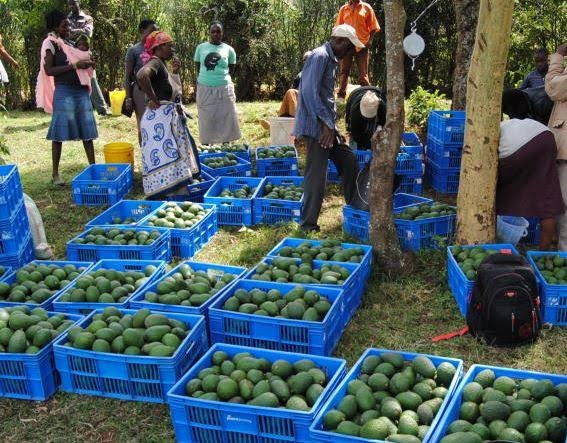
Avocado farming is emerging as one of Kenya’s most lucrative agribusiness ventures, attracting a growing number of young people seeking income from agriculture.
Often described as Kenya’s “green gold”, the crop offers farmers opportunities to earn substantial returns from both local and export markets.
According to avocado farmer and agripreneur Elijah Sawe, an acre of well-managed avocado trees can generate up to Sh1.428 million a year under favourable market and production conditions.

Sawe, the co-founder of Sakifarm in Nakuru, shared the insights on August 7 during a Co-op Bank Youth Forum that focused on opportunities in avocado farming.
He explained that the earning potential of an avocado farm depends on several factors, including the variety planted, tree spacing, availability of water, fertiliser use, general farm management and the timing of sales.
He said farmers can plant between 100 and 120 avocado trees per acre, depending on the spacing used.
“With 5 by 7 metres, you will do about 119 to 120 trees per acre. If you do 7 by 7 metres, you will do about 100 trees per acre,” Sawe said.
Proper spacing, he added, is important because it gives the trees sufficient room to develop while making activities such as spraying, pruning, fertiliser application and harvesting easier.
For new farmers, the initial investment in seedlings can be relatively manageable compared with the potential long-term returns. Sawe recommends the use of certified grafted seedlings, which cost about Sh200 each.
At 100 trees per acre, a farmer would therefore spend approximately Sh20,000 on seedlings alone, although the total establishment cost rises after factoring in water, fertiliser, labour, land preparation and other maintenance expenses.
“Avocado is very needy in terms of fertiliser and water,” Sawe said.
The crop’s income potential becomes more apparent once the trees reach maturity. Sawe estimates that a mature tree can produce about 300 fruits, equivalent to approximately 60 kilogrammes.
With 100 productive trees on an acre, this could translate into about 6,000kg of avocados under good growing conditions.
At a price of Sh100 per kilogramme, such a harvest would generate about Sh600,000 in gross revenue before production and marketing costs.
However, Sawe noted that avocado earnings can rise significantly when farmers take advantage of periods of higher market prices.
He said prices can be around Sh80 per kilogramme between February and May before rising to approximately Sh100 in August. In September, prices can move above Sh120 per kilogramme.
Between September and January, farmers can fetch about Sh150 per kilogramme, with prices reaching as high as Sh200 during favourable market periods.
It is this variation in prices, coupled with production volumes, that creates the potential for a farmer to earn more than Sh1 million from an acre in a good year.
For example, at Sh150 per kilogramme, a 6,000kg harvest would have a gross value of Sh900,000. At Sh200 per kilogramme, the same volume would be worth Sh1.2 million.
Higher production or more favourable prices could push annual gross earnings towards the Sh1.428 million figure cited by Sawe.
The figures, however, represent potential gross revenue rather than guaranteed profit. Farmers still have to meet expenses associated with fertiliser, water, labour, pest and disease management, harvesting, transportation and marketing.
Sawe also urged farmers to pay close attention to marketing rather than concentrating solely on production.
He advised growers to join savings and cooperative societies to strengthen their bargaining position and improve access to markets.
“Unit into saccos to get better bargaining power,” he advised.
Collective marketing can allow farmers to consolidate their produce, negotiate with buyers from a stronger position and potentially reduce some of the challenges associated with selling small quantities individually.
Beyond growing the fruit, Sawe sees opportunities for young people across the wider avocado value chain.
He said the business extends from seedling production and nursery management to aggregation, processing, packaging, transportation and export.
This means young entrepreneurs do not necessarily have to own an avocado farm to benefit from the growing industry.
They can instead identify opportunities in supplying inputs, providing farm services, aggregating produce or supporting the movement of avocados to domestic and international markets.
Also Read: Farmer questions Hass Avocado boom as oversupply and market access concerns mount