
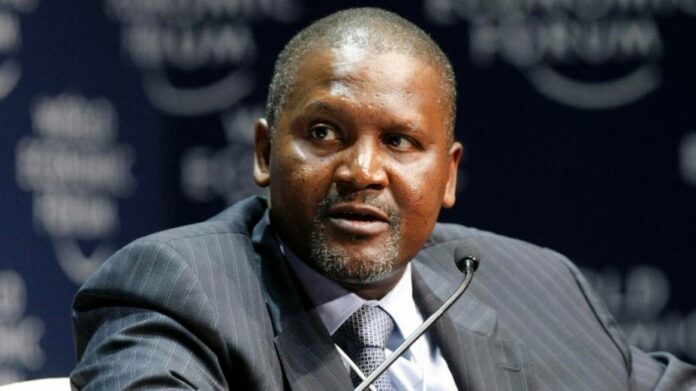
Nigerian billionaire businessman Aliko Dangote is planning a multi-trillion oil refinery project in Lamu, Kenya. This will be the first major project in the region for the man who is ranked as Africa’s richest man and the 35th richest person in the world.
According to Forbes, Dangote had a net worth of USD51.7 billion as at September 30, 2026. This was after an oversubscribed USD2.5 billion private placement pushed the net worth of Nigeria’s Aliko Dangote up USD20 billion to over USD50 billion.
How did Aliko Dangote get so wealthy? How did he build his wealth? Well, Aliko Dangote was born in Kano, Nigeria on April 10, 1957. His family was well off. His great-grandfather had established one of Nigeria’s most successful peanut farms, and the family made a sizable fortune exporting peanuts to the Europe in the early 1900s. Entrepreneurship was in Dangote’s blood, and he began selling candy, for a profit, while still in elementary school. Fast-forward to today, and everything the 56-year old businessman is doing, is in service of his relentless quest to grow his wealth and the fortunes of Nigeria.
Aliko Dangote: I need 35 visas to travel in Africa, way more than European visitors
Initially, he focused on building his business presence. After graduating from Al-Azhar University in Egypt, with a degree in Business, Aliko Dangote launched his first company, The Dangote Group, a trading company primarily dealing in cement. His family already had government connections, so he was able to secure the appropriate licenses quickly – a step that can often derail new ventures in Nigeria. Then he took his business elsewhere. He spent the next few decades working in South America, primarily Brazil. He made a major amount of money “cementing” Brazil, a country that was, and still is, on the rise. He bought multiple properties around the world, including homes in Atlanta. However, he ultimately decided to return to Nigeria, and to focus on bringing business to his home country.
In the late 90s, he returned to Nigeria, where he backed the People’s Democratic Party. After the PDP won the election, he used his clout to secure an agreement to build the biggest cement factory in the world — with the stipulation that the government would limit how much cement could pass through Nigeria’s ports. They agreed, and suddenly, Mr. Dangote had taken his internationally successful cement business, and turned it into the only game in town. He spent $1 billion building the mine and an airstrip to go with it. The company opened in 2008 and was an almost instant success. He currently has over 25,000 employees in Nigeria, as well as operations in 14 other countries across Africa.
He owns 85 percent of publicly-traded Dangote Cement through a holding company. Dangote Cement has the capacity to produce 48.6 million metric tons annually and has operations in 10 countries across Africa.
Cement was only one aspect of the plan, however. Aliko Dangote has been growing The Dangote Group bit by bit for the last decade. The seemingly unflappable businessman has made a concerted effort to secure control of any resource or food that could be produced internally, instead of imported. He now runs successful food processing, manufacturing, and freight arms, controlling the Dangote Sugar Refinery, Dangote Cement, Dangote Flour, and a salt mine. The sugar refinery has been especially successful, and 70% of the sugar used in Nigeria’s beverage and candy business comes from The Dangote Group.
It is the largest sugar refinery in Africa and the third largest in the world. He also controls a large portion of Nigeria’s export of cocoa, sesame seeds, ginger, cotton, and cashews. In addition to his food and cement-related ventures, he has also poured money in to real estate, textiles, transport, and telecommunications.
There is also Dangote Refinery. The refinery, which began construction in 2016, began its refining operations in early 2024. It has a capacity of 700,000 barrels per day (110,000 m3/d) and employs over 3,000 people.
In October 2025, Dangote announced ongoing expansion efforts which would increase the refining capacity to 1.4 million barrels per day. This would make it the largest refinery in the world based on current global refinery capacities. The expansion, estimated at USD14.3 billion, is expected to be completed by 2029.