Home Blog Page 2241

Joseph Wachira: Why I ditched selling mythical rabbit urine for rabbit meat

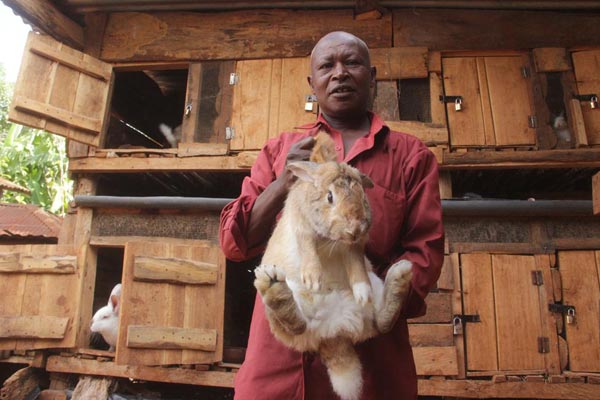
Joseph Kigaruri Wachira’s farm is situated in in Karundu village, Mukurwe-ini, in Nyeri. At the farm, Joseph is busy drying hay, and he directs his son to open the gate for us.

We are led to a wooden structure within the compound. This is where he rears his rabbits.

Joseph has over 100 mature rabbits and 50 kits. While other farmers rear rabbits to harvest their urine, Joseph rears them for meat and for to sell the kits. He cross-breeds some of the rabbits and sells their meat.

“When I started rabbit farming, I wanted to harvest their urine for sale, but I realised there was a larger market in selling kits and rabbit meat,” he says.

Joseph went into rabbit farming in July 2012, when rabbit urine was all the rage. The urine is used as organic fertiliser. Before this, he had been a long time coffee farmer.

With Sh5,000, part of his savings from coffee proceeds, he bought three young female rabbits, each costing Sh800. He then mated them with a neighbour’s buck, and by the end of the year, he had 28 rabbits.

Joseph tried harvesting urine by feeding them each day with green hay and vegetables without much success. In May 2013, he decided to use the urine on his coffee farm and instead started selling rabbit meat.

He invested Sh10,000 in five breeds of rabbits — California White, Flemish Giant, New Zealand, Chinchilla, Angora and the Earlobe.

HIGH HYGIENE STANDARDS

Through training offered to rabbit farmers in Nyeri by the Ministry of Agriculture, Joseph learned that breeding rabbits requires a strict mastery of the best breeds and their habits.

It is here that he learned that rabbit breeding and husbandry requires maintenance of high hygiene standards to prevent the spread of diseases like diarrhoea.

“Before, I would take the does to my neighbour’s buck for mating and they would get infected with diseases and would infect rabbits on my farm. But after I started breeding at my farm, I encountered fewer diseases,” he says.

Female rabbits mature in six to eight months. The bucks are ready for mating a month later than the does.

For mating to take place, the doe is taken to the buck’s cage. Sometimes, mating might not occur as female rabbits tend to be aggressive.

Rabbits have an average gestation period of 31 days, although sometimes it lasts between 29 and 35 days.

According to Prof Margaret Wanyoike of the Department of Animal Production at the University of Nairobi, a female rabbit can give birth up to a maximum of eight to 10 young ones.

She says farmers who choose to cross breed their rabbits should only do so when rearing rabbits for meat because cross breeding tends to alter genetic structures. Continued cross breeding leads to poor performance of the offspring.

Farmers practising rabbit breeding and husbandry should maintain high hygiene standards to prevent the spread of diseases.

“It’s advisable for farmers to use their own bucks because using neighbours’ bucks or lending to neighbours can result in transmission of breeding diseases,” she says.

Farmers should also develop a feeding program to enable the rabbits to mature at the right age. With good feeding and for medium size breeds like New Zealand and California white, maturity is attained at four to five months, but for larger breeds such as Flemish Giant and French Lop, this will be at six to seven months.

The common medium size breeds like New Zealand, and California attain an average weight of 4.5kg at maturity while small size breeds like Angora attain an average weight of 2.5kg at maturity.

Joseph sells two and-a-half months to three-months rabbits at Sh1,500 each, four to seven months at Sh3,250 each while those above eight months cost less, Sh3,000, because of their age.

In a month, he can sell 10 to 15 rabbits, although the numbers keep on varying. He also offers training to new starters at his farm.

Safaricom share is over-valued, says market report

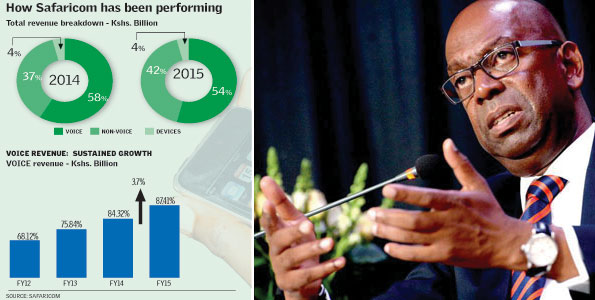
Giant telecoms firm Safaricom’s share is overvalued at the current price of Sh16, as it has a fair value of about Sh14, says Standard Investment Bank (SIB) in a new research. Noting that it already has a price-to-earnings (P/E) ratio of 20, the analysts attribute the valuation of the Safaricom share to the expectation that it faces stagnating expansion of voice revenues and slow growth in the mobile money business.

Only six other listed companies have a P/E above Safaricom’s. The ratio is an indication of the extent to which earnings are reflected in the price, with higher P/E tending to indicate how expensive a share is.

“We see voice stagnating in 2016, with the growth of financial services remaining robust but slower due to the high base already created. We expect SMS revenue growth to ease off as users adopt instant messaging apps,” SIB analysts Eric Musau and Faith Waitherero said in the joint report.

The firm also is currently staring at the prospect of adverse legislation which intends to curb its domination of the various segments of the market in which it operates.

SIB gives Safaricom fair value of Sh13.94, which is an upward revision from the previous valuation of Sh12.53, but the analysts maintain a “hold” recommendation on the share meaning that investors should not buy it though they do not have to sell it right away if they already have it.

“We have maintained our rating for Safaricom at ‘hold’ but with a downside of 13.7 per cent. Despite this, we have raised our fair value by 11.3 per cent to Sh13.94,” said the analysts.

The new rules are seen as targeting the telecommunications firm since they have lowered the criterion for determining dominance with the effect that the company will have to report separately for each service and competitors will have unfettered access to M-Pesa customers.

“While we greatly expect mobile data growth to remain robust, the recent launch of an android powered wireless 4G set-top box to deliver triple-play to clients is likely to have a slow uptake because of equipment cost,” said SIB. But some analysts do not agree with the lower-than-current-price valuation of the listed firm.

Mercyline Gatebi, a research analyst at Genghis Capital, has made a buy recommendation on Safaricom saying it has a fair value of Sh20.69 a share. “Our update on Safaricom Ltd begins with a ‘buy’ recommendation on the stock based on a fair value estimate of Sh20.69,” said Ms Gatebi.

She, however, added that competition in the sector had intensified as new players enter the market thereby constraining the margins of existing players and even forcing consolidation as seen with the acquisition of yUmobile by rivals.

Finserve, a subsidiary of Equity Bank, entered the market with the licensing of its mobile virtual network operator licence last year.

Ms Gatebi said that Safaricom’s six-month results will justify relooking at the firm’s share performance with possible new valuation.

NIC Bank signs deal to be Safaricom, MoneyGram agent

0

NIC Bank has signed a deal to be a Safaricom, MoneyGram and Western Union agent in a strategic move to increase its customer base.

The bank’s partnership with Safaricom’s M-pesa will see the financial institution offer transactional services including purchasing of float to M-PESA agents.

The bank has also announced that Kenyans can now walk into any NIC banking hall and carry out MoneyGram and Western Union transactions.

GROW CUSTOMERS

“This partnership is in line with the banks strategic agenda to grow our customer base, both across Retail and SME segments by offering a wide range of products and services. It also positions us to grow our diaspora proposition and tap to the growing remittances into Kenya through MoneyGram and Western Union,” said NIC Bank Group Managing Director John Gachora.

According to a statement from the bank, the new solutions are part of the bank’s three year strategy to become a one-stop shop proposition. This is by offering convenience in line with its Move to Now philosophy, which caters for customers on the go who are looking for easier, faster and convenient banking.

Vacancies: IEBC Is Hiring, Apply Before 20th July, 2015 (Many positions)

0

The Independent Electoral and Boundaries Commission (IEBC) seeks to recruit a dynamic, competent and result-oriented individual to fill the following position:

Human Resource Officer
Grade 6
Job Code: IEBC6/6/2015

Duties and Responsibilities
• Verification of information relating to recruitment, appointment and transfers.
• Human Resource Management records and complement controls.
• Assist in the development of staff development plans.
• Coordinate staff appraisal with other departments.
• Processing cases for the Commission Human Resource Advisory Committees.
• Assisting in the implementation of the decisions thereof.
• Supervising and guiding clerical staff in the Department.

Requirements for Appointment
• A Bachelor’s degree in Social Sciences from a recognized university / institution.
• Post-Graduate diploma in Human Resources.
• Three(3) years of relevant experience in a busy organization
• Must be computer literate.

Senior Procurement Officer
Grade 5
2 Posts
Job Code: IEBC3/6/2015

Duties and Responsibilities
• Deputizing the Manager, Procurement.
• Preparation of procurement plans in liaison with user departments.
• Preparation of tender documents for procurement of goods, works and services.
• Secretary to Commission Tender Committee.
• Participate in evaluation of Commission tenders.
• Preparation of contract documents.
• Maintain and archive document records for procurement and disposal activities.
• Make procurement follow ups.
• Monitor payments to suppliers.

Qualifications and Experience
• Must have a minimum of Bachelor’s degree in Commerce, Economics or Business Administration degree from a recognized university.
• An MBA or a Master’s degree in procurement will be an added advantage.
• Must possess a postgraduate diploma in Procurement/Supply Chain Management from a recognized institution of higher learning or a professional body.
• Must be a member of a professional procurement body.
• Must have working experience of 6 years in procurement, two of which must have served in a senior position.
• Must have good interpersonal and communication skills.
• Must be conversant with the provisions of the Public Procurement & Disposal Act and the related Regulations.
• A team player, good management and leadership skills.
• Must be computer literate and possess good analytical skills.
• Must be a person of unquestioned integrity.

Procurement Officer
Grade 6
1 Post
Job Code: IEBC4/6/2015

Duties and Responsibilities
• Processing of procurement orders, quotations and tenders in line with procurement regulations.
• Coordination of inspection, verification and receiving of goods and services,
Coordination of payments for goods and services.
• Assist in the preparation of procurement plans.
• Assist the regions in all procurement matters.
• Secretary to the Commission’s Procurement Committees.

Requirements for Appointment
• Must have a minimum of Bachelor degree in Commerce, Economics or Business Administration from a recognized university.
• Must possess a postgraduate diploma in Procurement/Supply Chain, Management from a recognized institution of higher learning or a professional body.
• Must be a member of a professional procurement body.
• Must have 6 years of working experience in procurement.
• Must have good interpersonal and communication skills, team player, good management and leadership skills.
• Must be computer literate and possess good analytical skills.
• Must be conversant with the provisions of the Public Procurement & Disposal Act and Regulations.
• Must be a person of unquestioned integrity.

HR Database Management Officer
Job Code: IEBC7/6/2015

Duties and Responsibilities
• Computerization of HR records
• Daily manning of the HR computerized systems including support to payroll.
• Ensuring the HR records are cleansed periodically
• Updating the staff establishment and other staff schemes
• Confirming existence of vacancies during start of any recruitment
• Updating staff records electronically
• Periodical evaluation/monitoring and cleanup of the HR system and payroll

Requirements for Appointment
• Degree in Computer Science, ICT or related field
• Possess of any relevant qualification in Human Resources will be an added advantage
• Three (3)years experience in a large organization
• Competency in software development
• Thorough understanding of data management systems and software.

Constituency Office Clerk (Samburu North Constituency)
Grade 8
Job Code: IEBC9/6/2015

Duties and Responsibilities
• Oversee the general management of constituency office in the absence of the CEC,
• Completing voter registration control sheets and control registers.
• Keep up to date statistics on voter registration exercise.
• Updating regularly and maintaining an updated register of electors and making sure it is always accurate.
• Checking that all electoral material and equipment are in good working condition.
• Assist the CEC in mapping of polling stations/registration centres.
• Assist in publicity of voter registration of voters, elections, inspection of the register and any other activity to be undertaken by the commission.
• Quality control the work done by registration and polling officer on voter registration.
• Receive, distribute and maintain an inventory of materials and equipment to registration centres in time.
• Replacing lost and defaced voters cards with duplicate cards.
• Assist in preparation of work plans, security plans, transport, and logistical plans.
• Safeguarding registration data.
• Assist in verifying the register of electors.
• Undertake any other duty assigned by the Commission.

Requirements for Appointment
• Minimum of C- (minus) in KCSE or division III in KCE,
• Must be computer literate,
• 2 years working experience in a large organization,
• Competent and confident in handling office processes,
• Must be a resident of the Samburu North Constituency.

Training Coordinator
Grade 5
1 Post
Job Code: IEBC5/6/2015

Duties and Responsibilities
• Ensuring that the Commission’s electoral training materials contain appropriate training content as per the relevant Electoral Laws in Kenya.
• Assist the Manager, Electoral Training in initiating and formulating electoral training policies and procedures in the Commission.
• In liaison with Director, Voter Registration and election Operations, identify, coordinate, select electoral training of trainers programmes and ensure the commission has a pool of electoral trainers.
• Preparing electoral training manuals and tools for training at appropriate times.
• Recommend appropriate training for electoral officers in liaison with Director, Voter Registration and Election Operations and Director, Human Resources and Administration.
• Management and safe custody of electoral training records.

Requirements for Appointment
• An officer must have a Bachelor’s degree in Social Sciences or Education.
• Must be computer literate.
• Have four (4) years of relevant experience in a busy organization.
• Practical experience in training and capacity building

Election Offenses Investigation Officer
Grade 6
2 Posts
Job Code: IEBC8/6/2015

Duties and Responsibilities
• Effectively and efficiently investigate election matters.
• To head and supervise investigations undertaken by the commission.
• The collection, tabulation and recording of history and data concerning criminal, undesirable and suspicious persons in electoral units relating to individual and matters calling for special enquiry.
• Conducting correspondence and interchange of reports on election matters with the commission.
• The investigation of complicated criminal offences and furnishing of assistance to Commission in cases of inquiries presenting difficult feature
• The supervision, where desirable, of individuals during election period.

Qualifications and Experience
• Degree holder in criminal prosecution from a recognized university.
• Being a police inspector or former prosecutor is an additional advantage.
• At least 3 years’ experience, preferably in criminal investigations.
• Ability to engage in Dispute Resolution.
• Computer literate.
• Team player.

Constituency Elections Coordinator
Grade 5
3 Posts
• Lagdera Constituency
• Alego-Usonga Constituency
• Turkana West Constituency
• Job Code: IEBC2/6/2015

Duties and Responsibilities
• Provide management support, develop and oversee the implementation of strategies, policies, plans and budgets at the constituency level while ensuring the alignment of these to the regional and overall Commission strategies.
• Ensure that election operation activities at the constituency level comply with internal controls and budget restrictions.
• Ensure provision of administrative support services at the constituency level including distribution of election material, transport management, implementation of security policies and protocols and ensuring the safe custody of the Commission’s assets.
• Be responsible for sound financial management and prudent use of all Commission funds at constituency level in line with commission’s financial policies.
• Liaise with the Regional Elections Coordinator to implement training programmes for registration and election officials at the constituency level.
• Identify and inspect suitable polling, nominations and tallying centers.
• Liaise with regional administrative and security officials at the constituency level to ensure safety of Commission Assets including warehouses.
• Undertake the verification, compilation and revision of Constituency voter’s register as required by law from time to time.
• Liaise with political parties with respect to elections and related activities.
• Develop accountability measures, monitor the performance indicators at the constituency level and ensure the timely preparation of periodic reports.
• Be the Returning Officer during elections and the Voter Registration Officer during voter registration.

Qualifications and Experience
• Minimum undergraduate degree from a recognized university.
• A minimum of six (6) years working experience in management in a large organization.
• Proven experience in results-based management, monitoring and evaluation or managing election process is an added advantage.
• Must be computer literate and should possess good negotiation, planning and coordination skills.
• Additional training, professional qualifications and experience of fieldwork will be an advantage.
• Must be a resident of the Constituency applied for.
• Must be computer literate.
• Integrity Clearance

In addition to the qualifications set above, the applicants must further meet and get the following clearances:
• Ethics and Anti-Corruption Commission (EACC)
• Criminal Investigation Department (CID)
• Kenya Revenue Authority (KRA)
• Director of Public Prosecutions (DPP)
• Chief Executive Officer, Higher Education Loans Board
• Professional bodies (where applicable) to which the applicant belongs e.g. LSK, ICPAK, AAK, IEK etc
• Credit Reference Bureau Africa Ltd or Metropol Credit Reference Bureau
Security Clearance: All shortlisted applicants may be subjected by the Commission to a security clearance by National Intelligence Service (NIS)

Application Submissions
• Interested candidates are requested to submit their duly completed applications together with an up-to-date curriculum vitae, copies of certificates and testimonials, email and telephone contacts together with names, telephone and email contacts of three (3) referees who must be familiar with the candidates previous work experience.
• Applicants must indicate the Job code, title and Constituency one is applying for on the top left corner of the envelope.
Applications and supporting documents shall be:
Hand delivered to the IEBC CEO/CS, 6th Floor, Anniversary Towers, University Way, Nairobi: and/or
Sent via Post Office to Independent Electoral Boundaries Commission (IEBC), P.O Box 45371-00100, Nairobi, Kenya.

Applications must reach IEBC by 20th July, 2015

How brothers are making it big in mixed farming

In the outskirts of Chuka town in Igamba Ng’ombe Constituency, Tharaka-Nithi County, there’s an outstanding farm along Kangoro-Rubate Road. The 3.5 acre christened Kagumo-Hort farm belongs to Murithi Musa and his brother Edward Micheni.Their farm is a beehive of activity. On the ground, lay bits of cassava well spread as part of the chicken feed; the poultry house is well constructed such that the chicken are kept clean and warm.
A hatchery composing of an incubator and brooder are also in place to cater for the high demand for the kienyeji chicken. Right adjacent to the poultry house is a warren that is stocked with big healthy rabbits. How did they start this enviable project?
Musa explains that one day, he needed a Sh0.5 million loan.
“I took my piece of land as collateral, but upon evaluation, I discovered that the value of the piece of land was high as compared to the amount of money I needed.
This made me re-think. I shelved my plans of taking the loan and thought of investing in the farm to make it more valuable,” he says. Since it was a family farm, he consulted his brother.
He bought into the idea and using the savings they had, they started with 200 banana tissue plants. The bananas picked up well then they went into poultry and rabbit keeping. They have since ventured into fish farming. “The trick with fish is that they are fed at specific times of the day.
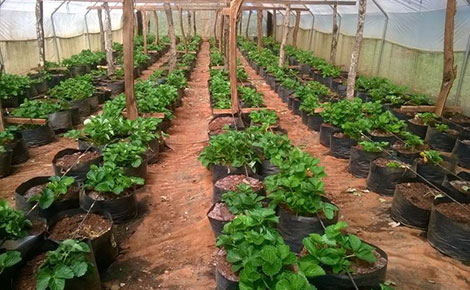
If it is cold the fish are not fed as tilapia fish don’t feed well when temperatures are low,” Musa who is a co-director of the farm with his brother shares. The pond’s water is rich in minerals and is often pumped to the other parts of the farm like the arrowroot farm, passion fruits farm, mangoes and the banana farm. The farm has four green houses, two that major purely on strawberries; the third one has garden peas while the last one has assorted crops that range from cucumbers, beetroots and courgettes.
Right beside each greenhouse are some weeds that are allowed to grow. These weeds are a way of enticing and attracting other insects that could otherwise find their way to the green houses.

Part of the farm is also inter-cropped with mangoes and cassava. Tree tomatoes also occupy part of the farm and it is one of the most beneficial farm produce as it yields throughout the year and requires little attention. “Its market is also good and the farm cannot even satisfy the demand which includes the two main supermarkets in Chuka town that is Jatomy and Maguna Andu Supermarkets,” says Musa.
The lower part of the farm is occupied by the sweet yellow passion fruit that was introduced to the farm by Techno-Serve Company under the sponsorship of Bill Gates Foundation and the Coca-Cola Company which trained them on how to tender for the fruit from the initial stage. On the far end of the farm, are the goats that are a main source of rich nutritional milk that is meant for their own consumption. At the edge of the farm are some well spaced beehives that help pollinate the farm and also generate honey for sale.
“Everything in the farm is of great value and nothing including the weeds is allowed to go to waste,” says Musa. The farm weeds that range from banana trunks are mixed together with wastes from the poultry, rabbits and goats’ farm and are all preserved in a pit to make compost manure.
The farm operates under a farm manager who is in charge of all the activities in the farm. The farm is the main source of income for the duo. Every garden has thorns, so what are the challenges they have faced? “First lack of a reliable source of water is a problem. So we have to incur huge expenses to meet that need.
The other challenge is the fact that our farm is near the road means that most of our produce is very dusty.
Another challenge is that sometimes we face setbacks when sourcing for fingerlings. The supplier tells us that we have to wait for several months. But we are working our way around that,” Musa says. Their advise to youth who want to join farming?

“Farming is rewarding. Instead of looking for white-collar jobs, youths should try farming,” Musa says. They also urge the young people to research widely before embarking on any income generating activity by attending forums, shows, workshops and also researching online.

Waceke Nduati-Omanga: my call to our banks

0

Jane has been banking with a XYZ bank since she opened her business 6 years ago. She has borrowed before with the bank through an overdraft and has handled it quite well.  Jane hires ten employees most of whom have also opened personal accounts with the same bank.

They have also done some personal borrowing as well with that bank and some have even used their investment products. For this reason, Jane assumed that the bank would be the first to support her when it was time to expand her business.

The same bank that not only has a business account with XYZ, but also now benefits from personal banking from her colleagues. Jane approached the bank for this expansion loan.  Jane was not given any specific person to deal with and kept being thrown back and forth.  Jane had all the required documents in order such as audited accounts, business plans etc.

At one point the bank asked for additional security i.e. a property.  Even though Jane had wanted to get this loan without that security (because she was buying equipment that would be the security), she was prepared to give it to them.  However no one got back to her and gave her a response.

She could not even get a meeting to discuss the issue properly.  It so happened that at that particular time a friend of hers introduced her to another smaller bank.  Let’s call this bank EFG Ltd. EFG had never dealt with Jane before.  Neither her nor any of her colleagues had done any banking with EFG Ltd.  After one phone conversation a relationship manager was dispatched to her office and they collected all her documents.

In about two days they got back to her requesting for more information on the equipment she was buying and the suppliers.  In two weeks Jane had an offer from this bank. Was it a perfect offer?

Absolutely not and she still ended up having to give additional security especially because she was a first time client.  But in exchange she was able to negotiate for a lower interest rate and her overdraft limit was increased.  But most of all, Jane liked the fact that they responded to her call and treated her like she was important.

As an experiment, Jane went and asked her old bank (XYZ) for a car loan for a similar amount to what she wanted to borrow for her business. They were more than willing to lend her the money and use the car as security. The loan would be processed in 48 hours.

Do you see the problem here? Firstly, XYZ is willing to lend to Jane’s employees but not to Jane to grow the business. They entrust that she will continue being able to regularly pay her employees the kind of salaries they need to service personal loans, but were obviously not interested in lending her money to grow the business, that will lead to her paying them more or employing more people. They see the business as risky, and want all sorts of security) but do not see risk in the salaries that the business generates.

They will process personal loans in 48 hours but take forever with a business loan. Banks – how can a salary be more secure to you than the enterprise that generates that salary? I have spoken to several business owner who say that the collective personal unsecured loans banks are willing to issue to their employees for consumption purposes is higher than the loan they are willing to give the same business for growth. Banks, my challenge to you is to evaluate what business you are in?  Funding growth or just helping people consume?  Growth to you is risky, consumption is not.

Aligned to that is that fact that Jane could get that same amount for a car but to use it on expansion was just not interesting enough.  She could not even get someone to respond to her business needs but they were ready to respond to the car loan. So this bank was willing to fund a depreciating asset but not to fund the appreciating entity. No one asks you for additional security to fund a car, which is losing value over time.

My second challenge is not realising who your future big customer is.  XYZ to date have not yet realised that most of Jane’s banking transactions have gone elsewhere. She just keeps enough money there to fund salaries simply because that is where her employees bank at the moment. I can guarantee you if Jane’s business keeps growing, XYZ will come back to chase her but she will not open the door again.

EFG did not provide a perfect solution but at least they came to the table.  They recognise the potential and have started treating their future big customer well now. In return for the not so perfect solution they gave her something – a lower interest rate and a larger overdraft. At least she feels like EFG are on her side.  Many times it’s just a response that people need.

Jane’s story is not made up. This situation is common amongst business owners and mimics an experience I have just had recently.  As I talk to more entrepreneurs many seem to have faced similar challenges. Many banks say that SME’s are key target market for them but I think very few are listening to the needs of those SME’s and responding to them.

They talk but they don’t walk. We keep saying entrepreneurship is the solution to a lot of economic challenges, but banks are not willing to enable the solution. Now the decision makers in banks may not read this article.  But maybe some people reading this can take it to someone who knows someone who can reach a decision maker.  My call to banks is simple. Rethink your lending model when it comes to businesses.

Evaluate why you are willing to lend to their employees for consumption but not the business. Take care of your future big client now. And like in Jane’s case remember your competition may be just right round the corner.

Kenya is a model investment destination for Africa – Richard Branson

0

Virgin Group founder and CEO Sir Richard Branson has said that Kenya is a model investment destination for the rest of Africa.

Speaking after he led a group of investors in talks with President Uhuru Kenyatta at Harambee House, Sir Branson said the proposed renewables project to be set up in Kenya would benefit the 50% Kenyans who are yet to access electricity.

The investors met President Kenyatta to discuss ways of exploring utilizing the most of Kenya’s abundant potential for green energy.

bransonkenya
bransonkenya

“Investors in this initiative have chosen Kenya because the Government is ready to listen to ideas and help implement them”, he said.

He pointed out that the project would cover Kenya and Rwanda, before being rolled out to other parts of the African continent. Both countries would serve as models.

Sir Branson thanked the President for supporting the new venture, saying Kenyans were diligent, and that it was only good sense to invest here.

The initiative comes in the wake of recent reports identifying a significant role for green mini-grids in rural electrification.

The proposed investment in renewable energy aims at displacing a percentage of diesel generation in off-grid stations.

Investment in renewables is set to raise the supply of clean energy for productive use, in support of Vision 2030 and is expected to open up job opportunities and revenue.

The meeting comes just a week after President Kenyatta launched the Lake Turkana Wind Power Project, expected to be the largest such project Africa generating 310 megawatts of electricity, 14 per cent of Kenya’s current generation capacity.

Other investors in the delegation included Jacqueline Novogratz (founder and CEO, Acumen), Chris Anderson (curator, TED Conference) Dipender Saluja (Capricorn Investments), Steve Jurvetson (Draper Fisher Jurvetson), Strive Masiyiwa (founder and chair, Econet Wireless), Jean Oelwang (CEO, Virgin Unite) and Zia Khan of the Rockefeller Foundation.

Also present at today’s meeting were Safaricom CEO Bob Collymore, Kenya Private Sector Alliance CEO Carole Kariuki, KEPSA chairman Dennis Awori, Athi River Mining Company CEO Pradeep Paunrana, Transport and Infrastructure acting CS Henry Rotich and Industrialization counterpart Adan Mohamed.

Jane Murage: I sustain my family and meet my energy needs from dairy feeds

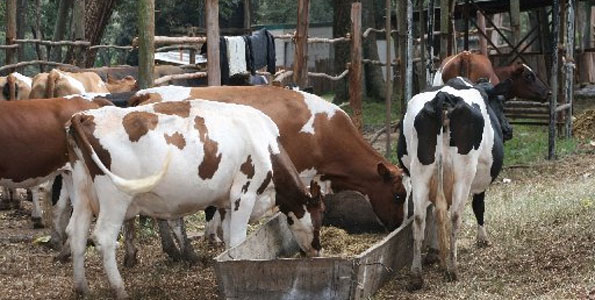
She has not regretted venturing into rearing dairy cows since 1989 when she received her first earnings from the sale of milk to the now defunct Kenya Cooperative Creameries (KCC).

Today, says Mrs Jane Murage earns Sh2,100 every day from selling 60 litres from her three cows.

The 51-year-old mother-of-five says she started with one Friesian cow her father gave her in 1988 when she was 27 years old.

She asked her husband, was working with the then Ministry of Works, Transport and Communication, to take early retirement in 1992 and join her on their farm at Ihururu in Nyeri County.

Combined production

“He also had a cow and I thought the combined milk production coupled with the earnings from our tea farm were enough to see us live comfortably,” says Mrs Murage.

In a month, Mrs Murage finds Sh63,000 deposited in her bank account, courtesy of the milk which she takes to Ihururu Dairy, where her husband has been the chairman since 1997. A litre of milk fetches Sh35.

The farmer says rearing dairy cows is not a difficult task if fodder is available.

Mrs Murage says that she spends about Sh4,000 to buy two 90-kilogramme bags of dairy meal, which she supplements with napier grass. She mixes this with other kinds of hay to provide her cows with a balanced diet.

“Cows, just like human beings, need to eat a balanced diet and for those reared for milk production, you have to provide them with food that is rich in protein to increase production,” she said.

The farmer invested Sh35,000 in a small biogas project that provides the family with a clean source of energy. She uses the waste produced by the cows to generate energy which she uses for cooking.

On the increased cost of milk, Mrs Murage says the October-December short rains that extended to part of January saw an in increase in pasture and therefore the price of milk should not go up.

The farmer has managed to pay fees for two of her children in boarding school while her third will sit for her Kenya Certificate of Secondary Education examination this year.

Mrs Murage says she is also paying fees for her fourth born in a private medical college through earnings from her cows while the last born just is waiting to join secondary school.

“Rearing cows for milk production was the greatest thing I did in my life and I do not know how I would have managed if I was not selling milk,” says the farmer.

She says she finds rearing cows an easy task as she does not need to take care of them throughout the day.

Mrs Murage makes sure that the cows have enough fodder and water for the day in the morning and only comes back in the afternoon to milk them.

High cost of production

The farmer, though, finds challenges especially during the rainy season when the animals suffer from mastitis due to sleeping on a wet floor and during the dry season when the cost of production increases due to scarcity of fodder.

She has, however, managed to survive the dry season by planting her own fodder. Availability of piped water has helped reduce the cost of production.

Mrs Murage encourages the youth to try cattle farming and not wait for white-collar jobs, adding that farming has proved to her that it is lucrative.

“It’s not a difficult task at all. The only heavy work is cleaning the cow sheds and carrying grass, but I do not see how youths cannot do this if I can do it at my age,” she says.

Deal on Greece finally reached

0

Nearly six months after the election of the radical Syriza coalition, after bank closures and July 5’s bailout referendum, Greece seems to finally have a deal.

Belgium’s Prime Minister simply tweeted the word “agreement.”

The Prime Minister of Malta followed up, tweeting “deal.”

We don’t have full details of what’s been discussed yet, but given the deterioration of the Greek economy and banking system, it seems likely that the deal signed off now will be more austere than the one Prime Minister Alexis Tsipras asked voters to reject in the recent referendum.

Germany and other eurozone states were pushing for a “time out” from the currency union, which quickly became referred to as temporary Grexit. On Saturday, when the Eurogroup of finance ministers was meeting, it seemed like a sudden exit was very much possible.

The marathon session of EU leaders lasted  more than 19 hours, according to Politico’s Ryan Heath. That breaks records for the bloc.

Kenya Power monopoly at risk as firm vies for ‘last-mile’ customers

0
Kenya’s renewable energy sector is set for a boost in September when a solar microgrid company plans to become the country’s first licensed private utility to sell power to the public, ending a half-century monopoly by the State electricity firm.

Earlier this year, the Government granted Powerhive East Africa, an energy technology venture with its roots in the United States, a permit to supply electricity to rural homes in competition with 53-year-old grid giant Kenya Power.
For over two years, Powerhive has been running pilot schemes in four villages in Kisii, providing around 1,500 people with solar power. “Our goal… is line with that of the Government – we want to connect and provide reliable service to as many rural communities as possible,” Powerhive’s co-founder and vice president for business development, Rik Wuts, said. Under the deal, the company will produce solar power and distribute it to rural off-grid communities, providing a clean, stable electricity supply on a “viable commercial basis”.

Powerhive will begin generating and distributing electricity under its new licence to homes in the west Kenyan counties of Kisii and Nyamira from September. The area has a high population density and concentration of homes, making it ideal for microgrid models that rely on short distances between the power source and target premises. The microgrids connect around 150 to 300 clients per locality, as well as serving public buildings like schools. Leveraging the falling prices of solar photovoltaic panels and power storage equipment globally, Powerhive says it has succeeded in bringing the cost of microgrid power closer to that of mains electricity.

“In many places in the developing world, the cost of (main) grid extensions is simply too high to be feasible,” said Wuts. distribution cost “The cost decline in solar and (power) storage will continue bringing off-grid generation costs ever closer to grid levels, and we have developed innovative technology to optimise the cost of distribution and the design of the distribution systems,” he told the Thomson Reuters Foundation.
Kenya is trying to speed up expansion of electricity penetration across the country, particularly in rural areas, under the Last Mile Connectivity Project launched by the Government in March. This scheme aims to connect some 310,000 people living close to 35,000 Kenya Power transformers to the grid.
The model used by Powerhive will help bring power to over 50,000 primary schools that are set to benefit from a Government-sponsored project to equip them with laptops, according to Director of renewable energy at the Energy Regulatory Commission, Pavel Oimeke.

The Powerhive utility concession is “a win-win development for Kenya that will allow more people to access electricity and make the industry more competitive”, he said. huge market Kenya has a huge market for power that firms like Powerhive could exploit, he added.
“If they make a good business case, we can expect more players to come on board and help connect more people,” Oimeke said. Powerhive may not pose a major threat to a well-funded, established entity like Kenya Power, but the role of smaller companies in energy-sector development should not be underestimated, he noted.