Home Blog Page 2244

Uchumi to lay off staff and cut branches, gets Sh. 500 million KCB loan

0

Uchumi Supermarkets has embarked on a cost-cutting exercise that will include closing down branches and laying off staff.

The retail chain will also sell a 20-acre piece of land it owns in Kasarani, Nairobi, priced at over Sh2.2 billion, in plans to settle outstanding debts to suppliers.

By mid last month, the retail chain owed suppliers Sh2.3 billion, but it approached Kenya Commercial Bank for a Sh500 million loan to clear some of the dues.

The chain store also announced it had finalized a Sh500m financing arrangement with Kenya Commercial Bank to pay outstanding supplier debts.

In a drastic move meant to cut out brokers from its supply chain, Uchumi will also source for supplies directly from manufacturers.

This would eliminate the practice in which insiders supplied goods to the retailer at inflated costs. This move would also see staff with links to suppliers exit the company.

Uchumi chief finance officer, Mr Sam Oduor, said that Uchumi’s problems began in 2013, when the rights issue that was originally meant to raise Sh1.5 billion was delayed by nearly two years.

The rights issue, which was later undertaken in 2014, raised over Sh800 million, Sh700 million short of the original target.

This affected its expansion plans and payment to a number of suppliers. The store has had challenges getting stock due to delays in paying suppliers.

“The two-year rights issue delay was very expensive as it led to a substantial decline in the share price,” Mr Oduor said today in an investor briefing, adding, “When the rights issue eventually took place, the money was not enough”.

Last month, the retailer fired its long-serving chief executive officer, Mr Jonathan Ciano, on allegations of mismanagement and using land valuations to declare the profits. A report done by Exotix, a London-based investment bank, indicated that the retailer should in fact have declared losses in 2013.

The retailer has now hired KPMG to undertake a forensic audit on the firm’s finances. Its decision to halt the expansion plans was reached after the firm said the strategy had been undertaken without proper funding. Most of the stores to be closed will be in Tanzania and Uganda.

Gerald Besseling: I saw a gap in local cow breeds, now I’m making my millions

While growing up in Holland in 1960s, I used to hear stories of how beautiful Kenya was from my parents and relatives.

Those of us who had not visited Kenya had mental images of its lovely beaches and breathtaking sceneries.

In my young mind, Kenya was heavenly. As I grew up, I made up my mind that I had to visit Kenya, as a tourist. But over the years, this changed to relocation, but I had to find a solid reason. I was keeping livestock and growing crops in Holland. I saw coming to Kenya as an extension of my farming.

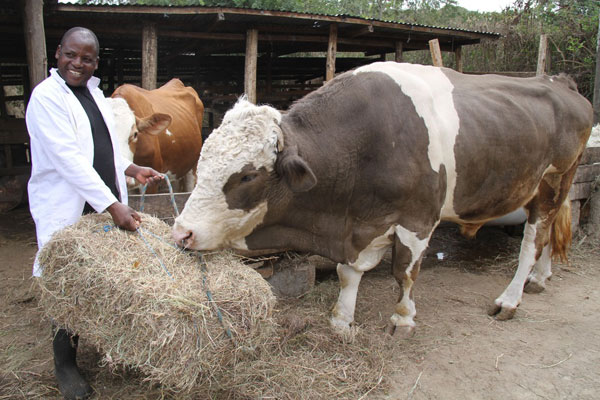
My answer came one day in 2002 while researching online about the Fleckvieh cow. In spite of being one of the most popular breeds across the world — that has been around since 1890, I was surprised that it was non-existent in Kenya, a country whose flowers the Dutch are obsessed with.

Fleckvieh cows are among the dual-purpose breeds of the world. If a Fleckvieh cow is lactating, then it should eat 25kg of feed a day. This is half what a Friesian eats, and it maintains a flat milking curve for 305 days.

I thought how much of a difference the breed would create for farmers if introduced in Kenya. I called my wife and told her, “Honey, I now have a reason to go to Kenya.” A few months later that year, I arrived in the country and immediately started making arrangements to ship the first Fleckvieh cow to Kenya.

Getting an importation licence was hard because not many people, including at the Ministry of Agriculture, knew what the breed was about.
For seven years, I struggled to get an importation licence, but as I did this, I saw another opportunity in the transport sector. I set up a transport logistics company known as Amicabre Tours.

This is what kept my dream alive. In June 2009, I brought into the country the first Fleckvieh cow, just in time for the inaugural Brookside Livestock Breeders Show.

The heifer arrived from South Africa to much fanfare at the airport.

In the run up to the day, I had put up a billboard near the City Stadium with photos of Fleckvieh cows saying, “We are coming to Kenya,” and even paid for adverts in newspapers. I spent $20,000 (Sh1.7 million) to buy and import the cow from South Africa.

But this did not bother me because I knew I had something that would change the country in 10 years. I exhibited the animal at the show and there was interest. But there were challenges.

While people showed interest, this did not translate into sales. A majority of farmers knew that the best cow breed was Friesian. They could not believe that a cow with a huge body could produce a lot of milk and still be a good meat producer.

When Fleckvieh became a hard sale, I imported another cow. This time, a crossbreed of a Friesian and a Fleckvieh. The two cows proceeded to win awards from one agricultural show to another, making farmers to start accepting them.

About five years after the first Fleckvieh cow landed in the country, farmers are now embracing it.
To date, I have sold more than 45,000 Fleckvieh crossbreeds semen to farmers through my firm Fleckvieh Genetics East Africa. Fleckvieh crossbreeds are more popular than the pure breed because the latter is expensive.

Crossbreed semen

I sell crossbreed semen for between Sh4,000 and Sh6,000, while the pure breed for more than Sh10,000.

I recently made deals with two county governments that want semen straws in an effort to change the fortunes of farmers. Bomet County government has agreed to get its farmers subsidised 3,000 straws of Fleckvieh crossbreed semen. Siaya County has also ordered 500 straws.

I am a firm believer that for Kenya to move from third world status to first world, the country does not need to industrialise heavily. It can depend on agriculture entirely and still become a developed country. Countries like Brazil have done it.

However, there are some things I feel that if farmers change, their fortunes too would better. For instance, those who feed their cows with hay commit a mistake by cutting long grass and using it to make hay.

You should cut the grass immediately it rains, and it must have not grown more than half a foot. Young grass has more nutrients than mature ones. In Holland, the biggest export is cheese. And one of the reasons we have succeeded is because farmers have formed cooperatives.

How I stopped diseases from destroying my chicken using home-made solution

Beatrice Mwingi leads us into a portion of her shamba that she has fenced off with wire mesh.

But before we can enter, we are required to dip our feet in a puddle of antiseptic at the gate. It is in this secluded section of the small farm that she has her chicken.

“Everyone coming in here must disinfect (their feet) so as not to bring in germs that may cause disease to my chicken,” she says.
This was one of the many lessons she learned the hard way after watching her flocks fall ill and die a few years ago.

The woman, who was well known at Kombo Village in Makima, Embu, and beyond for keeping big flocks of chicken, almost quit the venture after suffering heavy losses.

HARDLY VACCINATE THEM

“Not having the disinfectant was among several costly mistakes I was making that almost made me lose interest in chicken rearing,” she recalls.

But all this changed when she got a chance to train in disease prevention and management at the Kenya Agricultural Livestock Research Organisation (Kalro).

She learnt that her flocks had been dying of Newcastle disease, and that the disease kept recurring because she did not disinfect the chicken pens before restocking.

She also learned about coccidiosis, fowl typhoid, fowl pox and marek’s disease, which are equally common in the area.

“The other thing is that poultry farmers, especially those keeping kienyeji chicken, hardly vaccinate them against Newcastle disease, which is highly contagious and lethal.”

When Beatrice enrolled for the one-week course, all she wanted to know was how to confront the diseases that were snatching away her chickens. The skills she gained for Sh9,000 proved to be more than value for money.

“I could not just keep all this knowledge to myself, so I have become the village ‘guru’ on chicken rearing,” says the farmer who currently has 214 birds.

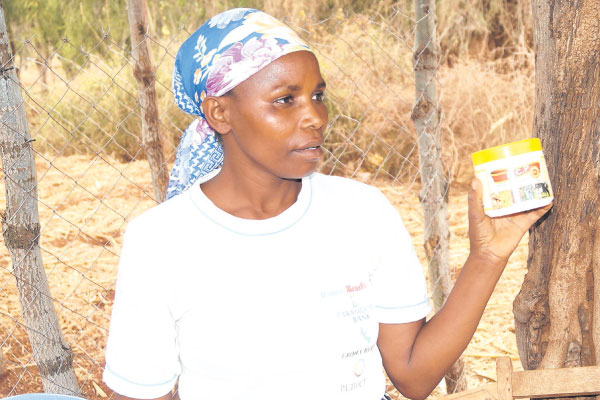
On our visit to her firm, Seeds of Gold finds Beatrice teaching a group of poultry keepers how to care for their birds. She displays for tins of minerals that she uses to supplement chicken feeds. One is Di Calcium Phosphate, which stops chicken from cannibalism.

Farmers who cannot afford the drug can apply aloe vera juice on victims of cannibalism. The plant’s bitter taste makes the culprits to stop pecking their prey.

Beatrice also displays Tylodoxi, an antibiotic that prevents respiratory diseases in the birds as well as an array of vitamins and other dietary supplements.

“From my training, I now know that chickens ought to be kept in a warm, dry place, eat a well-balanced diet and be let out to exercise and breathe fresh air,” she says, pointing to the space left between the fence and the coops.

That way, they can also forage for greens and peck on sand and eat bugs that have vital nutrients.

Farmers should also ensure chicken feeds are free from droppings. “They are a potential hazard to the health of the flock. It is important to use feeding troughs that ensure that the two do not mix.”

The informal teacher and field officer also shares with her friends home-made alternatives to good chicken care and management — knowledge she acquired by reading books she got from Kalro.

HOME MADE ALTERNATIVES

“I mash garlic and mix it in the feeds or throw onions for the chicken to peck at least once a week.” It is a secret many farmers do not know for keeping worms at bay, she says. An element in garlic and onions makes the environment in the gut less attractive to internal parasites and boosts the birds’ immune system.

She puts three cloves of crushed garlic in 10 litres of water or mixes two cloves for every meal. She feeds her chicken twice a day.

“I also regularly add sour milk in their feeds to ward off diarrhoea. It also helps when chicken are suffering from diarrhoea even when you are treating them with conventional drugs,” she says.

“I put just enough to cause lumps in the feed, but do not drench the feeds in it.”

These strategies have helped Beatrice reduce the incidence of diseases in her flock by almost 90 per cent.

“When you do this, you build the immune system of the birds and even though one bird can get sick, the disease is unlikely to spread to the rest as long as it is isolated as soon as you suspect it is ill.

“The best cure of all is always prevention,” she concludes.

Egerton University lecturer Sophie Miyumo says the ethno-veterinary methods of treating chicken work, but farmers must understand that it is important to strike a balance between the remedies and conventional methods.

“Many farmers keeping indigenous chicken refuse to vaccinate their birds, yet even as you use traditional remedies like these, it is important to incorporate important conventional methods which have been proved by science to work,” she says.

Old Mutual buys another UAP stake at Sh. 5.6 billion

Global investment firm Abraaj Group on Monday announced its exit from UAP following the sale of entire 13.6 per cent stake to Old Mutual.

In a statement, the firm said it had exited its investment in UAP Holdings, a pan-African insurance firm, in a deal estimated to be worth about Sh5.6 billion. UAP’s shares are traded over the counter (OTC) market.

In March 2012, Abraaj invested in UAP alongside Africinvest and Swedfund, using a convertible debt instrument, which was later in November 2012 converted into equity valued at about $54.8 million.

“We invested in UAP based on the company’s strong brand and well established business lines. With a surge in demand driven by the rapid expansion of a young, urban middle class across Sub-Saharan Africa, UAP has developed in key African markets, and is well positioned to lead the insurance sector in the region,” the Abraaj Group partner, Davinder Sikand, said.

In East Africa, Abraaj has over 19 investments, with an active portfolio in Kenya, including Brookside Dairy and cement company Athi River Mining.

Recently, London-listed investment firm, Old Mutual, announced it would acquire 37.3 per cent stake collectively held in UAP by Abraaj Group, AfricInvest and Swedfund at an estimated $155.5 million.

The acquisition handed Old Mutual control of the insurance firm with a 60.7 per cent stake.

Earlier in the year, Old Mutual bought a 23.3 per cent stake in UAP for $97.6 million. UAP has with subsidiaries in Kenya, Uganda, Tanzania, Rwanda and South Sudan. It also has an insurance brokerage arm in the Democratic Republic of Congo.

“Abraaj played an important role in developing UAP’s business, enhancing corporate governance and positioning the company for further growth UAP-Old Mutual Group, chairman, Dr Joseph Wanjui, said.

Vacancies: CIC Insurance (CIC Life) Is Hiring, Apply Before 17th July, 2015

0

CIC Insurance Group is the leading Co-operative insurer in Africa and one of the top three insurance companies in the country. CIC Insurance Group consists of three subsidiaries; CIC General Ltd, CIC Life Assurance Ltd and CIC Asset Management Ltd; currently CIC has businesses operating all over Kenya with 23 branches.

In order to execute its ambitious growth and expansion strategy, CIC wishes to recruit high caliber individuals to fill the following position:

1. Assistant Underwriter – CIC Life

Job Purpose: Assess and prudently underwrite Life business on commercially sound terms and to ensure that all underwriting and documentation duties in the department operate effectively and efficiently.

Duties & Responsibilities

• Perform underwriting function for submitted proposals within risk guidelines and archiving the information in manual and electric form.
• Verify product rates are adequate and within reinsurance terms before risk acceptance.
• Confirm all proposal forms are captured electronically and premiums posted.
• Submit reassurance returns on a quarterly basis.
• Issue and dispatch proposal forms to the branches and the policy documents to the clients.
• Submit reports to the management on areas of operation.
• Stationery requisition and reconciliation done on a monthly basis.
• Ensure service providers are paid on a monthly basis.
• Ensure service providers are paid on time.
• Ensure invoices are paid out to the relevant service providers and answer any querries they may have.
• Ensure returns for substandard, death is done.
• Sensitive customers on new products, policies, processes and terms to cross sell.
• Follow up on renewal lapses.
• Ensure timely receipt capture and posting and allocation, capture of policy loan repayments.
• Develop and ensure a clear communication process.
• Help with job training of new staff.
• Contribute and support a harmonious relationship with the various pay points.
• Ensure premium refunds are timely and accurately done.
• Ensure all policies due for deduction are correctly done and money remitted.
• Ensure timely delivery of launch schedules to the various pay points.

Academic Qualifications

• Minimum Bachelor of Business administration in Accounting and Finance or bachelor of commerce in Accounting, Finance and Insurance or Bachelor of Science in Actuarial Science
• Professional qualifications – Progress in insurance professional papers ACII or AIIK

Relevant work experience

• At least 1 year as an underwriter in a busy working environment or related field Skills, Knowledge and Competencies.
• Excellent communication skills especially vocal and listening.
• Computer literate in MS Office and other office applications.
• Excellent interpersonal skills.
• Good analytical skills.
• Knowledge of trends in insurance underwriting.
• Training skills.
• Innovative.

2. Underwriter, CIC Life

Job Purpose: Assess and prudently underwrite Life business on commercially sound terms and to ensure that all underwriting and documentation duties in the department operate effectively and efficiently

Duties & Responsibilities

• Assess business risk proposal.
• Process schedules and issue policy document and endorsement.
• Ensure proper and accurate debiting and crediting.
• Quotation for clients in consultation with the underwriters where necessary.
• Process commission of agents and brokers.
• Ensure timely renewal notification.
• Ensure timely renewal confirmations- endorsements and debits.
• Processing of premium refunds
• Attend to customers and intermediaries inquiries
• Reconciliation of policy holders’ premium accounts and ensure outstanding premium is paid.
• Medical underwriting for all cases above free cover limit.
• Preparation of business monthly reports.
• Supervising, assigning tasks and coordinating activities in the section in the absence of the assistant manager.

Academic qualifications

Bachelor’s degree in any discipline preferably in finance, accounting, actuarial science, insurance.
•Professional qualifications – Good progress in ACII or AIIK
• Relevant work experience – 3 years as an underwriter in a busy working environment or related field
Skills, Knowledge and Competencies

• Excellent communication skills.
• Problem solving skills.
• Customer care skills.
• Consistent and decisive.
• Good analytical Computer literate.
• Leadership skills.

3. Branch Manager
Location: Homabay, Bungoma, Kitale

Job Purpose: To ensure the branch runs effectively; coordinate marketing and sales functions for CIC products, generate revenue, increase market share through efficient and friendly customer service and to safeguard company property in accordance with the Company’s policies and objectives.

Duties & Responsibilities

• Market and sell all CIC Insurance products to ensure branch growth and penetration.
• Administer branch activities in accordance with the company policy and values.
• Prepare and send branch performance report to the HQ and give updates of the business status of the branch.
• Determine and develop the annual branch Revenue/Expense budgets.
• Perform marketing and public relations activities to create business awareness.
• Design and identify new marketing initiatives and operational plans.
• Recruit and train intermediaries.
• Ensure delivery of all renewal notices and close follow-up for business retention.
• Advice and assist clients to update/carry out policy reviews.
• Manage and control the branch expense budget.
• Monitor and carry out routine branch audit on the use and accountability of the motor certificates and receipts.
• Handle branch administrative issues including leave plan for the staff.
• Attend Sacco/Co-operative societies AGMs or SGMs, Education meetings and any invited leaders meetings.
• Liaise with the co-operative officers.
• Ensure credit control compliance of 50:25:25 monthly.
• Ensure business portfolio mix.
• Manage loss ratios of the branch within set limits all the time.
• Ensure effective and efficient processes are followed in the Branch all the time.
• Represent the Company in all relevant forums.
• Handle customer needs that are beyond the Branch staff capability.
• Ensure all underwriting processes are adhered to at all times.
• Identify staff training needs.
• Maintain good relationships with all service providers.
• Signing of branch documents.

Academic Qualifications

• Degree –Business Related.
• KSCE C+ and above.
• Professional Qualifications
• Diploma in Insurance – Mandatory
(AIIK/ACII)
• Relevant Work Experience
• At least 4 years in the financial services industry with at least three in supervisory position Skills, Knowledge and Competencies.
• Excellent communication and presentation skills.
• Excellent customer care skills.
• Good negotiation skills.
• Good Computer skills.
• Understanding of the working environment /competitors.
• Technical competence in underwriting insurance risks and claims procedures.
• Basic knowledge of regulations by AKI and IRA.
• High emotional intelligence.

Personal Attributes (3-must, 2-should, 1-preferably).

• High integrity – 3
• Good team leader – 3
• Results oriented – 3
• Dynamic -3
• Fair and objective – 3
• Problem solving – 3
• Highly organised – 3
• Self-driven – 3
• Diplomatic at all times – 3
• Highly organised – 3
• Pleasant and friendly to customers -3
• Good judgement and quick decision maker – 3

If you have the aforementioned professional and academic qualifications and you are ready to execute the above mandate, kindly send your resume to the address below indicating on the subject of your email the job title.

For example: Ref: Application for Assistant Underwriter – CIC Life Assurance Ltd.

To:

The Group Human Resources Manager
CIC Insurance Group Ltd
Strictly through Email: [email protected].

The application should reach us by close of business on 17th July, 2015.

Please note only short listed candidate will be contacted. If you do not hear from us by 21st July, 2015 consider your application unsuccessful.

Equity ranked 4th in Africa in investor returns, KCB leads Kenyan banks in world list

Kenyan lender Equity Bank has been listed among the African financial institutions that earned their shareholders the highest returns last year. London-based Financial Times says in its annual ranking of global banks that Equity profits were 48 per cent of its capital, indicating that an investor who put his money in the lender at the beginning of last year will have recouped his investment, if it returns a similar profit this year.

High level profitability is one of the parameters that enabled Equity to clinch fourth position in the list of banks that earned shareholders the highest returns, according to the FT’s annual The Banker report. Two other Kenyan banks, KCB and Co-operative are among Africa’s top 10 lenders with the highest returns to shareholders.

KCB which is Kenya’s biggest bank by capitalisation is ranked sixth while Co-op Bank is ranked seventh, underlining the sector’s attractiveness to investors and the constant focus on its profitability by the public which feels burdened by the high cost of credit.

Bankers, however, defended the returns, arguing that other surveys have shown returns to shareholders by Kenyan banks are comparable with their peers in the continent.

“A survey by a group of institutions, including Deloitte found that we are comparable with the rest of Africa. Globally, the returns are lower in developed markets because risks are lower, but in developing economies the returns have to be higher commensurate with the risk,” said Kenya Bankers Association chief executive Habil Olaka.

Kenyan banks cite the high risk they take by offering unsecured personal loans and funding small and medium-sized businesses that do not have assets to offer as security as the key driver of interest rates.  But the FT report shows the three Kenyan banks are outliers clustered among the top players in a group of more than 30 African banks that made it to the Top 1,000 global list.

Only CBE of Ethiopia with a return of 90 per cent on capital, Egypt’s Banque du Caire and National Bank of Egypt were ahead of Kenya’s Equity. Ethiopian financial industry is still closed to international investors while Egypt has recently become unstable, facing the threat of terrorism.

Kenya’s Central Bank in a recent report put the banking sector’s return on equity at 26.7 per cent based on the industry’s total profit before tax of Sh141 billion. That rate of return means that investors in the sector could recoup their investment in four years. Helios Investment, which has started reaping its eight-year investment in Equity Bank, has so far earned an estimated Sh27.5 billion from the sale of half its holding in the bank.

The company still owns 9.7 per cent of the bank valued at an estimated Sh11 billion which is equivalent to the initial investment it made in the lender.

Equity, KCB and Co-op Bank are the only Kenyan lenders that made it to the list of the world’s largest 1,000 based on the strength of shareholders capital. Co-op Bank returned to the prestigious list at position 981 after missing out last year. KCB was the best ranked local bank at position 833 up 13 places from last year while Equity is the world’s 916th largest bank, up from 990 last year.

Equity has also been ranked 10th among the fastest growing lenders on the continent, its shareholders capital having grown 19.5 per cent last year.

This is the third year in a row that Kenyan banks are ranking top in the list of lenders with the highest returns, but analysts said introduction of a common base rate by Central Bank of Kenya is likely to spoil the party.

“In the past the returns have been coming from high interest margins, but going from the looming increase of core capital and introduction of Kenya Bankers Reference Rate [KBRR] I don’t see it staying there. It will come down to global and continental averages,” said Vimal Parmar, who heads research at Burbidge Capital.

Kenyan banks are required to gradually raise their core capital to Sh5 billion by 2018. Though this is not likely to affect the top banks, it will cut back the amount of cash available to them for trading.


Why Nairobi is Africa’s most successful ICT hub

0

Where is Africa’s ICT hub? Is it South Africa, Nigeria or Nairobi, the capital of Kenya? By growth, it would have to be Nairobi, with my county’s ICT sector expected to grow by 15 per cent this year, compared to around 6 per cent for the economy as a whole.

Kenya and Nairobi – dubbed the “Silicon Savannah” – has boomed in recent years through international partnerships and home-grown products, the most famous being M-PESA the mobile money transfer service that has revolutionised financial transactions for hundreds of millions across the world. Innovation spaces such as iHub have helped spur growth for young tech entrepreneurs offering opportunities for co-working and incubation. Other products such as M-Farm, an app providing an online marketplace and real-time prices for agricultural buyers and sellers and iCow, an SMS-based service for farming information – just to name a few – have seen Nairobians’ technology spread far beyond city borders.

Only this month, in a real boost for Nairobi, IBM opened a new big data research centre in our city, underlining our new front-runner status. This body will assist in analysing big data, support the decongestion of traffic and improve accessibility and speeds for accessing information and services.

So why has Nairobi been growing so fast? There have been many reasons for this growth spurt: Nairobi’s location and time zone; our language, English; the high standard of education particularly at university level; our long-standing friendship and partnerships with western countries; and preferential taxation and regulation that have encouraged competition. Even our 2013 national and regional polls were a showcase – not for instability that is too often the byword for elections in Africa – but for the use of technology across many of the winning campaigns, using social media and other platforms to reach out to the 75 per cent of Kenyans who are under 25. Many of the international media that covered the election dubbed it Africa’s first truly digital contest.

My city wide Government is also playing its part to boost the growth of this sector. We are transforming the way citizens can interact with regional government services by introducing a new electronic public tendering process that is open and easily available for all to see and follow and will underpin the transparency of tenders. The digitization of applications and payments – implemented under my Governorship – has already streamlined operations and increased parking and payment rates in while raising collections for City Hall.

We will go further than this in coming months and years, as well as focus on the longer-term needs of Nairobi that, were they to go unsolved, eventually hold our city back. These start with modernizing infrastructure. Under my governorship we are repairing and augmenting the drainage network, the road network and junctions to improve Nairobi’s notoriously congested traffic. We are investing in schools by opening new classrooms, dining rooms and ensuring by the end of my first term in office all state schools have a reliable and constant electricity supply – connected to the national grid. This will bring the opportunities for e-learning and ICT classes directly to all primary as well as secondary students in Nairobi, a first for Africa.

We are also beginning to construct public housing, for rent and sale,to cater for the 100,000 new Nairobians we welcome every year to our city from across Kenya and further afield, as well as unveil plans to build a rapid transit system with Japanese engineers.

All of this is underpinned by a Masterplan for urban development, the first such plan Nairobi has had since 1949.

Ultimately, however, none of this work can be completed unless it is paid for. While the digitization of citywide collections and increased grants from central government will help, we will need far greater investment to grow at the pace we need. This can and must come in part from the ICT sector, and I encourage anyone seeking to develop products and services using world-class professionals at highly competitive rates to look no further than Nairobi.

Africa’s burgeoning middle class, requiring not just the best products from the west and east but offerings they can see as truly African are waiting for your business. We can see from the development of the sector to-date that there is a market for homemade products as much as there is for the latest western social media app or smartphone.

My office is always open to entrepreneurs and investors and we will be delighted to help you find partners and colleagues to grow your business in the centre of what is now the world’s fastest growing hub for ICT.

Jamii Telecoms owner builds Sh1bn Eldoret maize mill

Jamii Telecoms owner Joshua Chepkwony has built a Sh1 billion Eldoret-based milling company with a capacity to process 3,000 bags of maize per day.

The Jamii Milling plant is located 15km northeast of Eldoret town and sits on an eight-acre piece of land. Its maize flour brand is set to be launched in three weeks.

“Before venturing into this business we scanned for various opportunities and settled on this one,” Mr Chepkwony told the Business Daily.

“You cannot get it wrong with food. There is growing urbanisation which has increased the demand for processed foods.”

The milling plant is expected to employ 100 permanent staff and 50 workers on contract in the first phase. It will start by producing maize flour, poultry, animal and fish feeds. The second phase of the project will include wheat flour processing.

The North Rift is considered Kenya’s grain basket.

In 2014, value of marketed maize was Sh10.1 billion, according to the Kenya National Bureau of Statistics, a five per cent decline from the previous year.

Maize production dropped by 4.2 per cent to 39 million bags in 2014. The entry of Jamii Milling into the business is expected to offer farmers an additional market for their produce, but raise competition for raw materials with existing millers such as Unga, Dola and Jembe that also have milling plants in the town. Mr Chepkwony said the investment is a family business financed through several bank loans.

He said Jamii does not intend to grow its own maize but will buy the grain from local farmers. It is also betting on investment in the latest milling technology to reduce cost of production and increase efficiency. The milling plant has a storage capacity of 30,000 tonnes.

There are plans to put up extra storage of 40,000 tonnes for wheat by the beginning of next year. The milling machines were supplied and installed by a Switzerland-based firm, Buhler.

“We are using our experience as a technology company to accelerate food processing to the people. The first thing we did was to bring fibre optic cable to this place. This has enabled us to access data. I can get information from my Nairobi office or at home anytime I want to,” he said, adding that the mill would operate for 24 hours in three shifts.

Mr Chepkwony said the investment would create an opportunity for the neighbouring community to build decent residential houses for employees or supply farm produce such as vegetables, milk and eggs for consumption by the workers.

“I decided to put a billion plus in the jungle. I have mortgaged myself. This is not because I am a mad person but because it is the only way to transform our country,” he said. “We need to be practical about industrialisation. It is the only way we can create employment.”

Jamii is targeting the East African market with its products, but will first concentrate in Kenya where, Mr Chepkwony says, it would reach out to supermarkets, learning and health institutions in the next two weeks in what he calls a soft-launch.

The factory has been built at a time when millers have claimed they were experiencing maize supply shortages, forcing them to increase flour prices.

The government has, however, refuted the shortage claims, and offered to open the doors of the National Cereals and Produce Board to the millers to access cheaper supplies.

Kenya is a maize deficit country that also relies on cross-border trade to supplement stocks. Millers have said the high cost of raw material was due to restricted movement of maize from neighbouring countries such as Tanzania that is facing an acute shortage this year.

The ex-factory price of maize flour has risen from the range of Sh84 to Sh87 per two-kilogramme packet in February to between Sh95 and Sh100 last month, a 13 per cent increase.

In The Company Of Men: Don’t Leave A Decision To A Woman

1

For the longest time, we have had to keep our mouths shut. But now you’re in the company of men.

One of man’s biggest responsibilities

You’ve heard it and you probably heard it from your wife, girlfriend, sister, or mother. Men couldn’t handle pregnancy. Men couldn’t handle the stirrups and crank. Men couldn’t handle this and men couldn’t handle that. Women regularly remind us that they have it not only worse, but that we could not handle being them. But think about this: The flip side is true. Women couldn’t handle being men. Why? For starters, women couldn’t handle making the tough decisions that routinely fall to men.

Why would women fail at making decisions like men? Because of speed, repercussions and self-doubt.

Men are expected to be decisive

Men have to make quick decisions without the counsel of their friends, family or coworkers. Women tend to need to talk, debate and discuss decisions before making a choice. While this can make for good sounding boards, it can cost time — and being decisive usually means making snap judgments. Men are expected to make swift and sound decisions and move on their own.

Moreover, men have to live with repercussions of their decisions. Our choices may make some family angry and we may lose some friends, but these possibilities go hand-in-hand with making decisions. Our wives and girlfriends often worry themselves with fears of what-if’s and who’ll think what. Men can’t afford to do that. Sure, we may make the call and unfortunately tick someone off, but that’s life. We’re supposed to man up and handle our business.

Wrestling self-doubt in private

Men must wrestle and defeat doubt. Every tough call has its associated doubts, but we have to move in spite of that. We have to make up our minds and make a decision by weighing odds and possibilities. There’s little time to wait on someone else for guidance to show us the way. Think about how we’re raised — little boys get toy soldiers that storm enemy strongholds with only their bare hands; little girls get Barbie dolls. Men doubt, but we don’t have time for deliberation. It’s about self-reliance, and decisions have to be made.

in the company of men

Being a man is harder than women like to acknowledge. Being a man is about making decisions. It’s a tough job and it takes a man to do it.

I’m Dean Cardell and I make no apologies.

Mafioso: Why Today’s Youth Is Garbage

1

When I was just a boy many, many moons ago, boys were taught to be tough. Real toughness, not that garbage type of toughness you think you get by driving an SUV on rough terrain.

No. When I use the word “tough,” I mean tough enough to get the crap kicked out of you and still be able to go to work the next day. Tough enough to go without food for three days and still be able to wrestle a freaking alligator if you had to. Tough enough to walk 10 miles in the freezing Illinois outback to bury a guy with your bare hands.

Now? Now young people think being tough is going a couple of hours without cable.

So what went wrong?

A lot went wrong. Somewhere, somehow, parents in the last two decades have bred weaklings, wimps and complainers. What future do we have when the “youts” of today have all the ambition of a sewer worker and the mental toughness of a finocchio interior designer?

Think I’m exaggerating? Think again, you stronzo. Sure, there are exceptions, and many of my young readers likely fall into that category, but one thing is inescapable: we’ve got the biggest bunch of spoiled brats that the human civilization has ever produced in North America. Let me make my case:

Problem No. 1

They’re mentally weak

I already talked about today’s youth being weak and lacking physical toughness. When I was young (along with many from my generation), I didn’t need crutches, a hug from my father or to have every goddamn, meaningless accomplishment praised by someone in order to feel good about myself.

Today’s youth will not hesitate to bitch and complain about how tough they have it. They lose a girlfriend; they turn into wet mops suited to clean prison toilets. They lose a job; they look for the nearest bridge. Someone insults them; they need counseling to get over the “emotional baggage.” Don’t you hate that? So do I. If any cafone ever says any crap like this in front of me, I will not hesitate for one second to break his legs. Not one.

Problem No. 2

They blame the older generation

Another dumb trait of today’s young punks is their inability to take any responsibility for anything. They are never responsible for any of their mistakes, and the “older generation” is to blame for every crack whore, lost suit button and hurricane in the world.

And if you are a bum because you’re lazy and useless and can’t find a job, it’s the baby boomers’ fault. Right? If you know anyone like this, give them a message from me: “Get the hell out of this country before I really render you useless.”

All this crap about the generations of the ’60s, ’70s and ’80s destroying America’s future is the biggest load of crap I’ve heard since John Gotti told a state court he was merely a plumber. Every generation lives in its moment. So what if people 20 years ago used big cars, wasted water like they had Niagara Falls in their backyard or dumped toxic waste next to where the ducks play with the fishes? We did it, and it was done. It’s history. Get over it. And now they’re doing things that people will surely bitch and complain about in another 20 years.

If you have to blame society for your own ineptitude (big word of the day), then you don’t deserve to breathe the same air I do. Lose yourself in the desert. Blame no one but yourself for whatever life you’ve chosen for yourself.

Problem No. 3

They have no motivation and ambition

Today’s youth doesn’t want to change the world. They don’t want to start a revolution or make the world a better place. They just want to listen to music only jackhammers would enjoy, break things and see how long they can ride on their parents’ backs (or more appropriately wallets). With the exception of a select few, today’s generation is content to just have a job, a place to live, a Honda Accord, and plenty of money to buy macaroni and cheese. They have no drive. Unless you force them to do something, they don’t do anything. And the worst part? They don’t seem to care — they have the motivation of a donkey.

Nobody wants to get their fingernails dirty. No one wants the unglamorous job. There are unemployment lines from that stretch from Miami to San Francisco, yet job openings in restaurants, farms, factories, and fishing boats go unfilled because no one wants to break a sweat on the job. Today’s kids just want to prance around in their Dolce & Gabbana outfits and smoke cigarettes with Monica Bellucci look-alikes.

Problem No. 4

They’re a “Me & Now” generation

Today’s youth is all about me, me and me. How does this and that affect me and me alone?

They say to themselves: “I don’t give a damn about what you think or how what I want affects you, I care only about myself.”

“I’m a selfish prick and I don’t care.”

What’s next? Are kids going to tell their parents not to take vacations when they retire because they’re wasting away their future inheritance?

Another problem? They’re all about right here, right now. They have no patience. It’s instant this and instant that. They don’t have any discipline; they can’t even stick to a diet for more than two days. After all, that’s too much work and time, why not just pop some pills or have daddy pay for some surgery to remove the fat and lard?

In my crew, the young Turks think they can became made men without earning their bones. They think that decades of tradition are going to be thrown out the window because they don’t have the patience to earn their way into a Famiglia. “Butchering” jobs are a time-honored traditional ritual of making a name for yourself, earning respect and moving your way up in our Organization. But today’s younger associates, they can’t be bothered to get their Gucci sweatpants dirty, let alone some blood in their hair.

Problem No. 5

They’re a society of victims

You get the impression that every single baby born after 1980 seems to be a victim of something. My espresso machine doesn’t work; I’m a victim. My mother gave me too much food as a kid and made me fat; I’m a victim. My schoolteachers didn’t support me when I was a clown in school; I’m a victim. Just shut the f*ck up.

The only thing that today’s youth are victims of is their own stupidity. Yeah, yeah, it isn’t everybody, but it’s a lot of people.

When I was growing up, you were laughed out of your neighborhood if you ever called yourself a victim. If you fell down because someone didn’t shovel his driveway, you got up and walked it off. Nowadays people call some rat injury lawyer schmuck before their asses hit the ground.

Problem No. 6

They have no respect for authority

One of the keys to my organization and any other legitimate business is respect for the hierarchy within a business. You don’t talk back to people who sit on top of the volcano (mob term). The boss is the boss and you are not, so go back to your cubicle and shut up. Today’s youth thinks that because they have some website called I’m-a-freaking-stronzo.com that everyone wants to hear their opinion. They talk back, they talk out of line and they talk more useless nonsense than my Aunt Maria.

Elders and people in positions of authority deserve respect. Today’s youth seem to think that respect is not picking their nose when someone is talking to them.

Problem No. 7

They’re welfare recipients

I hate taxes. My readers know this. But I can’t escape paying some taxes, and as much as I hate it, I realize that someone has to pay for the roads and the nice parks where my mistresses and I “play.” What I hate though, is how our welfare system works. We pay people to do nothing and be lazy. That’s what welfare is. People get money and don’t have to do anything to earn it. Many “youts” are discovering this little loophole in our great little country. I’ve always said that anyone on welfare should do some type of work during the week or risk not getting anything. Go clean dog crap off the floor, clean the vomit from public toilets. Do something to contribute to the world. Let the youth of America know there is no easy way out of life’s tough blows. But never give money away for free — it’s unearned and undeserved.

Problem No. 8

They have no etiquette

Not only do youths today have no respect for anyone, they have no etiquette either. They dress like bums, eat like bums and can’t possibly begin to appreciate the finer things in life. They don’t know the difference between Chianti and Cabernet, and the thought of wearing a suit is as foreign as Egypt. Maybe I’m old, but even as a 4 year old I would take off my hat when I sat at the dinner table. If I wasn’t too good to do it, why should anyone be any different?

Problem No. 9

They like crappy music

A little more Sinatra and a little less Bloated Daddy, or whatever his name is, will go a long way. Have you heard any of the music young people listen to? You’d think Sodom and Gomorrah were still in full swing. No one is inspired by the crap they listen to; it’s repulsing. It makes me sick. I need to open a bottle of scotch every time I accidentally hit the wrong dial on my radio and listen to that garbage. A little more Tony Bennett and a little less Toni Cool J MC.

solutions

So now that I’ve made my case, I’ll offer a few solutions for any young parents who still have a chance to save their children, because unlike today’s youth, I’m not a useless, selfish bum:

1- Be strict, be evenhanded, but never bend. Your rules are non-negotiable; make no exception with your kids and they will learn discipline. Never show weakness in front of them.

2- Make them suffer. Deny them things. Don’t give them a single thing without them working for it, even a crappy $1,000 car. Make them earn the food you give them and the clothes on their backs.

3- Smack them around once in a while. I never forgot a good smacking. You don’t need a belt, but a good slap across the face once in a while lets them know who’s boss.

4- Drive them through the crappiest neighborhood you know. Let them hang out with bums and people on welfare when they are young, to traumatize them into never becoming like them.

It’s scary where our children are headed, but with some good old-fashioned discipline, patience, motivation, and ambition, they can be saved. All right, that’s enough for today.

Watch your backs and keep your noses clean.