

Home Blog Page 2248

Let us deal with our own youth unemployment by Birundu

0

A graduate friend was recently interviewed for a job. He performed well and he emerged to be the only one to pass to the final session. This may sound as a good story, right? Surprisingly, during the discussion about his salary, the employer offered him half of what was on the table. I know most of my graduate friends reading this could not have taken it but he was a wise man. That is my opinion.

A careful observation of the statistics of unemployment gives a shocking reality. According to World Bank policy institute and The Kenya bureau of statistics, the youth unemployment rate is around 40% of this 70% is are of age between 15-24 and are either full time students at secondary level and the remaining majority are form four leavers. Only fragments of the 30% join institutions for tertiary education. (CIA world fact book.)

As a young generation we face challenges unlike most people alive have seen. Such situations require adaptive strategies. I am too in the unemployed gap and here is my open letter to fellow comrades.

In at least all job advertisements relevant/any experience is a requirement. Job seekers fresh from college: like my friend, do not possess expected experience. That is the reality and we have to deal with it. When we finish college we show up in the market place empty handed.

This is because our society and the educational system decided that we should sit behind a desk for almost 18 years (5 year when one enters class one sum it up with the 8-4- 4) than spend time in a real world that is likely to hire us later. So basically at age 22-25 no employer wants you. This is the age where most of us finish college and truth is no employer wants you at this age.

My own experience: when I first became of age and started to comprehend the world around me, My father ,Like most fathers used to tell me that he wanted me to be a doctor . He told me stories of a happy life from his little gospel testimonials of his friends who had made it to the field. I think he used to admire doctors. I lived my early ages in his well packaged illusion/understanding of the world and cherished every moment of it. Above all values, my urges to find any other purpose in education were suppressed and all I was supposed to do was to excel in my studies and trust the system and I could reach my destination. Now the reality has caught up with me just like my comrades. Of all the comrades I started school with, only 1% actually make it to their childhood dreams.

The rest of us are expected to make it on our own.

How do we make it on our own? That is the right question that every unemployed youth should ask. It comes down to your personal level. What values do you have that can make sense in any institution that you want to work for. Well if we don’t find a match. Let us start by considering why my friend ended up parting with half of the salary.

The only reason that a firm employs you is the fact that it will make more money with the employee than without the employee. As you get paid for the work you do it in turn makes higher returns. This means that one has to add more value to the organization than they get from it. This task however is not easy. Most graduates do not understand that businesses have costs to cover in addition to your salary: government mandates for your insurance, NSSF, health cost (NHIF) and for your training. The burden of employing you and a couple of other uncertainties in total the warrant you have baked hence half salaried as was the case with my friend. The good news is that he will start earning a full salary after 3 months of rigorous training and half salaries.

Try to give more than you take is the first and vital golden rule: Looking for post internships is a good way to start building the skills that your employers want. You can be a volunteer and work for free. This will give a better advantage than other youths sitting around waiting for a job. In order to get ahead lets be players and put aside our expectations. If you find anything /something jump on immediately. No job is so menial or beneath you.

Despite all the society has told us, it is our way of thinking that will finally lead to our undoing so let our visions be to get into the game. Let us put our salary expectations at the altar of getting job experiences. One day when you finally gained the reputation of a hustler every company will be fighting to keep you. Every company is looking for professional hustlers in different fields.

Let us learn from each job that we get: be it waiter, sales, shop keeping, supermarket attend… Learn interpersonal skills; know how business is runs, how those who succeed in that job think or even how your employer thinks.

There is a lot to learn than we learn from the professors in college. Most problem with us is that we think that in some way the kind of job we are doing at the moment will some way define who we are; this is a misconception the truth is each job is a pillar of our foundation.

Do more than dropping a CV or filling an online file: A personal visit to a firm for a follow up can be a selling point. Know as much as you can about the company and there challenges. Try to write proposal on possible way you think they can solve these problems. Selling yourself like a commodity is the key. Actually, marketing is a most crucial feature in almost all commercial acts. Meet the managers and get them to know you.

Discipline: In any job success is not hard. All you need to do is stand out. Observe simple rules and follow all you supervisor’s duties. Do anything positive that adds value to your environment that way you build reputation and professional friends that can recommend you or hook you up with your dream job.

Add value to yourself: In this digital age professional networking tools can be of great value. Sites such as linked and many other sites where jobseekers can advertise themselves through creation of profiles can be helpful in building lifelong professional networks. Take possession of the work you are doing and make it your own experience. Attach that to your personal identity. Never stop looking for your dream job while you are thinking of excelling of the current job. Once you get the next best option go for it. In that way you hone a lot of skills and experience and that places you at a better position. You will actually have learnt a lot at the end of the day when you land your dream job lesson like ethics, psychology, emotions and behavior and a lot more are sometimes come in unfriendly manner but they are valuable lessons for your professional development.

Pessimistic unemployed youths see a hopeless future. These perceptions are not true. Though barriers exist we are to overcome them by making right informed decisions. The world never works the way we were told. Let us deal with that. Let us wrestle the world around us. Our success or fail ultimately depends on our decisions.

Every time I think of how I imagined life could be. I feel that I was lied to and at some time the system has conspired against me. However, I don’t want to play the victim and when I know I have an unfinished work to do I wake up as early as 2:30 Am. Power on my PC. And tell myself may be one day I will be writing my own book. I will be a victor in a system that conspired against me. So let us get down and dirty in the game we will score someday.

Clinton Birundu is an Undergraduate Electrical and Electronic Engineering student at the Technical University of Mombasa. He is a social science enthusiast specifically Politics and Economics. He is the co-founder of Youth Alive Initiative a university student based charity organization in Mombasa.

Is my business idea viable?

0

How to put your business idea through its paces – and see if it still stands up

Sadly, not all great ideas translate into great businesses. Even if you’ve thought of a fantastic product or service, you need the right business model, pricing, funding, marketing and people to make it work – and of course, enough customers willing to pay for it.

So how do you know if your idea is worth pursuing? Here are a few pointers to make sure you’re onto a winner before diving straight in.

Is there a market for it?

The first step towards determining whether your business idea has legs is to carry out extensive market research. You need to establish if there is a market for your business, and whether this is big enough to make the venture a success.

Many great ideas have been scuppered by a lack of research and this stage should never be overlooked. Not only do you need to work out whether there is sufficient demand for your offering, you must also determine what marketing, pricing and business model will work for your target market.

To do this, you need to find out as much information as possible about your potential customers: How many are there? What type of people are they? Where do they shop? How do they behave and what drives their purchasing decisions? If they are consumers, how much do they typically earn and how much disposable income do they have? How often would they buy your product or service?

Research strategies

Thankfully, you can carry out much research yourself at little or no cost. Market research falls into two main categories: primary (which you conduct yourself) and secondary (analysing data published by secondary sources).

The research can be quantitative (based on numbers and statistics) or qualitative (based on attitudes and opinions). Ideally, you want a mixture of all of these sources to gain a reliable picture of the market.

Your primary research could include focus groups, to gauge prospective customers’ attitude towards your offering; surveys; or sizing up the competition. Look at your rivals’ use of technology, customer service, prices, marketing and business models and try to find out what your potential customers think of these things – this will help you to identify areas for improvement.

Often you can access valuable secondary data free of charge simply by asking for it via a phone call or email, or for a nominal charge to cover postage or photocopying. Much of it is also available online: trade and industry associations often publish data such as sales figures, economic trends, and other statistics and reports. Look at industry specific magazines and publications too.

Remember, the goal is to arm yourself with as much information as possible about the state, size and needs of your market. Do enough research to ensure the results aren’t one-sided, and take feedback on board. Be prepared to change your idea according to what your customers want, not what you prescribe as the best solution.

Is there room for you?

Is your idea original or are you building on an existing concept? If it’s the latter, is there really room for another player in the market, and is your idea sufficiently distinct and compelling to lure business away from your competitors? You need clear unique selling points (USPs). Similarly, if no-one else is doing it, is there a reason for this?

One way to evaluate the viability of your idea is to conduct a SWOT analysis. This is a strategic planning tool that involves analysing the Strengths (what gives your company an edge over competitors); Weaknesses (in what areas would your company be at a disadvantage); Opportunities (what external chances are there to make greater sales or profits) and Threats (what could put your idea at risk, eg a larger competitor copying your idea).

Is there anything about your technology or approach that couldn’t be easily copied by a rival with big buying power? If the answer is no, think carefully before moving forward.

Mitigate the threats by protecting your intellectual property where you can. You can’t protect the idea itself, but you can safeguard your name, brand, designs and inventions through trade marks and patents. Equally, run a search on the trade mark and patent databases on the Intellectual Property Office’s website to ensure you’re not treading on anyone else’s toes.

What’s the business model?

It’s what you do with a great idea that counts – you need the right execution. Google wasn’t the first search engine and Facebook wasn’t the first social network, but by finding the right business model and honing the offering, these companies were able to build on an existing concept to become market leaders.

You have to be able to monetise your idea if you want a sustainable business. You also need the right marketing, pricing and cost base, and a product or service in tune with how your customers want to use it.

Often there will be different business models and revenue streams to consider; for instance, a web business could charge end users a monthly subscription fee, or make the website free for the user but earn a commission for every ‘lead’ or sale that it generates for another company (eg Toptable, price comparison websites), or sell advertising space. The freemium model, where a basic service is offered for free but customers can pay for a premium service, could also be an option.

Again, research is vital to test the viability of your model – what are your customers willing to pay for and how much would they pay? Can you charge enough to cover your costs and turn a profit?

Can you fund it?

Do you have the funds in place to get your business off the ground? You need enough to support yourself and to provide sufficient working capital until your company hits profitability.

Undertake some honest and thorough analysis of how much it will cost to set up and run your business, how much you expect to sell each month and when you expect to break even. What are your margins? Can you sell enough at the right price to make it viable?

Look at sales figures from your industry and analyse your competition to forecast more accurately and think carefully about all the costs involved.

It is better to over-estimate than to find yourself falling short. Ideally, do three different forecasts, covering the best-case and worst-case scenarios, and your likely results. Can you stay afloat if the worst happens?

Think about how to keep costs down without cutting corners and avoid unnecessary extravagances. Operating online or from home initially, negotiating with suppliers, shopping around for the best deals, being ruthless with spending, trying to exchange your products, expertise or services for those of others and using freelance or part-time staff could all help to keep your start-up costs down.

Unless you have savings, minimal costs or you’re starting a business while still employed, you may need to raise external finance. You will need a bulletproof business plan that includes your detailed cost analysis, and sales projections backed up by solid research. Crucially, if you are looking for a bank loan, remember to factor debt repayments into your forecasting.

Have you got what it takes?

Last but by no means least, have you got the right attitude and skills to make your idea a success? Setting up a business is an endurance challenge.

The success of your idea hinges on your commitment to seeing it through – during the bad times and the good. Your idea needs to be something you’re passionate about, and you then need the skills, drive and belief to make it work.

Mumias to pay farmers first before renovations start

0

Debts owed to cane farmers contracted to Mumias Sugar Company will be paid first before the company embarks on renovation, firm’s managing director Coutts Otolo has announced. The sugar miller owes farmers Sh600 million. This follows the Government’s release of Sh1 billion bailout for the company, which was staring at closure due to lack of funds to run operations. “We are going to pay farmers first.

Part of the balance will be used to buy spare parts for renovations to enhance cane crushing capacity,” said Mr Otolo. Facing serious financial crunch, the company failed to pay farmers on time. This became worse when the company stopped supplying electricity to Kenya Power. The miller has the capacity to produce and supply 24 megawatts of power to the national power grid.

The Government blames the crisis on former managers. Acting Agriculture Cabinet Secretary Adan Mohamed blamed the former management for the financial woes facing the company, warning that the Government would pursue and prosecute them. “Mumias Sugar had major issues with its governance making it hard to meet its financial obligations.

We have many options to revive the company and the Government has decided to work with lenders to achieve long term sustainability,” said Mohamed. However, Sh1 billion is not enough to resuscitate the country’s biggest sugar miller since it needs at least Sh10 billion to enhance its operations and performance.

According to Mohamed and Otolo, the Sh1 billion was urgently needed to rescue the company from collapse. The company is expected to raise between Sh3 to Sh4 billion through a rights issue. “The company needs more funds. We expect it to raise at least Sh3 billion through the rights issue to modernise and return it to normal performance,” Mohamed said.

Otolo said the Government has agreed to underwrite the rights issue to help the company raise more funds. Farmers contracted had earlier asked the company management to give more emphasis on their payment.

How billions of toxic loans are ruining National Bank of Kenya

The following report on National Bank of Kenya was first published in the Sunday Nation Newspaper.

After spending the week insisting all was well and accusing the media of “malicious and sensational” coverage, fresh details have emerged indicating that the National Bank of Kenya (NBK) is holding toxic loans that could leave it exposed.

Documents detail how NBK is saddled with loans running into billions of shillings which it bought from other banks in the last two years and the fresh loans issued by NBK could be lost as some of the clients are contemplating receivership to avoid payments.

Documents show that one of those loans bought by NBK from another local bank (name withheld) belonged to the Kenya Red Cross Society (KRCS). The money was pumped into Boma Hotel in Nairobi’s South C, which is run by the local chapter of the Red Cross to generate income for its activities.

An internal KRCS communication evaluating Boma’s survival scenarios, show that the hotel is facing financial difficulties and has problems repaying the loan whose value is not specified in the document.

“Capital has been wiped out from a positive Sh16.9m in 2011 to a negative Sh1.4bn, the situation is further exacerbated by the fact that we have virtually impaired about Sh0.8bn invested by the KRCS over the same period. Current liabilities have never been covered and the situation has deteriorated further,” says the report.

According to the analysis, Boma could be contemplating receivership in the event that it cannot raise Sh1 billion cash injection to cover payments to creditors.

It gives the “worst possible scenario” as working with top lenders to place the business under receivership, “leading to favourable return on assets or liquidation”.

“This is a consequence probably starting from the statutory creditors or any creditor who has not thought through the gravity of the matter. Ironically, during the receivership period, no one gets paid, but this time legally (sic). Staff can also then be terminated and negotiate the contracts afresh,” says the document.

According to the internal assessment, Boma also owes Kenya Revenue Authority (KRA) accumulated Value Added Tax (VAT) and there are fears the taxman could freeze bank accounts of Boma or KRCS for unpaid taxes. They also fear that unpaid taxes may negatively impact directors’ tax assessments.

The Boma document also discusses NBK at length and at some point notes the bank was aware that the loan was toxic when they disbursed it.

“Despite initial concerns that the loan was not viable on its current terms, they still went ahead and disbursed the same. Certain senior management will therefore back any proposal to contain the issue.”

In the report, the strategy team discusses how to restructure its balance sheet apart from injecting capital. It proposes that Boma management should engage their NBK counterparts led by CEO Munir Ahmed to convince them the hotel was on a new trajectory.

“From the onset, the credibility of those involved to deliver on this undertaking is usually the biggest challenge. To gain confidence, it is highly unlikely the current management will be allowed to carry out the process by the secured and to some extent unsecured creditors,” says the report.

To convince all that Boma was opening a new page, the team argues there is need to engage an investment banker. But their assessment of how the NBK is likely to handle the matter is telling.

“Ironically, we have a lot going for us on this front as the NBK top management has largely limited options and will have to support the process. This is the largest exposure for that Bank under the new management. They have taken a lower valuation than one recommended by KRCS management hence taking the business into receivership will lead to huge provisions that will attract industry players and serious board action,” the report says.

It then goes on in reference to the NBK management: “Being young and ambitious, reputations are at risk. They will try to prove that the problems are temporary, more to do with current management than overall credit risk mismanagement problem.”

They also argue that top creditors would have to co-operate as “should NBK take the business to receivership, payment that could have paid in one year could take over 5yrs (5 years) and on a prorata basis, if at all”.

Mr Gullet had not responded to our enquiries on the confidential document by the time of going to press.

TAXI COMPANY

NBK is also stuck with a loan of Sh250 million from a taxi company, a hotel in Nairobi’s Upper Hill owes Sh400 million and the Sh1 billion loan secured by a company whose title deed was among those cancelled in Lamu last year. The contentious Lamu land loan was also taken over by NBK from another bank.

Presbyterian Foundation is also involved in a court battle with NBK over a loan that was bought from another bank. The foundation wants to cite Mr Ahmed for contempt of court for trying to sell Milele Beach at the coast, which is said to be worth Sh1 billion.

“We are fully aware that you are hell bent on selling our client’s property worth more than a billion shillings for a song. This is the very reason you ignored express court orders to achieve your eternal desire to carry out a shambolic sale,” the lawyers claim in court documents.

Last week, details were revealed on what appear to be questionable transactions at NBK putting at risk billions in workers’ savings invested by the National Social Security Fund (NSSF) in the bank.

NSSF has a 48.05 per cent stake in NBK while the government owns 22.5 per cent of the shares. The Sunday Nation investigation also unearthed how the senior bank officials used the institution to dish out loans to relatives and companies associated with them.

Our inquiries also revealed suspected cases of asset stripping, staff purging, a high number of employee exits and irregular payments of bonuses to senior managers. NBK is also having trouble replacing these managers.

Last Tuesday, NBK board held a meeting where they gave assurances that all was well with the bank. And on Friday the bank bought space in the major dailies explaining it was in a solid position. The statement also said a letter from the Treasury asking for due diligence to be done on the bank did not amount to investigation.

However, days after we first raised the red flag over the hiring of Mr Chris Kisire as chief finance officer despite being under investigation by the Ethics and Anti-Corruption Commission for his role in Mumias Sugar, National Bank announced he was under suspension.

Nakuru MCA’s use 370m meant for development to fund their lavish lifestyle

0

Members of the County Assembly of Nakuru diverted Sh370 million meant for development to buy cars and houses, a report by the Office of the Controller of Budget has revealed.

The latest report on the county government budget implementation for the third quarter of the 2014-2015 financial year, has put Governor Kinuthia Mbugua’s administration on the spot for failure to put in place an internal audit committee.

“The county should constitute an internal audit committee to enhance oversight and management controls in financial management,” the Controller of Budget, Agnes Odhiambo said in her recommendations. The revelations came just weeks after the High Court in Nakuru halted the mortgage scheme by the county assembly where each of the 74 ward reps was to get a Sh2 million car loan and a Sh3million mortgage from the taxpayers’ money.

The case filed by nominated MCA Margaret Wanjiku Kiiru and still pending in court claims the process was flawed and that there lay a risk of misusing public funds since no committee had been appointed to manage the funds. But the report released last week by the Controller of Budget, noted that there were instances in the county budget where funds released to one department were diverted to other sections, signalling weak budgetary control.

An analysis of the county expenditure in the first nine months of the year showed that a total of Sh4.29 billion (84.2 per cent) was spent on recurrent activities while Sh803.19 million (15.8 per cent) was spent on development activities.

The Office of the Controller of Budget criticised the county government for ineffective administration and accounting of funds. The county spent Sh370million on construction and rehabilitation of roads, street lightning and drainage works, Sh117 Million on construction of health centres and dispensaries, Sh113 million on construction of Early Childhood Development classrooms, Sh67 million on construction and provision of community water projects.

Another Sh60 million was spend on construction of market sheds and market complexes, Sh38.71 million on cattle dips and provision of pyrethrum seeds and fertilisers and Sh20 million on local revenue automation. Ms Odhiambo recommended to the county to institute appropriated measures to improve absorption of development funds.

The report further recommended that the county executive member for finance should designate an officer to administer each established county public fund in line with Section 116 of the Public Finance Management Act, 2012.

How to feed an in-calf cow in last trimester

Your cow is at a critical time in the reproductive life as she continues to gain weight primarily due to the foetus.

Your management objectives should, therefore, rotate around better feeding for the cow to calve a strong healthy calf, maintaining good health and staying in a good condition to increase the likelihood of rebreeding after calving, say after about three months.

Since your heifer will calve down in four weeks, you should now feed her on extra dairy meal concentrate at a recommended rate of 2kg per day, which is enough not to result in over-conditioning.

The feeds are high quality and balanced in protein, minerals, and vitamins. The practice is known as steaming up or extra supplementary feeding.

This feeding allows a cow to store some reserves that will be used for milk production from the beginning of the lactation and to adapt rumen microbes in digesting concentrates in early lactation when extra concentrates will be fed.

It also minimises digestive disturbances and ensures that the cow adequately nourishes the unborn calf since the growth rate of the foetus at this time is about 70 per cent and ensures adequate supply of milk for the new-born calf.

HIGH LEVEL OF ENERGY

The cow can be fed good quality forage or if poor quality, supplemented with concentrates to provide 12 per cent crude protein.

The diet should have a higher level of energy to prepare the animal for lactation and protein because the unborn calf largely needs the diets.

Take care not to underfeed as this results in a small bodied animal that will have difficulty in calving (dystocia) and raise chances of other health problems like milk fever and ketosis.

Over-feeding, on the other hand, may result in a fat animal which may lead to difficulties during calving.

Provide trace mineral salt or phosphorus mixture at all times.

Special minerals such as magnesium is needed to prevent grass tetany (a nutritional disease arising from feeding on grasses high in water content and potassium and low in magnesium), and selenium should be added as needed especially if cereals, straw or weathered hay is a major part of the diet.

The amount of minerals provided such as calcium and phosphorous fed should be restricted to 0.4 per cent and 0.25 per cent respectively to minimise incidences of milk fever.

It is important to note that calf management begins before birth. A few days before the calf is born, prepare calving grounds which should be clean and dry and make a calf pen.

When she calves down, the new-born calf should be given good quality colostrum from the dam within 24 hours.

The nutrition of your heifer before calving plays a big role in getting this quality colostrum. Also, arrange to have the cow transferred to a clean, dry, well protected site away from cows that are yet to calve.

If you experience difficulties during calving, do not hesitate calling a veterinarian. I advise you identify one already to attend to the cow.

Kenya has highest informal jobs in Africa

0

Kenya has the highest informal sector employment among nine countries covered in a new report by the United Nations’ Economic Commission for Africa.

Employment in the sector stands at 77.9 per cent of the total ahead of Rwanda’s 73.4 per cent, Uganda’s 59.2 and Tanzania’s 8.5 per cent. In Egypt, Liberia, Madagascar, Mauritius and South Africa, the sector offers jobs to 51.2, 49.5, 51.8, 9.3 and 17.8 per cent of workers, respectively.

The study, launched Thursday in Nairobi, looked at the informal employment outside the agricultural sector with the overall focus being industrialisation through trade.

“In Kenya and Rwanda, three out of four workers are employed in the informal sector, a proportion that increases to over 80 per cent among women,” said the report.

The study attributes the high level of informal sector workers to inability of the formal sector to absorb the huge number of job seekers.

“As the formal sector — public and private — cannot absorb the increased tide of job seekers, informal employment usually drives job creation in most countries,” says the report. It notes that over 70 per cent of jobs in eastern, central, western and southern Africa in the past 10 years have been in the informal sector.

In Africa, abundant labour supply is compounded by the fact that there are no social safety nets, making it difficult for most low-skilled workers to quit the labour market.

The coverage of social protection of informal workers in Africa is estimated at about 10 per cent compared to 50 per cent in Latin America and the Caribbean.

“Most of these workers operate under a high degree of informality and vulnerability, resulting in small and unpredictable incomes, poor working conditions and low productivity. Such informality is likely to trap people into poverty,” says the report.

According to data from Kenya’s Economic Survey 2015, the informal sector employed 11.8 million people in 2014 against 2.4 million in the modern or formal sector.

Total recorded employment stands at 14.3 million. Out of the 799,700 jobs created last year, 693,400 were in the informal sector.

The number of new formal sector jobs fell in 2014 to 106,400 from 134,200 in the previous year.

“Majority of the small businesses such as retailers, hawkers, boda boda operators and other service providers fall in this sector but (it) excludes drug trafficking and any other illegal activity,” said the Economic Survey.

The survey further noted that the sector had expanded over the years to include people engaged in small-scale manufacturing, transport, information, communication and technology.

Vacancies: Jomo Kenyatta Foundation Is Hiring, Apply Before 10th July 2015

0

The Jomo Kenyatta Foundation (JKF) is a Company Limited by guarantee and having no share capital. It is a leading educational publisher established by the Government of Kenya in 1966 and mandated to advance education and knowledge through competitive publishing and provision of scholarships. The scholarships are extended to bright and needy secondary school students.

In pursuit of its mission and guided by the vision of being the premier publishing house in Eastern Africa and a leading scholarship provider to the needy in Kenya, the Foundation is looking for suitably educated, trained, experienced, self-driven and motivated individuals with exceptional creativity, enthusiasm and energy to fill the following vacant positions:

Job Title: Manager, Finance

Reports to: General Manager, Finance & ICT Job Group: 10 Supervises: Senior Accountants Key Responsibilities

1. To deputize the General Manager Finance & ICT.
2. To ensure timely preparation of long-terms plans, budgets and cash flow forecasts.
3. To liaise with the Kenya National Audit Office during statutory audits and assist in managing all statutory audit queries pertaining to overall financial management and control at the Foundation in consultation with the Finance Manager.
4. To ensure all internal controls are adhered to while examining all payments by the organization.
5. To ensure procurement procedures are adhered to while examining LPO’s by the organization.
6. To ensure periodic maintenance and updating of the fixed asset register and testing the accuracy and reasonableness of the rates of depreciation charged.
7. To ensure generation of quality management reports and analysis that will facilitate decision making and cost control in JKF.
8. To ensure practice of good quality stock management controls and reporting.
9. To ensure proper management of the Foundation bank accounts and that bank reconciliation and cash position are done on a daily basis.
10. To ensure that all revenue realizable to JKF is timely and accurately.
11. Recorded proper management of debtors within reasonable debtor days.
12. To assist the ERP users in maintenance of the various modules in liaison with the IT Manager.
13. To ensure adequate liquidity position at all times to facilitate prompt payment of suppliers, authors, and employees.
14. To ensure VAT refund claims are paid within a reasonable period.
15. To perform any other relevant duty assigned by the Finance Manager.

To be appointed to this position, one must have

• Bachelor’s Degree in Commerce or its equivalent from a recognized university.
• CPA(K)/ACCA qualification.
• Master’s Degree in Business Administration will be an added advantage.
• A member of ICPAK or any other internationally recognized accounting body in good standing.
• Proficiency in use of computerized accounting packages (Preferably Syspro).
• Must be conversant with International Financial Reporting Standards • Excellent communication, analytical and problem solving, negotiation, interpersonal relations, team building, effective time management, leadership and organizational skills.
• At least 5 years as Senior Accountant or equivalent.

Job Title: Manager, ICT
Reports to: General Manager, Finance & ICT

Job Group: 10

Supervises: ICT staff Key Responsibilities

1. Formulates ICT strategies and policies and ensures their implementation.
2. Evaluates ICT systems, and advices on their upgrading/modernization.
3. Initiates and conducts ICT project feasibility studies.
4. Formulates and implements ICT systems.
5. Develops and enforces information systems security, data back-up and disaster recovery plans in JKF.
6. Maintains/administers all ICT systems, e.g. desktop publishing infrastructure.
7. Maintains/updates the JKF website.
8. Evaluates and recommends suppliers of ICT products and services.
9. Carries out ICT staff capacity building.

To be appointed in this position, one must have:

• Bachelor’s Degree in ICT or its equivalent from a recognized university.
• Master Degree in ICT or its equivalent will be an added advantage.
• MCSE certification
• CCNA certification.
• Information systems security certification will be an added advantage.
• Excellent communication, analytical and problem solving, negotiation, interpersonal relations, team building, effective time management, leadership and organizational skills.
• At least 5 years relevant experience, 3 of which should be at a senior level.

Job Title: Senior Editor-Sciences
Reports to: Manager Publishing, Research and Development

Job Group: 9

Supervises: Editors

Key Responsibilities

1. Coordinating Editors in his/her section to ensure production of quality manuscripts.
2. Assessing manuscripts for content and relevance to established lists.
3. Copy-editing manuscripts and other projects as assigned.
4. Designing manuscripts for page layout and illustrations; 5. Co-ordinating writing workshops.
6. Preparing author-publisher contracts in consultation with section editors.
7. Preparing regular section reports on work progress.

To be appointed to this position, one must have:

• Bachelor’s Degree in Education with the following subject combinations: Mathematics/Chemistry or Biology/Chemistry).
• Computer proficiency.
• A post graduate Diploma in Mass Communication will be an added advantage.
• Leadership training from a reputable institution.
• At least 4 years as an editor in a book publishing environment.
• Excellent communication, negotiation, inter-personal relationship, team building, leadership and organizational skills.

Job Title: Assistant Editor (Humanities)
Job Group: 6 Reports to: Editor II

Supervises: None

Key Responsibilities

1. Assist in copy-editing manuscripts and other projects as assigned or as instructed by the section editor.
2. Assist in proof-reading manuscripts.
3. Designs manuscripts for page layout and illustrations.
4. Assist in co-ordinating writing workshops.
5. Assists in preparing author-publisher contracts in consultation with section editors.
6. To perform any other relevant duty assigned by the Publishing Manager.

To be appointed to this position, one must have:

• Bachelor’s degree in Education with the following subject combinations: History/CRE or History/IRE.
• Computer proficiency.
• A post graduate Diploma in Mass Communication will be an added advantage.
• Leadership training from a reputable institution.
• At least 3 years classroom experience or 1 year editing experience in a publishing house.

Job Title: Research & Development Officer I

Job Group: 8
Reports to: Senior Research & Development Officer
Supervises: None

Key Responsibilities

1. Assist in carrying out market research.
2. Collaborate with editors and Senior Research & Development Officer in coming up with new publishing ideas.
3. Assist in preparation of new title proposals
4. Assist with budget development and reviewing the same for accuracy before submission to the Management.
5. To perform any other relevant duty assigned by the Publishing Manager

To be appointed in this position one must have:

• Bachelors’ degree in Social Sciences or Information Science.
• A diploma in research and development studies or its equivalent.
• Computer proficiency • Excellent communication, negotiation, inter-personal relationship, team building, leadership and organizational skills.
• At least 2 years’ experience in research and development in a publishing/communications environment or as Editor II.

The positions are permanent and pensionable and a competitive remuneration package will be offered to the successful candidates.

Those who had applied for the positions re-advertised need not apply.

Interested applicants should apply by emailing us a copy of filled-in respective ‘JKF Job Application Forms’ to: [email protected]

The forms are available on our website: www.jkf.co.ke

Please note that the Application Forms should not be accompanied by testimonials. The closing date for receipt of the forms is Friday, 10th July, 2015.

Persons living with HIV and AIDS, disabilities and women are encouraged to apply.

The Jomo Kenyatta Foundation is an equal opportunity employer.

130 Chinese manufacturers to exhibit at China Trade Week at KICC next week

1

Over 130 Chinese manufacturers will next week showcase their products at the China Trade Week in Nairobi. The event, which will run from July 1 to July 3 will be hosted at the Kenyatta International Convention Centre’s (KICC) Tsavo Hall.

The even follows the 2013 announcement by the Chinese government on the re-establishment of the historic ‘Silk Road’ trading routes which linked the Middle East, Europe and Africa. The current initiative has been dubbed ‘One Belt, one Road’ and is aimed at re-connecting China with its long standing trading partners in these areas commercially, politically and culturally.

In this year’s event, the exhibitors from China will be looking to connect with sales and distribution agents, wholesalers and retailers, investment partners and direct customers in sectors such as construction materials and machinery, consumer electronics, hoe electrical goods, print and packaging equipment, electric vehicles, plastic molding equipment and materials, lighting, home furnishing and interior design products, stone and ceramic products, low cost portable housing, green energy solutions and elevator systems. The event will be free of charge.

Kenyans prefer America than other Countries

0

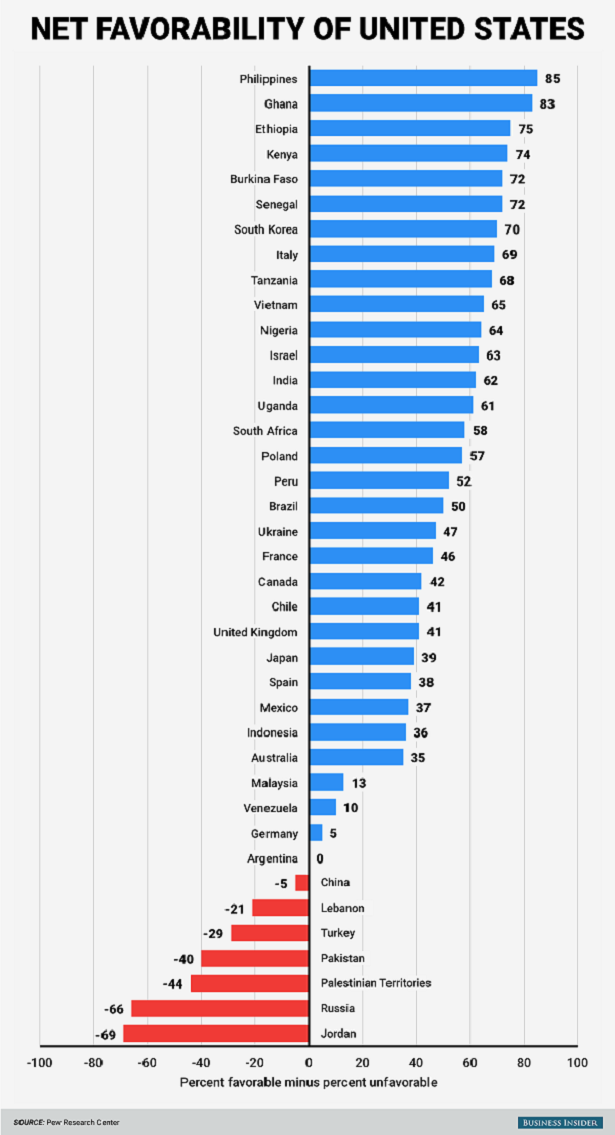
The Pew Research Center recently released a study on how people in 39 different countries around the world view the United States. One of the questions they asked was whether or not respondents had a favorable or unfavorable opinion of the US.

The results varied pretty widely. The US is very popular in sub-Saharan Africa: Five of the six countries with the highest net favorable views of the US were in that region. The US maintains positive approval ratings in most other regions as well, including Europe, Asia, and Latin America.

The Middle East is more of a mixed bag. While 39% of Lebanese respondents had a favorable view of the US, a full 60% had an unfavorable view.

Residents of Jordan had the absolute lowest net approval of the US among the 39 countries in the study, with 83% unfavorable compared to just 14% favorable.

As tensions build over economic sanctions and the simmering conflict in the Ukraine, Russians strongly disapprove of the United States, with 81% unfavorable and just 15% favorable. There has been a huge decline in Russian views of America over the last few years: As recently as 2013, a majority of Russians had a favorable view of the US.

Here’s the net favorability, or the percentage of respondents who have a favorable view of the US minus the percentage who have an unfavorable view, for each of the 39 countries in the study. For more detail, check out the Pew study here:

Net us favorable worldwide