

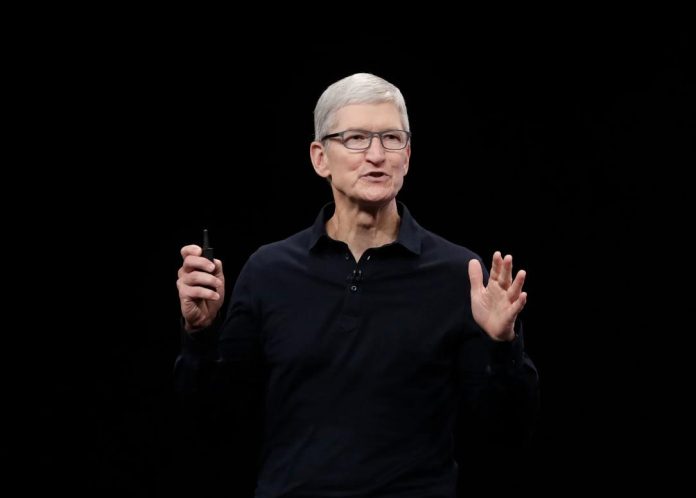
Tim Cook to Step Down as Apple CEO
In a significant leadership transition, Tim Cook has announced he will step down as Chief Executive Officer of Apple Inc. effective September 1, 2026, ending a 15-year tenure at the helm of one of the world’s most valuable companies.
Cook will transition into the role of Executive Chairman, maintaining strategic oversight and continuity at board level.
He will be succeeded by John Ternus, Apple’s Senior Vice President of Hardware Engineering, marking a carefully planned internal succession.

The End of a Transformational Era
Cook took over leadership in 2011 from Steve Jobs, inheriting a company already known for innovation but still heavily dependent on the iPhone.
Under his leadership, Apple evolved into a diversified global ecosystem business:
- Became the first company to reach $1 trillion, then $2 trillion and beyond in market valuation
- Expanded into new product categories such as wearables (Apple Watch, AirPods)
- Built a services division generating over $100 billion annually
- Strengthened global supply chain resilience and operational efficiency
More critically, Cook institutionalized Apple—shifting it from founder-led brilliance to process-driven scalability.
Namsia: 3 phases of a retirement plan you need for a good lifestyle after retiring
Why This Transition Matters
1. Planned Succession, Not Crisis Management
This is not a reactive leadership change. Apple’s board approved the transition following a long-term succession plan.
For serious businesses, this is the benchmark: leadership transitions should be engineered, not improvised.
2. Internal Talent Pipeline Wins
Ternus represents continuity. He has spent over two decades inside Apple’s product ecosystem.
This reinforces a key lesson:
High-performing organizations build leaders internally before they need them.
3. Governance Evolution
Cook’s move to Executive Chairman mirrors a governance model seen in global corporates—where outgoing CEOs retain strategic influence while enabling operational renewal.
Who is John Ternus?
John Ternus is an engineer by training and has led Apple’s hardware engineering teams, overseeing core products including iPhone, Mac, and emerging technologies.
His appointment signals Apple’s continued prioritization of product excellence and engineering-led leadership.
Strategic Implications for Apple
The transition comes at a critical moment for Apple:
- Intensifying competition in AI and next-generation computing
- Regulatory pressures globally (privacy, antitrust, digital markets)
- Slowing smartphone growth and need for new revenue drivers
Ternus will inherit a structurally strong company—but one that must define its next innovation curve.
Lessons for African Entrepreneurs and Business Leaders
This transition offers practical insights relevant across markets:
1. Build institutions, not personalities
Founder dependency limits scale. Cook proved that systems outperform charisma over time.
2. Invest in succession early
Leadership gaps destroy value faster than market competition.
3. Operational excellence compounds value
Cook was not a “product visionary” in the Jobs mold—but he built the most efficient technology company in history.
4. Separate ownership, governance, and management
Mature companies distinguish these roles clearly. That is how longevity is achieved.
I have Sh900k retirement savings. How can I get to Sh10 million in 15 years
Lessons for African Entrepreneurs and Founders
The transition offers grounded insights for growth-stage and founder-led businesses:
1. Institutionalize early
Move from personality-driven leadership to process-driven systems before scale exposes weaknesses.
2. Build leadership depth
Strong companies develop at least two layers of leadership beyond the founder.
3. Separate roles over time
Founder, CEO, and board chair should not remain permanently fused in scaling businesses.
4. Operational excellence is a competitive moat
Markets reward consistency and reliability, not just innovation.
Tech giants Apple’s $3.02 trillion networth higher than GDP of 48 African countries combined
Lessons for African Corporate Leaders
For executives running banks, telcos, FMCGs, and state-linked enterprises across Africa, the implications are more structural.
1. Treat succession as a strategic priority, not a governance formality
Across many African corporates, CEO transitions are still event-driven—often triggered by retirement, crisis, or political shifts. Apple demonstrates that succession must be a continuous board-level agenda with measurable readiness metrics.
2. Strengthen board independence and competence
Effective transitions require boards that are technically informed, independent, and assertive. Weak boards produce weak transitions. Strong boards shape leadership pipelines years in advance.
3. Build internal executive pipelines deliberately
Over-reliance on external hires signals failure in talent development. Institutions like Safaricom PLC and Equity Group Holdings have shown that internal leadership grooming improves continuity and market confidence.
4. Align leadership with long-term strategy, not short-term optics
Leadership changes should reflect strategic direction—digital transformation, regional expansion, or operational efficiency—not optics or political compromise.
5. Embed governance beyond compliance
Many firms treat governance as regulatory obligation. High-performing companies treat governance as a value creation system—covering capital allocation, risk management, and leadership continuity.
6. Plan for dual roles during transition phases
The Executive Chairman model used by Apple provides stability while allowing a new CEO to operate. African corporates can adapt this selectively, particularly in founder-influenced or family-linked businesses.
7. De-risk key-man dependency
A recurring weakness across African enterprises is over-centralization around a single leader. This constrains scale and weakens investor confidence. Structured delegation and leadership redundancy are essential.
Conclusion
Tim Cook’s exit as CEO is not just a leadership change—it is a case study in disciplined corporate stewardship.
He leaves Apple stronger, larger, and more resilient than he found it. The real test now shifts to John Ternus: not to replicate the past, but to define Apple’s next decade.
For business leaders, the takeaway is straightforward:
Enduring enterprises are not built on moments of brilliance, but on systems of continuity, accountability, and prepared leadership.