

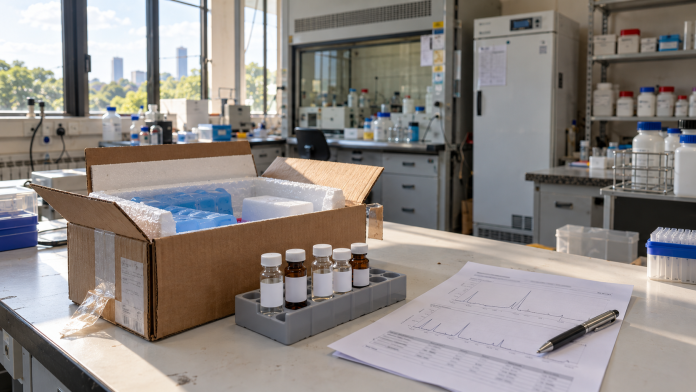
Price is the easiest thing to compare and the least useful. What actually tells you about a supplier is the paperwork they’re willing to show: a certificate of analysis for the batch you’ll receive (not a sample one), the HPLC and mass spec data it’s based on, research-use-only labelling that isn’t contradicted elsewhere on their site, and some detail on how the parcel gets to Kenya. Start the import paperwork early as well. A shipment held up in clearance for a week can arrive warm, and some reagents don’t survive that.
Peptides, antibodies and most other specialty reagents used in Kenyan university, institute and private labs come from abroad, usually from Europe, the US or Asia. Each order ties up grant money and weeks of planning, so a poor batch costs far more than its invoice.
Why a supplier’s paperwork deserves a second look
Keep in mind that a certificate of analysis (COA) is the supplier’s own report on its own product. A study published in 2015 checked how far that can be trusted. The researchers bought synthetic quorum-sensing peptides that were meant to be at least 95% pure and tested them in-house. Fewer than half – 44% – passed, and in one sample the main compound wasn’t even the structure that had been ordered. The authors warned that relying on suppliers’ certificates alone could have serious consequences for peptide research.

Impurities are not just a question of percentages. Synthetic peptides can contain sequences with missing or extra amino acids, as well as counter-ions left over from purification. Trifluoroacetate (TFA), a common counter-ion from HPLC purification, reduced cell numbers in osteoblast and chondrocyte cultures at concentrations of 10⁻⁸ to 10⁻⁷ M. In the same work, TFA salts of several peptides gave consistently lower proliferation than hydrochloride salts, enough to hide a real effect or suggest one that wasn’t there. For a lab, that can mean months of work built on a misleading result.
SHINE research report reveals hidden mental health crisis
What to ask for before you place an order
| Document or detail | What it tells you | Warning sign |
| Batch-specific COA | Results for the exact lot you will receive | No lot number, or identical results across every batch |
| HPLC chromatogram | Relative chromatographic purity under the stated analytical conditions | A purity figure with no chromatogram behind it |
| Mass spectrometry data | Whether the molecular mass matches the expected compound | Identity claimed without MS data |
| Counter-ion and peptide content | How much of the powder is actually peptide | Purity presented as if it were net peptide content |
| Testing laboratory | Who ran the analysis, and whether it is ISO/IEC 17025 accredited | An unnamed or untraceable lab |
| Storage and shipping conditions | How stability is protected in transit | No temperature information for a sensitive product |
| Labelling and product claims | The intended, lawful scope of use | Health claims or dosing advice on a research product |
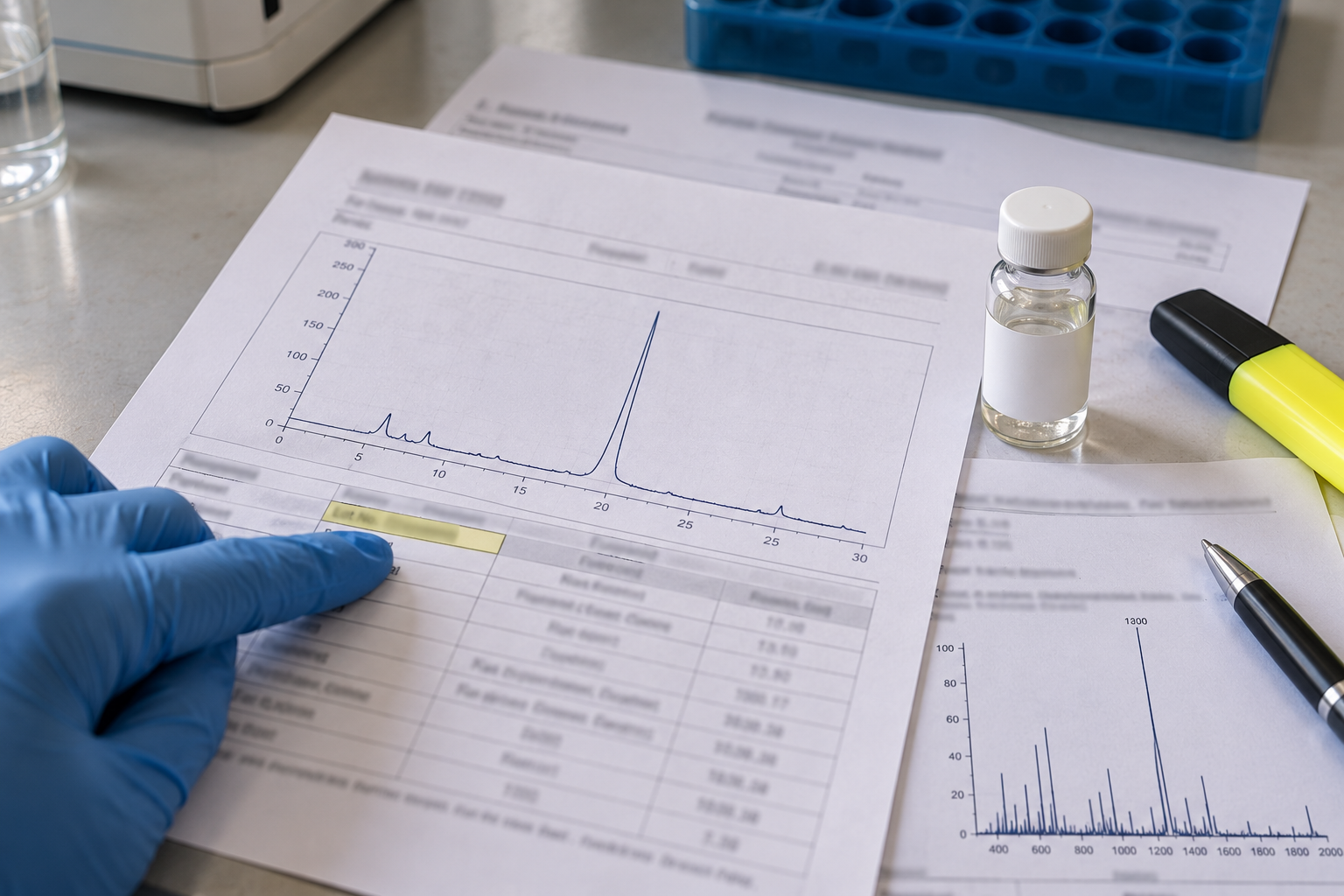
Here is what that looks like for a single order. A tesamorelin purchase for a study of growth hormone-releasing hormone (GHRH) signalling should arrive with a lot number on the vial that matches the paperwork, along with an HPLC trace and an MS result for that lot. Tesamorelin itself is a synthetic GHRH analogue. There is an approved prescription medicine based on it, but research-grade tesamorelin is a different product, sold for lab work and nothing else. If a supplier’s page for a compound like this reads like a treatment guide, that is a good reason to keep looking.
Paperwork and shipping on the Kenyan side
Kenya’s Pharmacy and Poisons Board (PPB) oversees health products and technologies, and its import and export guidance was revised in 2026. Not all research reagents are treated alike – whether you need a PPB permit for a particular item depends on how it’s classified and what it’s going to be used for. It’s much easier to get that answer from the Board before placing the order than from a customs officer afterwards. NACOSTI, the National Commission for Science, Technology and Innovation, deals with something else entirely. Its job is research licensing and the registration and accreditation of research institutions; customs clearance and permits for specific products aren’t part of its remit.
Standards inspection has also changed. Under Kenya’s 2026–2029 pre-export verification arrangements, your shipment might be checked for conformity before it’s dispatched, or inspected once it lands – that depends on the country it’s coming from and what’s inside. Some products follow a different procedure, and a few are dealt with by other agencies altogether. Check with KEBS which route applies to your shipment before it leaves the supplier.
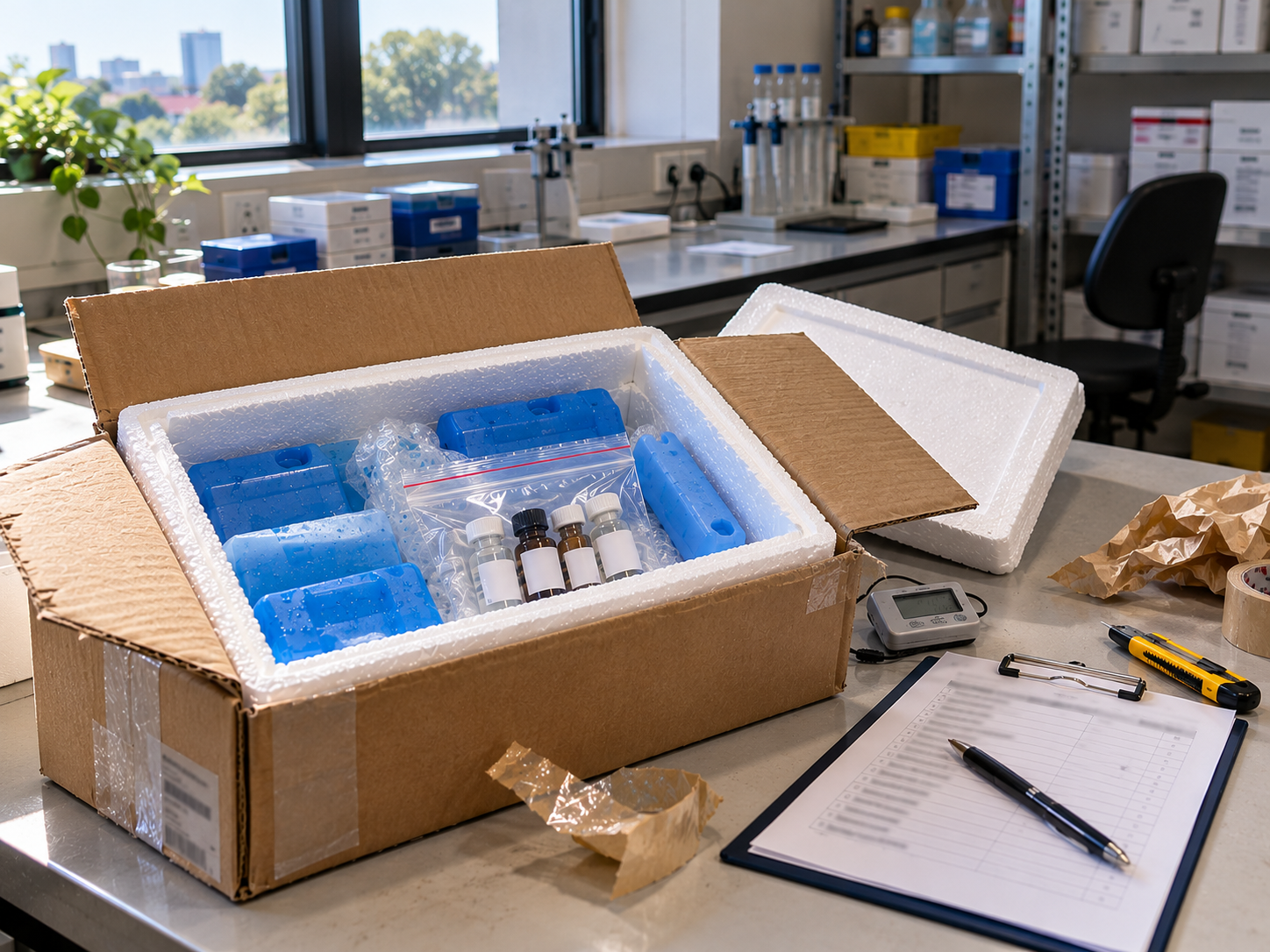
Cold-chain items are the ones that suffer most when a parcel gets stuck. So before paying, find out how it’ll be packed, which temperature range the packaging has been validated for, and for how many hours. Peptides shipped dry, as a freeze-dried (lyophilized) powder, usually travel better than solutions. Once they’re in, Bachem’s advice is to store them below −15 °C for maximum stability.
Checks worth doing after delivery
The paperwork stage is only half the job. When the parcel lands:
- Check that the lot number on every vial matches the one on the COA.
- Note when the parcel arrived, what state the packaging was in and what the temperature indicator showed, if there was one.
- Get the material into the storage conditions listed in the documentation without delay.
- Set aside budget for an independent identity check on anything a major experiment depends on. In the 2015 study mentioned earlier, the problems would have gone unnoticed if the researchers hadn’t tested the peptides themselves.
None of this is expensive. It simply means that when someone asks where a reagent came from and how good it was, the lab has the records to answer.
Products discussed in this article are intended strictly for laboratory research. They are not for human or veterinary use.
Sources
- Verbeke F, Wynendaele E, Braet S, D’Hondt M, De Spiegeleer B. Quality evaluation of synthetic quorum sensing peptides used in R&D. Journal of Pharmaceutical Analysis. 2015;5(3):169–181.
- D’Hondt M, Bracke N, Taevernier L, et al. Related impurities in peptide medicines. Journal of Pharmaceutical and Biomedical Analysis. 2014;101:2–30.
- Cornish J, Callon KE, Lin CQ, et al. Trifluoroacetate, a contaminant in purified proteins, inhibits proliferation of osteoblasts and chondrocytes. American Journal of Physiology. 1999;277(5)–E783.
- NIH ClinRegs. Kenya country profile: Pharmacy and Poisons Board, NACOSTI and import guidance.
- SGS. Kenya renews mandate for pre-export verification of conformity services. 2026.
- ISO. ISO/IEC 17025 – Testing and calibration laboratories.
- Bachem. Care and handling of peptides.