

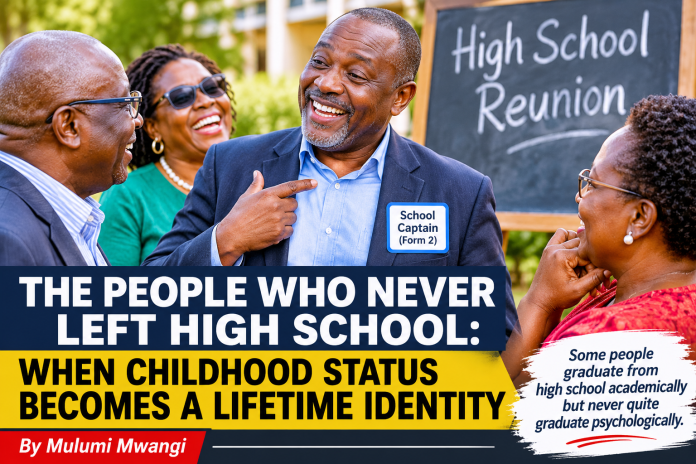

They may have built businesses, accumulated wealth, raised families and acquired professional titles, yet a significant part of their identity remains anchored in their high school years.
You will find a person approaching 60 who still proudly introduces themselves by a nickname given to them in Form two, another is forever reminding people that they were the school captain, the most popular student, best dancer, the sports champion or the kingpin of a particular social circle.
For some, school reunions have become more than opportunities to reconnect; they are platforms for displaying accumulated wealth, professional titles, expensive lifestyles and social achievements.

Interestingly, many still expect the same audience, admiration and social authority they enjoyed, or perhaps desired, during their school years.
But what drives this behaviour?
Training a generation before we lose the family structure
The Psychology of Unfinished Identities
Psychology offers some interesting explanations.
One is the concept of self-continuity, the human desire to maintain a connection between who we were and who we are today.
Research by psychologists Constantine Sedikides and Tim Wildschut has demonstrated that nostalgia strengthens this connection and can improve feelings of belonging, meaning and psychological well-being.
For some people, their school years represent the last period when they experienced a particularly strong sense of belonging, recognition or social importance, holding on to old nicknames, friendships and former positions becomes a way of preserving that identity.
When Adulthood Becomes an Opportunity to Rewrite the Past
However, there is another, perhaps more interesting category:
People who were socially overlooked, financially disadvantaged, unpopular or considered insignificant during their school years.
For these individuals, adulthood presents an opportunity to rewrite their personal history; they return to reunions with businesses, expensive cars, impressive titles and visible financial success. Their achievements are genuine, but the need to display them before former classmates may reveal something deeper: a desire to receive the recognition they believe they were denied earlier in life.
Psychologists sometimes explain such behaviour through compensatory self-enhancement and social comparison. When people feel that their self-worth has been challenged, they may seek external validation by demonstrating superiority in areas where they now feel successful.
In other words, the reunion becomes an opportunity to settle old psychological accounts.
Flooded by Habit: Nairobi’s waste problem is a people problem too
Still Seeking the Audience of Yesterday
The irony is that both categories may be seeking the same thing: validation from people whose opinions mattered decades ago.
One wants to preserve the status they once enjoyed, the other wants to prove that they have finally acquired the status they missed.
Both may struggle to appreciate that the social hierarchy of adolescence has long expired.
When School Reunions Become Competitions for Recognition
There is nothing wrong with celebrating success, maintaining lifelong friendships or remembering one’s childhood.
The concern arises when present-day self-worth depends on maintaining an old identity or winning recognition from an audience that has moved on.
A school reunion should be a meeting of people who have lived different lives, experienced different challenges and grown into different individuals. It should not become a permanent competition over who has travelled furthest from the classroom.
The Real Measure of Maturity Is Moving Beyond the Past
Perhaps the real measure of maturity is not how much wealth you bring back to impress your former classmates, or how successfully you preserve your old nickname.
It is whether you have developed an identity that stands comfortably on its own, without needing the approval of people who knew you at 14 years.
You can celebrate the person you once were without spending the rest of your life trying to convince your former classmates that they are still somebody important.
After all, some people graduate from high school academically but never quite graduate psychologically.
When the job title goes home and you stay behind
About the Author
Mulumi Mwangi is a seasoned businessman with more than five decades of life experience, bringing a rare depth of perspective to both enterprise and writing. Trained as an electrical engineer, he has founded, built, and managed ventures across diverse sectors, including advertising, marketing, agribusiness, real estate, and fintech.
His writing is firmly grounded in lived experience. It draws from family life as a father, husband, brother, and uncle; from public life through his service as a political party official; and from the hard lessons of business, both failure and success. These experiences, combined with everyday social interactions, have shaped a reflective and pragmatic worldview.
Mulumi’s work is offered as a personal perspective rather than a prescription. His views are candid, experience-driven, and open to debate—acknowledging that insight is often refined through dialogue, reflection, and the humility to accept that one may be right or wrong.
Contact: [email protected]
Did you love the story? You can also share YOUR story and get it published on Bizna Click here to get started.