

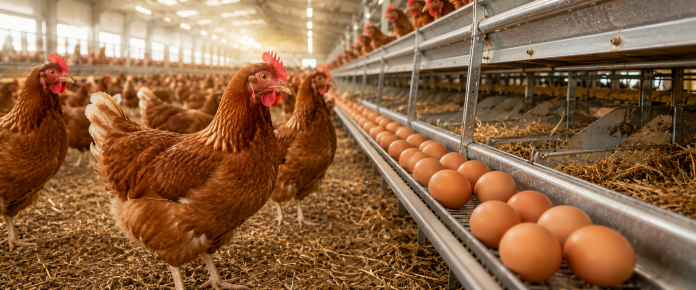
Layer chicken farming continues to rank among the most profitable agribusiness ventures due to the consistent demand for eggs across households, hotels, schools and food businesses.
Unlike some agricultural enterprises that depend on seasonal markets, egg production provides farmers with a steady source of income throughout the year.
However, while the returns can be attractive, poultry experts caution that success in layer farming requires adequate capital, particularly during the early months when birds are not yet producing eggs.

Agriculture expert and agronomist Antonio Mudong’i estimates that a farmer intending to start a simple layers poultry farm with 300 birds should be prepared to invest at least Sh500,000 to comfortably cover the first six months of operation.
According to Mudong’i, feed is the biggest expense in layer farming as it accounts for approximately 80 percent of the total production cost. Below is the cost breakdown:
Feed Costs During the First Six Months
Day 1 to Day 60: Chick Mash
During the first two months, each chick consumes an average of 45 grams of feed per day. For 300 chicks, daily consumption comes to 13.5 kilograms.
Over a 30-day period, the birds consume:
13.5kg × 30 days = 405kg
For two months, total consumption rises to:
405kg × 2 = 810kg
Since chick mash is sold in 50kg bags, the birds will require:
810kg ÷ 50kg = 16.2 bags
With a 50kg bag of chick mash retailing at Sh4,000, the feed cost will be:
16.2 bags × Sh4,000 = Sh64,800
After factoring in transportation costs from the agrovet to the farm, the total expenditure for chick mash rises to approximately Sh70,000.
Day 61 to Day 120: Grower Mash
Between the third and fourth month, the birds transition to grower mash and consume an average of 65 grams each per day.
Total feed consumption during this period is calculated as:
65g × 300 birds × 60 days = 1,170,000g
This is equivalent to:
1,170,000g ÷ 1,000 = 1,170kg or 1.17 tonnes
The birds will therefore require:
1,170kg ÷ 50kg = 23.4 bags
At a retail price of Sh2,950 per 50kg bag, the feed cost comes to:
23.4 bags × Sh2,950 = Sh69,030
Adding transportation costs brings the total expenditure to approximately Sh70,000.
Mudong’i advises farmers to continue feeding birds on grower mash until the first egg is laid.
“The birds should be fed on grower mash until the day you see the first egg. This is important for the formation of high-quality eggshells. If the birds do not receive sufficient grower mash, farmers may experience challenges with weak eggshells during production,” he says.
Day 121 to Day 180: Grower Mash Mixed With Layers Mash
Assuming the birds have started laying eggs, feed consumption increases to an average of 90 grams per bird daily.
The total feed requirement for 300 birds over 60 days is:
90g × 300 birds × 60 days = 1,620,000g
This translates to:
1,620kg or 1.62 tonnes
The number of 50kg bags required is:
1,620kg ÷ 50kg = 32.4 bags
At Sh3,000 per bag for the grower and layers mash mixture, feed costs amount to:
32.4 bags × Sh3,000 = Sh97,200
Including transport expenses, the total cost rises to approximately Sh100,000.
Total Feed Budget
The cumulative feed budget for the first six months is:
- Chick Mash: Sh70,000
- Grower Mash: Sh70,000
- Grower Mash Mixed with Layers Mash: Sh100,000
Total Feed Cost: Sh240,000
Cost of Chicks
A day-old chick currently costs Sh184.
For 300 chicks:
300 × Sh184 = Sh55,200
The cost can therefore be estimated at approximately Sh55,000.
Equipment Requirements
A farmer will also need basic poultry equipment.
Drinkers
A flock of 300 birds requires about six drinkers.
- Cost per drinker: Sh300
- Total cost: 6 × Sh300 = Sh1,800
Feeders
Ten feeders are sufficient for a starter flock of 300 birds.
- Cost per feeder: Sh600
- Total cost: 10 × Sh600 = Sh6,000
Bedding Materials
At a stocking density of six birds per square metre, approximately 25 bags of wood shavings will be required.
- Cost per bag: Sh200
- Total cost: 25 × Sh200 = Sh5,000
Labour and Water Costs
Labour remains another significant expense.
Assuming a farmhand earns Sh10,000 per month, labour costs over six months will amount to:
Sh10,000 × 6 = Sh60,000
Water expenses are estimated at:
- Sh10,000 for six months
Farmers should also budget for brooding equipment, including two brooding jikos and charcoal for the chicks during their early growth stages, as well as disease management.
Minimum Capital Requirement
When all major expenses are considered, including chicks, feed, equipment, labour, water and brooding costs, Mudong’i advises prospective poultry farmers to have a minimum capital of Sh500,000 before venturing into a 300-bird layers project.
“If you want to start a layers chicken farm of 300 birds, the least amount you should have is Sh500,000,” Mudong’i says.
Also Read: Why your chickens are not laying enough eggs: top causes and solutions