

As climate change, shrinking land sizes and rising feed costs continue to challenge livestock farmers, fodder production is increasingly emerging as one of the most promising agricultural ventures.
The growing demand for quality animal feed, coupled with the expansion of dairy and livestock farming, has created lucrative opportunities for entrepreneurs willing to invest in forage production.
Unlike many traditional crops, fodder can offer multiple harvests annually, a ready market and the potential for value addition through products such as silage.

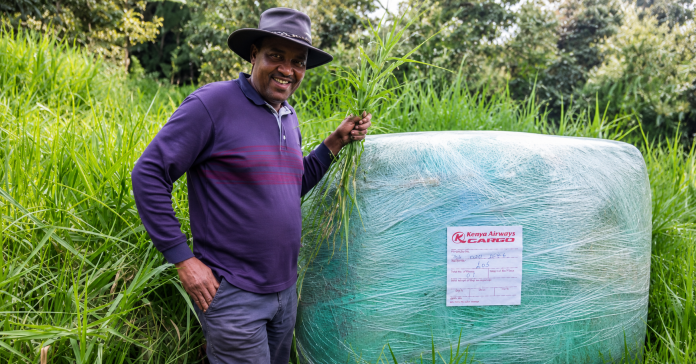
Mr. Githaiga Kihara, a farmer in Chorong’i village in Nyeri Central Sub-county, is among the few farmers who have successfully tapped into this opportunity.
What began as a personal quest to find quality feed for his dairy goats has evolved into a thriving agribusiness that now exports fodder planting materials to 12 African countries.
Kihara ventured into fodder farming a decade ago after shutting down his printing business in Nairobi. Seeking a new direction, he turned to agriculture and started researching ways to improve livestock nutrition on his farm in Gakindu, Mukurwe-ini.
“I started this enterprise about ten years ago in Gakindu, Mukurwe-ini sub-county, out of a need because I had some dairy goats which did not have enough feed. When I did some research, I realised that I could get better feed, and I went for it,” he told KNA.
His journey began with the cultivation of signal grass, introduced through support from the then Kenya Agricultural Research Institute (KARI), now the Kenya Agricultural and Livestock Research Organization (KALRO), at its Katumani station in Machakos County.
That initial experiment opened the door to a wide range of forage crops. Today, Kihara manages about 100 hectares under animal feed production, growing varieties such as Australian Red Napier grass, Guinea grass, Guatemala grass, Juceo grass, Signal grass, Super K vine and Nacedero.
Among these, Australian Red Napier has become the flagship product of his enterprise and the backbone of a growing export business.
Farmers from countries including Nigeria, Sierra Leone and the Democratic Republic of Congo are among those purchasing planting materials from his farm.
The popularity of Australian Red Napier stems from its superior nutritional value and productivity.
According to Kihara, the grass contains between 20 and 24 per cent crude protein, making it one of the most nutritious Napier varieties available to livestock farmers.
Beyond its nutritional benefits, the grass is highly productive. A single acre can yield between 180 and 200 metric tonnes of biomass annually. It also matures quickly, allowing farmers to begin harvesting within 45 to 60 days after planting.
The entrepreneur sells individual Red Napier splits at Sh50 each for retail customers, while bulk buyers pay as little as Sh15 per split, with room for negotiation depending on volume.
In addition to supplying planting materials, Kihara has established a successful silage business aimed at helping farmers overcome feed shortages during dry seasons.
His silage, packaged in 70-kilogram bales, retails at approximately Sh1,050 and can remain viable for up to three years when stored under recommended conditions.
The bulk of the silage is supplied to arid and semi-arid regions, including counties in the former North Eastern Province and parts of the Rift Valley, although local farmers also purchase the product as a reliable feed reserve.
Kihara currently dedicates about 75 hectares in Mweiga to silage production. To improve accessibility, he has established several sales outlets along the Ruring’u-Kiandu road, Gatitu, Karatina, Chaka Milimani and Sasini, with plans underway to open another outlet in Othaya.
While quality products have played a major role in the growth of the business, Kihara attributes much of his success to digital marketing.
Through social media platforms including Facebook, WhatsApp, Instagram and TikTok, where the enterprise operates under the brand name Moo Fodder Supermarket, he has been able to reach customers far beyond Kenya’s borders.
“When I started posting my products on Facebook, people started making inquiries, and it became a business. This went on until I got what I can call a breakthrough when I received an order of one million splits,” he recalls.
The overwhelming response encouraged him to diversify further, leading to the introduction of additional fodder varieties such as Super Napier, which has also performed well in the market.
Beyond commercial production, Kihara’s farm has become a centre for agricultural training, offering practical lessons on fodder establishment and management to individuals and organized groups.
The enterprise has also created employment opportunities for numerous young people who work as part-time marketers, helping connect farmers with quality forage products.
“This enterprise has given me a lot of money. I have never seen any other business which can potentially give you the kind of money this fodder business has given me,” he said adding that through the business, he has been able to educate his children up to university level, and build a house for his family.
Also Read: You need at least Sh500,000 to start a 300-bird layer farm. Here is the breakdown