
The Kenya Revenue Authority (KRA) has intensified its efforts to crack down on tax evasion, targeting individuals and businesses suspected of engaging in tax fraud, under-declaration of income and other forms of tax non-compliance.
The enforcement operations form part of the taxman’s broader efforts to increase revenue collection, seal tax loopholes and ensure businesses and individuals meet their statutory tax obligations.
The raids also highlight KRA’s growing focus on using intelligence, data analysis and investigations to identify taxpayers suspected of concealing income or manipulating financial records to avoid paying taxes.

KRA raids and investigations targeting tax evasion
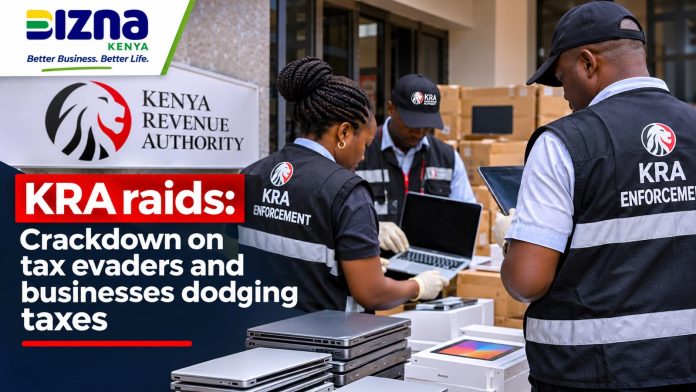
The operation started in October and continued into November 2026, with KRA officers raided a residential apartment in Kileleshwa, Nairobi, and seized electronic goods valued at approximately KSh13 million.
The operation followed intelligence reports alleging that the premises were being used to store and distribute electronic products suspected of having been imported without payment of the required taxes and customs duties.
KRA recovered 529 electronic items, including 358 laptops, nine iPads and 162 electronic accessories. The authority said investigations would establish the origin of the goods and determine the applicable tax and customs obligations.
KRA announces changes to Tax Return Filing timelines and system architecture under Finance Act 2026
KRA targets businesses involved in fraudulent VAT schemes
In November 2026, KRA intensified scrutiny of businesses suspected of exploiting VAT registration to facilitate tax evasion.
The authority raised concerns over companies allegedly registering for VAT without conducting genuine business operations, instead issuing or facilitating transactions designed to help other businesses reduce their tax liabilities illegally.
KRA Commissioner for Micro and Small Taxpayers George Obell said the authority was introducing additional verification measures to identify suspicious applications while making registration easier for legitimate businesses.
The crackdown is aimed at preventing fraudulent VAT arrangements, including missing trader schemes, which allow businesses to claim tax credits on transactions that never actually took place.
KRA uncovers KSh4 billion VAT fraud
The enforcement campaign follows another major investigation announced in October 2026, when KRA uncovered an alleged KSh4 billion VAT fraud involving fictitious electronic invoices.
According to the Kenya News Agency, 42 individuals and companies faced prosecution over transactions involving 72 related entities suspected of generating fake invoices between 2020 and 2025.
The entities reportedly transmitted 62,869 invoices through the electronic Tax Invoice Management System (eTIMS), with a combined value of approximately KSh33.83 billion.
KRA said the alleged scheme enabled businesses to claim approximately KSh3.996 billion in input VAT deductions through transactions that were not supported by genuine supplies of goods or services.
The authority said it had forwarded 57 investigation files to the Office of the Director of Public Prosecutions, with six suspects already arrested at the time of the report.
KRA to auction smartphones, construction materials and other goods in four towns
Tax evaders risk heavy penalties and prosecution
Businesses and individuals found guilty of tax evasion face significant financial and legal consequences under Kenya’s tax laws.
Under the Tax Procedures Act, businesses found guilty of tax evasion may face penalties equivalent to twice the amount of tax avoided.
Depending on the nature of the offence, offenders may also face criminal prosecution, fines and other sanctions provided for under the law.
KRA is also targeting individuals and companies that facilitate tax fraud, including those involved in generating fictitious invoices, concealing taxable income or assisting other taxpayers to submit fraudulent tax returns.
How KRA is identifying tax evaders
The tax authority is increasingly relying on technology, intelligence gathering and financial investigations to identify businesses and individuals suspected of evading taxes.
Some of the measures include:
- eTIMS monitoring: Tracking electronic tax invoices to identify suspicious transactions and fictitious purchases.
- Financial investigations: Examining financial records and transactions to identify inconsistencies in declared income.
- Business verification: Checking whether companies seeking tax registration have genuine business operations.
- Intelligence-led raids: Conducting enforcement operations based on information about suspected tax fraud and illicit trade.
- Inter-agency collaboration: Working with other government agencies to investigate tax offences and facilitate prosecutions.
List of goods excluded from KRA’s Sh2 million cargo clearance framework
What the crackdown means for Kenyan businesses
The intensified enforcement measures could have significant implications for businesses operating in Kenya, particularly those that have relied on informal accounting practices or questionable tax arrangements.
Businesses are expected to maintain accurate financial records, issue genuine electronic invoices, declare their actual income and comply with VAT, PAYE and other applicable tax obligations.
Companies should also ensure that purchases claimed as business expenses or input VAT are supported by genuine transactions and appropriate documentation.
KRA’s enforcement activities are also intended to protect businesses that comply with tax regulations from unfair competition by operators who avoid paying their statutory obligations.
KRA steps up revenue collection efforts
The crackdown comes as the tax authority pursues higher revenue collection and seeks to strengthen compliance across different sectors of the economy.
In a November 5, 2026 announcement, KRA reported that it had crossed the KSh1 trillion revenue collection mark, highlighting its ongoing revenue mobilisation efforts.
The latest operations signal that businesses suspected of tax fraud, customs violations and fraudulent VAT arrangements are likely to face increased scrutiny.
KRA has encouraged taxpayers to comply with tax laws and report suspected tax evasion through its reporting channels.
For businesses and individuals, the message is clear: maintaining proper financial records and meeting tax obligations is increasingly important as the authority strengthens its enforcement and investigation capabilities.