
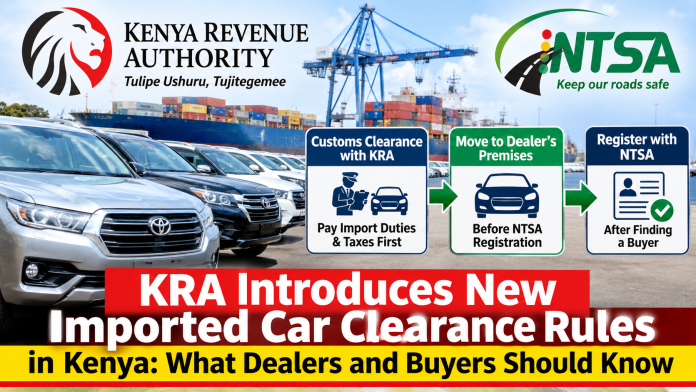
The Kenya Revenue Authority (KRA) has introduced new imported car clearance procedures allowing licensed motor vehicle dealers to move second-hand vehicles from customs yards to their business premises before completing formal registration with the National Transport and Safety Authority (NTSA).
The changes are expected to ease the financial and administrative burden on car importers and dealers by separating customs clearance from vehicle registration.
Under the new arrangement, licensed dealers must pay all applicable import duties, taxes and customs levies before their vehicles are released from customs-controlled facilities. However, NTSA registration fees and levies will only become payable after a dealer secures a buyer.

The revised procedure follows a government directive aimed at making it easier for licensed dealers to manage imported vehicle inventories.
KRA announces changes to Tax Return Filing timelines and system architecture under Finance Act 2026
How the New KRA Imported Car Clearance Process Works
Under the revised guidelines, licensed motor vehicle dealers must first lodge an import declaration through KRA’s Integrated Customs Management System (iCMS) once their vehicles arrive in Kenya.
Dealers must settle all applicable customs duties, taxes and levies before proceeding with clearance.
Unlike the previous arrangement, NTSA registration fees and levies will not be collected during the initial customs entry stage.
KRA customs verification officers will physically inspect the vehicles before the Centralised Release Officer reviews the import entries and authorises their release.
This allows dealers to complete customs clearance without immediately obtaining ordinary Kenyan registration numbers for vehicles that have not yet been sold.
NTSA to Issue Special Identifiers for Imported Vehicles
Before an imported vehicle can be moved from a customs yard to a dealer’s premises, the dealer must apply for a special Kenya Dealer (KD) identifier through the NTSA online platform.
NTSA will issue a unique identification code comprising the dealer’s KD number and the vehicle’s chassis number.
The identifier will also be captured in KRA’s customs management system to facilitate tracking and accountability.
A Border Control Officer will physically verify the identification details recorded in the iCMS system against those displayed on the vehicle.
Only vehicles whose identification details match will be authorised for release and transfer to the dealer’s yard.
KRA to auction smartphones, construction materials and other goods in four towns
When Will Imported Cars Be Registered in Kenya?
Under the new arrangement, formal vehicle registration will take place after a dealer secures a buyer.
Once a customer purchases an imported vehicle, the dealer will initiate the registration process through NTSA.
The dealer will then pay the applicable registration fees and levies through the government’s eCitizen platform.
Following successful registration, the vehicle’s Kenyan registration number will automatically be transmitted to KRA’s customs management system through an Application Programming Interface (API).
This will enable the two government agencies to reconcile vehicle registration information with customs clearance records.
What the New KRA Rules Mean for Car Dealers
The revised procedures are expected to provide relief to licensed motor vehicle dealers operating in Kenya.
Previously, dealers faced additional financial and administrative obligations associated with completing registration before putting imported vehicles into their yards for sale.
The new system offers several benefits:
- Reduced upfront costs: Dealers can defer NTSA registration payments until a vehicle is sold.
- Improved cash flow: Businesses will have less money tied up in unsold inventory.
- Faster vehicle movement: Imported vehicles can move from customs yards to dealers’ premises after meeting clearance requirements.
- Better inventory management: Dealers can hold imported vehicles while searching for prospective customers.
- Improved tracking: The KD identification system will help KRA and NTSA monitor vehicles before formal registration.
List of goods excluded from KRA’s Sh2 million cargo clearance framework
Will the New Rules Reduce the Cost of Imported Cars?
The changes could ease financial pressure on car dealers, particularly businesses importing several vehicles and holding them in stock for extended periods.
By allowing registration payments after a vehicle is sold, dealers can reduce the amount of capital tied up in unsold inventory.
However, the changes do not eliminate import taxes or customs clearance charges. Dealers must still pay all applicable customs duties, taxes and levies before vehicles leave customs-controlled facilities.
Therefore, the new rules should not be interpreted as a reduction in the overall import duty payable on vehicles entering Kenya.
What Imported Car Buyers in Kenya Should Know
Kenyans planning to purchase imported second-hand vehicles should establish whether a vehicle has completed customs clearance and whether its chassis details match the relevant identification records.
Buyers should also request import documentation and confirm that the dealer can facilitate formal NTSA registration.
Importantly, the new arrangement specifically addresses vehicles imported by licensed dealers. It should not be interpreted as a blanket exemption from registration requirements or taxes for individuals importing vehicles for personal use.
How to use KRA’s Soma Label app to identify counterfeit products
Conclusion
KRA’s new imported vehicle clearance procedures represent a significant change in how licensed dealers manage imported second-hand vehicles in Kenya.
By separating customs clearance from formal NTSA registration, the government is allowing dealers to move vehicles into their business premises without immediately incurring registration-related costs.
The changes could improve dealer cash flow, inventory management and the availability of imported vehicles in Kenya’s motor vehicle market.