
Kenya’s commercial banks disbursed KES 424.67 billion in new loans to Micro, Small and Medium Enterprises (MSMEs) in the first nine months of 2026, representing a 30 per cent increase from the KES 326.5 billion recorded during the same period in 2025.
The latest figures from the Kenya Bankers Association (KBA) indicate that leading banks are approaching their KES 500 billion target for new MSME lending in 2026, signalling growing financial support for small businesses across the country.
The increased lending comes amid easing borrowing costs, improving business confidence and a gradual improvement in the quality of commercial bank loan portfolios.

The growth also highlights the important role commercial banks continue to play in financing entrepreneurs, supporting business expansion and strengthening Kenya’s private sector.
Co-op Bank ranks second in MSME lending after advancing KSh60.26 Billion by Q3 2026
Equity Bank Dominates Kenya’s MSME Lending Market
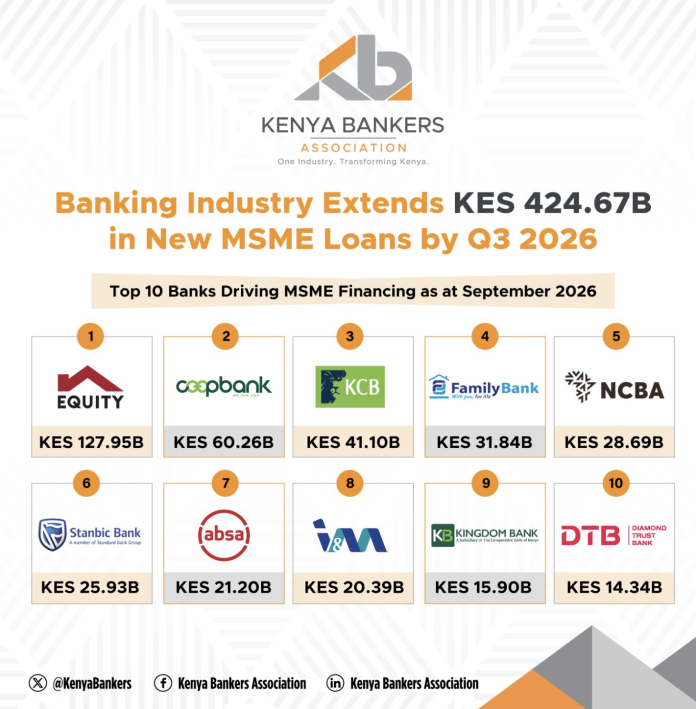
Equity Bank emerged as the leading financier of micro, small and medium enterprises, disbursing KES 127.95 billion in new MSME loans by the end of September 2026.
The amount accounted for approximately 30.13 per cent of all new MSME credit issued by the banking industry during the period.
Equity Bank’s lending was more than double the KES 60.26 billion disbursed by its closest competitor, Co-operative Bank of Kenya, and more than three times the KES 41.10 billion recorded by KCB Bank.
The lender’s performance reflects its strong presence in the MSME segment, which includes businesses operating in trade, manufacturing, agriculture, services and other sectors of the economy.
Top 10 Banks Lending to MSMEs in Kenya
The Kenya Bankers Association data shows that ten commercial banks accounted for significant portions of new MSME financing between January and September 2026.
Here is the ranking of the leading banks by new MSME loans disbursed.
| Rank | Bank | New loans | Market share |
|---|---|---|---|
| 1 | Equity Bank | KES 127.95B | 30.13% |
| 2 | Co-operative Bank | KES 60.26B | 14.19% |
| 3 | KCB Bank | KES 41.10B | 9.68% |
| 4 | Family Bank | KES 31.84B | 7.50% |
| 5 | NCBA | KES 28.69B | 6.76% |
| 6 | Stanbic Bank | KES 25.93B | 6.11% |
| 7 | Absa Bank Kenya | KES 21.20B | 4.99% |
| 8 | I&M Bank | KES 20.39B | 4.80% |
| 9 | Kingdom Bank | KES 15.90B | 3.74% |
| 10 | DTB | KES 14.34B | 3.38% |
The ranking highlights the dominance of Equity Bank, which commanded nearly one-third of the industry’s new MSME lending.
Co-operative Bank and KCB Bank followed, while Family Bank occupied the fourth position with KES 31.84 billion in new loans.
NCBA, Stanbic Bank, Absa Bank Kenya, I&M Bank, Kingdom Bank and Diamond Trust Bank (DTB) completed the top ten.
Step-by-step guide to applying for an Equity agent float loan
Lower Lending Rates Support Growth in MSME Financing
The expansion in MSME lending has been supported by a more favourable economic environment, particularly the moderation of commercial bank lending rates.
Average commercial bank lending rates declined to 14.4 per cent in September 2026, compared to 17.2 per cent in November 2024.
The reduction in borrowing costs has helped improve credit conditions for businesses seeking financing to expand their operations, purchase equipment, increase inventory and meet working capital requirements.
Private sector credit growth also improved, reaching 10.6 per cent in September 2026, up from 10.3 per cent in August.
The improving credit environment suggests that businesses are gradually regaining confidence in borrowing as financing costs moderate.
Banks Record Improvement in Loan Repayments
Another factor supporting the expansion of MSME lending is the improvement in the quality of commercial bank loan portfolios.
According to the Kenya Bankers Association, the gross non-performing loan (NPL) ratio declined to 13.9 per cent in September 2026, from 14.8 per cent in June 2026.
This represents a further improvement from the 17.6 per cent recorded in August 2025.
The declining NPL ratio points to improved loan repayment conditions across the banking industry.
The improvement has been attributed to stronger credit risk assessment by financial institutions and healthier business cash flows as supply chain challenges and inflationary pressures ease.
For banks, better loan repayment performance can support increased lending appetite, including financing for small and medium-sized businesses.
Msamaria Women’s loan offers up to Sh10 Million credit to entrepreneurs
Kenya’s MSME Lending Approaches KES 500 Billion Target
With KES 424.67 billion already disbursed in the first nine months of 2026, the banking industry is moving closer to its KES 500 billion annual MSME lending target.
The amount represents approximately 84.9 per cent of the target, leaving KES 75.33 billion to be disbursed during the final quarter of the year.
If the lending momentum continues, Kenya’s banking sector could record a significant milestone in financing micro, small and medium enterprises.
The growth is particularly important given the role MSMEs play in employment creation, household incomes, entrepreneurship and economic activity across the country.
However, access to affordable credit remains an important consideration for businesses, particularly smaller enterprises that may face challenges meeting conventional bank lending requirements.
The latest figures demonstrate the growing contribution of commercial banks to enterprise financing and the importance of MSME lending in supporting Kenya’s broader economic growth.