

Home Blog Page 145

By understanding Africa risk, EIB-backed Boost Africa programme helps businesses thrive

0

The European Investment Bank (EIB), the lending arm of the European Union, is playing a pivotal role in transforming Kenya’s private sector by providing catalytic funding that enables local enterprises to scale their operations, create jobs, and drive innovation across industries.

Over the past few years, EIB’s investments have gone beyond traditional infrastructure to focus on inclusive, private sector-led growth, channeling financing to startups and small businesses that are often the backbone of Kenya’s economy but face persistent barriers to accessing capital.

Through targeted initiatives such as Boost Africa, the Bank has injected millions of euros into Kenya’s entrepreneurial ecosystem through local intermediaries and venture capital funds which in turn invest in high-potential enterprises in sectors such as agritech, fintech, clean energy, and health.

The goal is not merely to fund businesses, but to nurture them into scalable, sustainable ventures capable of expanding regionally and globally.

Samuel Munguti, the CEO and founder of agri-tech firm Shamba Pride, is one of the entrepreneurs who is growing his business through EIB’s timely support.

Munguti says that EIB through the Boost Africa program allocated his business an initial funding of USD500,000 which enabled him to expand his business, including investing in professionals. The funds were delivered through Boost Africa’s partner fund Seedstars Africa Ventures.

“At Shamba Pride, we felt that we needed financial partners like EIB and we feel that such funds really resonate with local early-stage capital needs to spur development. Beyond the capital that Seedstars Africa Ventures (the EIB backed Fund) deployed to Shamba Pride, we have really benefited as a business a lot from the technical assistance offered to grow our senior management team,’’ Munguti explains.

Shamba Pride, an agri-tech firm, currently connects over 80,000 farmers and 4,000 agri-retailers through tech-powered digishops. Its platform modernises agro-dealer operations, improves supply chains, and builds local farming communities through the provision of quality farm inputs and linkage to markets for farmers’ produce.

“Farmers in the Shamba pride ecosystem report a 2.5X increase in farm productivity,” Munguti notes.

According to Munguti, through Boost Africa, Shamba Pride grew its revenues from Sh5 million to close to Sh300 million within 3 years from 2021. Additionally, the firm its workforce from 4 direct employees to more than 40 within four years.

ALSO READ: How funding from the EIB helped our businesses to break even

Turaco Ltd

Turaco is an insurtech company that provides affordable and simple insurance products, primarily to underserved customers in Africa.

With Boost Africa’s support, it’s scaling customer-centric insurance products for the mass market across Kenya.

“I learned about EIB being a part of AfricInvest (the private equity fund) when he had some challenges in our business around developing and coaching our people to be upskilled. I really wanted resources to be able to do this, and Boost Africa came alongside us and met the specific needs we had in the business at that time,” Turaco Insurance CEO and Co-founder Ted Pantone said.

According to Ted, Turaco has experienced a remarkable growth from 100,000 users to 1.6 million active users in the last three years.

“That’s around $1.5 million of premium to $12 million of premium. By going to a Fund like AfricInvest which is backed by Boost Africa and EIB, we were able to find people who understood Africa risk in terms of investment and were able to see the potential and what we were trying to build,” he explained.

Poa Internet

Founded in Nairobi in 2015, Poa Internet is closing Kenya’s digital divide by delivering low-cost Wi-Fi to underserved communities.

With support from Boost Africa, Poa scaled its operations to reach peri-urban and semi-rural areas, where traditional telecoms had little presence.

“We’ve been working with Boost Africa through an EIB backed fund called Seedstars Africa and that capital has been used to finance additional infrastructure, equipment and to hire additional people into the business and to train them in all the necessary skills,” Poa Internet CEO and founder Andy Halsall said.

The firm currently operates in Nairobi, Mombasa, Nakuru and Eldoret, employing 400 people directly. A 2024 impact study revealed that 62 percent of Poa users were first-time home Wi-Fi subscribers, and 70 percent of low-income households accessed the internet through Poa.

Among professional users, 85 percent used the work service, and 68 percent reported increased income or savings. The platform also boosted digital literacy, with 83 percent of users learning new skills and 82 percent expanding their professional networks.

Edward Claessen, Head of European Investment Bank, Regional Hub for East Africa, says that Boost Africa supports businesses in all stages through financial and technical assistance to grow sustainably.

“At a higher level, Boost Africa is supporting incubators, accelerators, early-stage and growth stage fund managers who then, in turn, invest in companies from the inception stage to the growth stage, to more mature companies,” says Claessen.

He adds that for the venture capital industry to effectively support the country’s private sector, more private capital is needed, as the public sector cannot meet the demand alone.

“We have had to find a way to attract private sector money into these venture capital funds since the amount of capital needed is extensive. At Boost Africa, we have a unique approach to mobilising capital. We invest in funds by structuring a junior tranche, which means that we, as the European Investment Bank, commit to taking on some losses, if there are losses, therefore shielding the other private sectors who have put their money in the venture funds,” notes Claessen.

So far, Boost Africa has supported 73 companies, and the number is projected to reach 120 companies by the end of the investment window, thus creating thousands of jobs.

EIB’s investment of EUR 78 million in Boost Africa has encouraged other private investors to bring in nearly EUR 400 million for investing in African companies.


ALSO READ: Unlocking Opportunity: How Kenyan entrepreneurs can access European Investment Bank support

Connect academy graduates first cohort, Boosting Kenya’s digital skills pipeline

0

Connect Academy has today held its inaugural graduation ceremony for its first cohort of 48 students. The Academy is an initiative between Safaricom and the ICT Authority of Kenya.

Launched during the 2024 Connected Africa Summit, the academy seeks to address Kenya’s growing demand for skilled digital infrastructure talent. It equips young Kenyans with practical, industry-ready fibre deployment skills aligned with the country’s dynamic digital transformation.

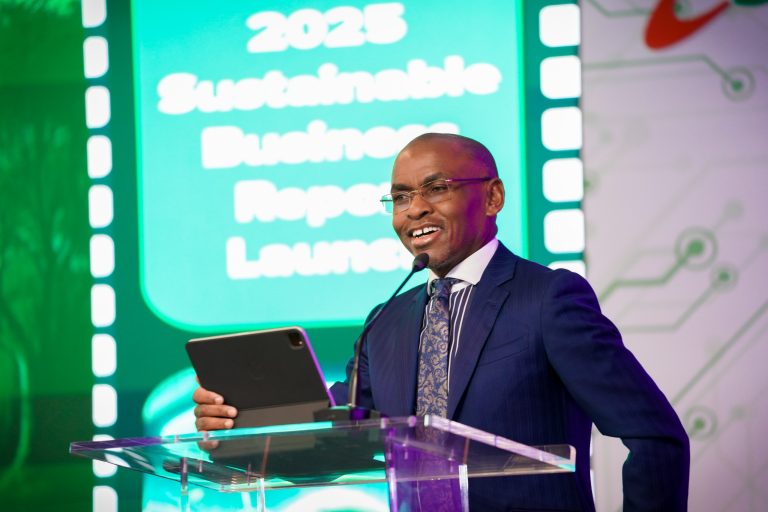
“The Connect Academy to us represents our commitment to building Kenya’s digital future by investing in technical future-ready skills in the people who make connectivity possible. Today, this graduating class is stepping into a digitally led future, and we are assured that the future is in good hands,” said Dr Peter Ndegwa, CEO of Safaricom Plc.

The inaugural cohort was selected from Safaricom’s technician base, referrals from the Connected Africa Summit and community applicants, reflecting the programme’s commitment to accessible opportunities and inclusive digital upskilling. During the rigorous three-month curriculum, the graduates have received technical training, mentorship from industry experts and exposure to real-world work environments.

Safaricom receives CMA approval for Sh40 billion corporate bond

The programme is already demonstrating strong employment outcomes from Safaricom and other partners with 98% already absorbed into the job market.

 “This partnership couldn’t have happened at a more opportune time. As a country, we have a national goal of strengthening the ICT workforce. By ensuring alignment of training with industry needs, the Connect Academy is helping to create a continuous pipeline of skilled technicians who will drive Kenya’s digital infrastructure expansion in the coming years,” said Zilpher Owiti, Ag. CEO ICT Authority Kenya.

As the Connect Academy implements its future programmes with Cohort 2 starting in January, Safaricom and the ICT Authority is committed to expanding opportunities for Kenya’s youth and refining the programme as needed to build a skilled workforce ready to drive the country’s national digital agenda forward

Who was she? Inside the career profile of Raila Odinga’s sister Beryl Achieng

0

The Odinga Family has once again been thrown into mourning following the death of Beryl Achieng, a sister to the late former Prime Minister Raila Odinga.

Beryl’s demise was confirmed by her sister Ruth Odinga, who disclosed that she died on Tuesday, November 25 at a Nairobi Hospital.

“It is with a heavy heart that we announce the sudden passing of Beryl Achieng Odinga. Daughter of the Late Jaramogi Odinga and Mama Mary Ajuma Oginga. Mother to Ami Auma, Chizi and Taurus,” Ruth announced.

“While we are deeply saddened by her demise and the immense void left in our lives, we take solace in the belief that she is safe in the Lord’s arms and are thankful for the invaluable gift of the time we were privileged to share,” she added

According to media sources, Beryl had been sick for a long time and had been in and out of the hospital including the Indian facility where former Prime Minister Raila Odinga had been admitted.

Despite growing up in a family with a strong political background, Beryl maintained a low profile, staying away from politics like her siblings.

She completed her Form Six (‘A’ Levels) studies in December 1972 and pursued dual careers as a teacher and lawyer.

During Oburu Oginga’s birthday celebration in October 2023, she revealed that she had been a classmate of former Wiper Party leader Kalonzo Musyoka and Kisumu Governor Anyang’ Nyong’o.

Beryl made history as the first Black Town Clerk of Mutare, the third-largest city in Zimbabwe. She also served as Company Secretary of the Housing Corporation of Zimbabwe.

She continued with her public service in Kenya and was in 2020 appointed Chairperson of the Nairobi Water and Sewerage Company (NWSC).

ALSO READ: Inside Odinga Family’s Sh120 billion estate in Kisumu with 1,400 houses

Urysia powers into Kenyan market with multi-brand era with Jeep and Citroën Debut

0

Urysia Limited today officially unveiled two well-known automotive brands, Jeep and Citroën, marking its transition into a full multi-brand dealership in Kenya. Previously recognized as home to Peugeot, the company will now host three international brands while providing complete after-sales support and genuine spare parts for Peugeot, Jeep, and Citroën.

This launch marks a significant change in Urysia’s strategy as it aims to meet Kenya’s fast-changing mobility needs. The expansion strengthens the company’s product range, customer support, and access to new automotive technologies.

This move connects to the global merger of PSA Groupe and FCA that formed Stellantis, one of the world’s leading automotive groups. Through Stellantis, Urysia gains wider access to top brands, innovative technologies, and different mobility solutions designed for the region.

At the event, Principal Secretary for Trade, Regina Ombam, praised Urysia for supporting Kenya’s industrialization goals and responding to the growing demand for variety, reliability, and quality service.

“Kenya’s automotive industry is changing, and the dealers who succeed will understand today’s consumer needs — choice, reliability, and service quality. Urysia’s transition to a multi-brand operation is a strong vote of confidence in our market,” she said.

SBM Bank announces auction of motor vehicles for as low as Sh280k

Under the new structure, Urysia will present a wider selection of passenger and commercial vehicles. This includes Jeep’s adventure-focused 4×4 models, Citroën’s efficiency-driven urban mobility options, and Peugeot’s versatile SUVs and sedans.

Each brand offers unique strengths in the Kenyan market:

– Jeep – known for lifestyle and adventure-oriented 4x4s
– Citroën – recognized for innovative, comfort-focused engineering
– Peugeot – the world’s oldest car brand, known for durability and modern performance

The expansion is backed by Urysia’s enhanced after-sales services, with fully equipped service centers in Nairobi, a network of partner workshops nationwide, mobile service units, and brand-neutral technical expertise to minimize customer wait times.

Urysia Managing Director Claude Mwende said the change reflects shifting consumer expectations.

“Customers today want more than just a car — they want convenience, reliability, and choice. By grouping Peugeot, Jeep, and Citroën under one roof, we are creating a dealership experience that is versatile, focused on the customer, and globally competitive,” he noted.

He added that Urysia will provide flexible financing options through partner financial institutions, customized leasing packages for corporations and NGOs, structured fleet support solutions, and concierge-style customer care that includes vehicle delivery and priority servicing.

With the rising demand for SUVs, pickups, and lifestyle vehicles, and growing interest in experience-led dealerships, Urysia aims to set a new standard in the market. The company will introduce vehicles with better performance, improved safety, increased efficiency, and lower emissions, while keeping prices affordable for a broad range of buyers.

The new strategy also prepares Urysia for Kenya’s gradual shift towards electrification, using Peugeot’s EV-ready platforms and the Stellantis global innovation pipeline.

The expanded showroom will showcase the latest models from all three brands, including the Jeep Grand Cherokee, Wrangler, and Gladiator, the Citroën C3, C3 Aircross, and C5 Aircross, along with Peugeot’s trusted lineup in Kenya.

The launch event was attended by representatives from the US and French embassies, industry stakeholders, financial partners, and corporate fleet buyers. Urysia confirmed that this multi-brand approach marks the start of a new long-term growth phase focused on innovation, improved customer experience, and market diversification.

Family Bank Q3 2025 net profit jumps 56 percent to Sh3.6 billion

0

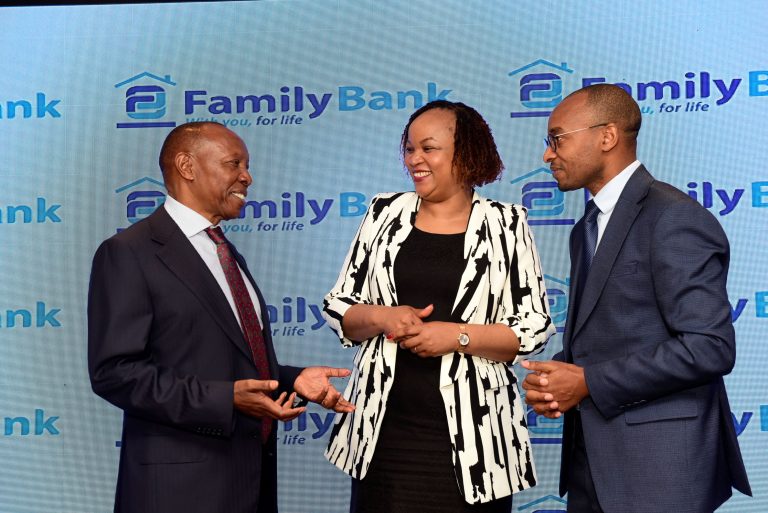
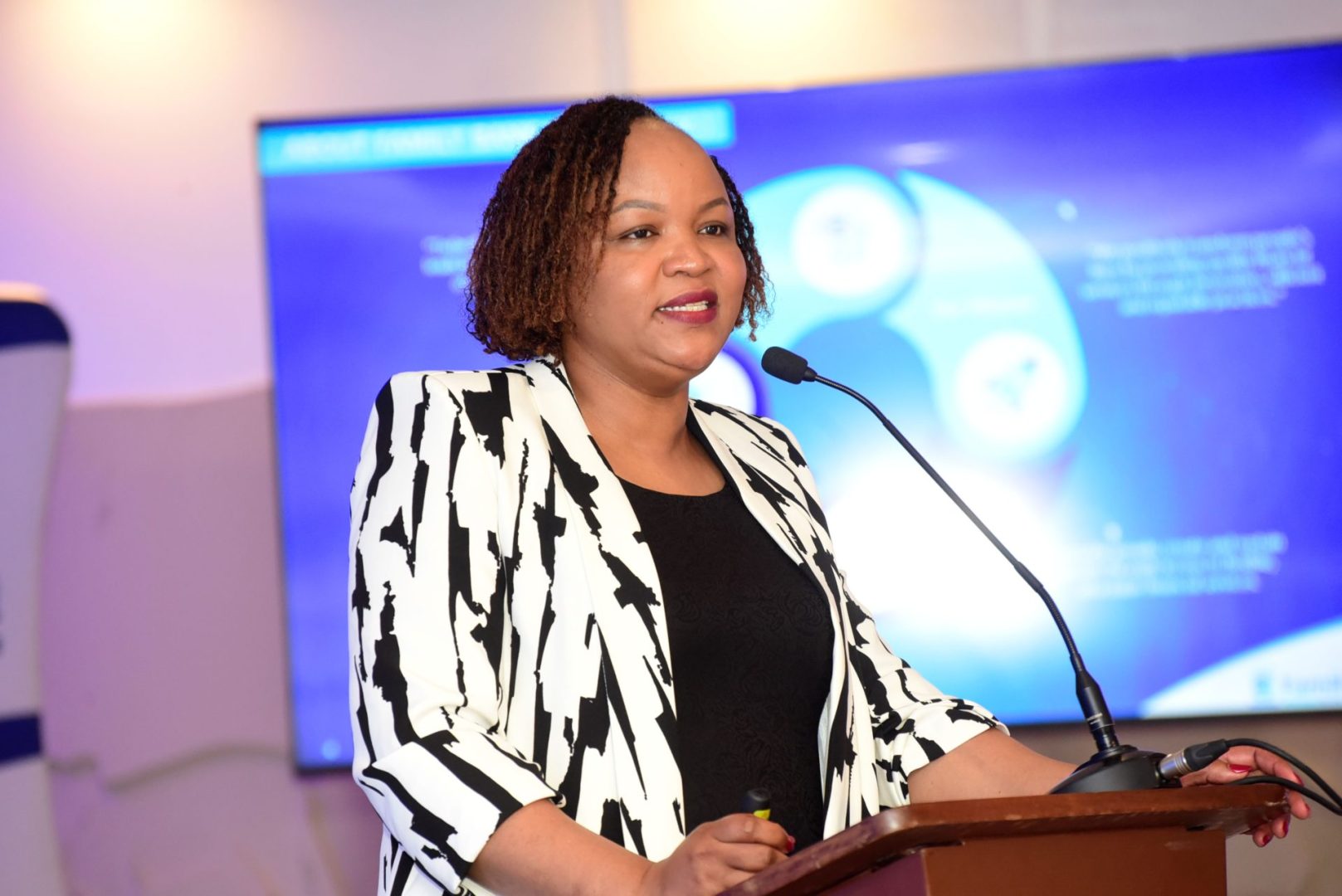
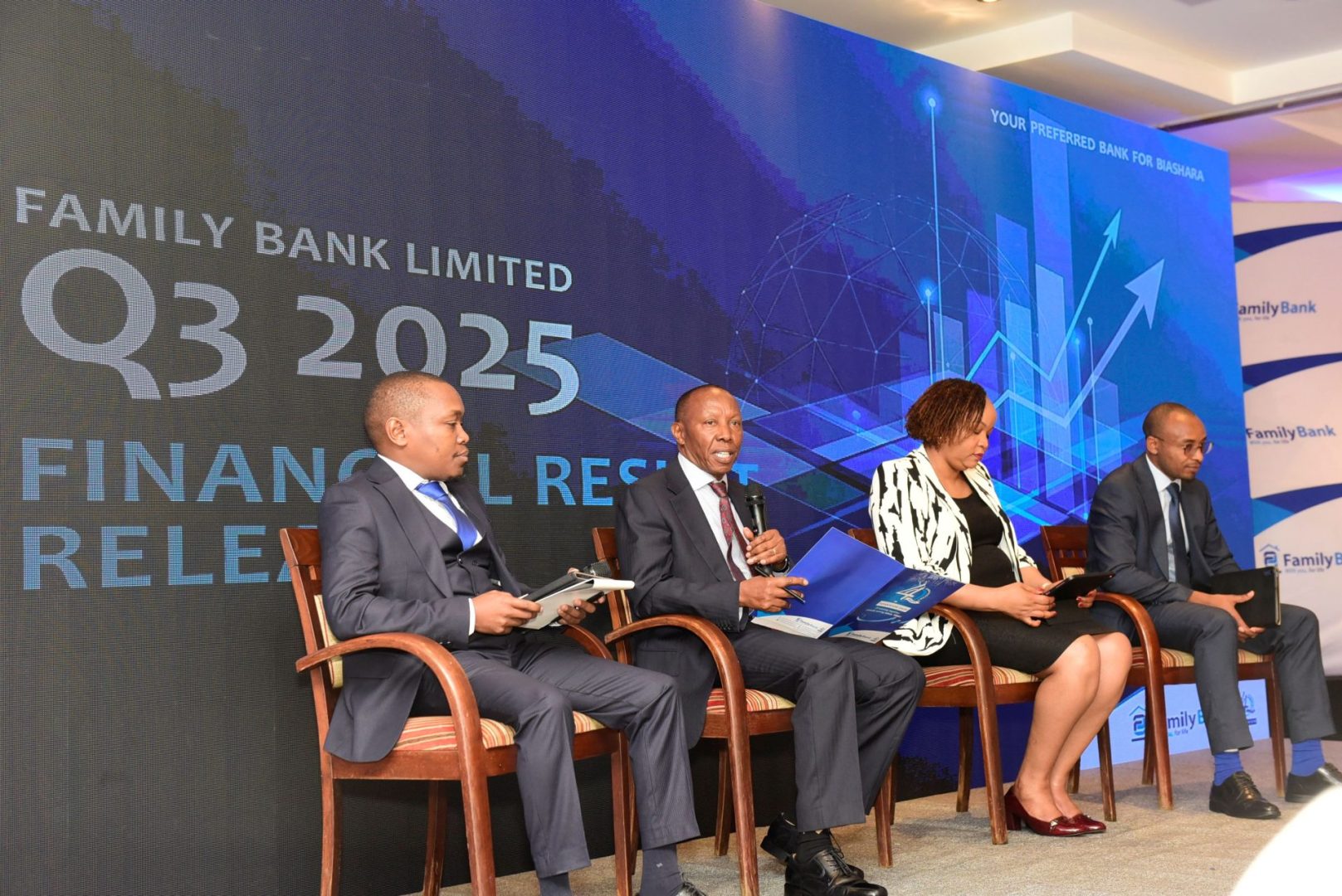
Family Bank has announced a net profit jump of 56 percent in the first nine months of the year. The Family Bank Q3 2025 net profit covering the period to September 30 came in at Sh3.59 billion.

In the same period the previous year, the lender had realized a net profit of Sh2.3 billion. The Sh3.59 billion net profit was derived from a profit before tax of Sh4.49 billion.

The bank’s assets increased by 24.1 percent in the period to stand at Sh202.6 billion while customer deposits went up by 15.3 percent to close the period at Sh146.8 billion. In the nine-month period for the 2024 financial year, Family Bank’s assets had stood at Sh163.2 billion while customer deposits had stood at Sh127.3 billion.

At the same time, net interest income stood at Sh10.9 billion. This represented a gain of 43 percent. Non-interest income came in at Sh3.8 billion which was equivalent to a growth of 14.4 percent.

Loans and advances to customers went up to Sh103.7 billion. This was a growth of 10.1 percent from the 94.21 billion that the lender had dispersed to customers in loans and advances in the same period the previous year.

Family, which became a fully-fledged commercial bank in May 2007, is currently preparing to list on the Nairobi Securities Exchange (NSE). This listing is expected to be by way of introduction.

This means that the lender will list its existing shares for trading on the local securities market without raising new capital as would happen with an Initial Public Offer (IPO). This listing is expected to happen in 2026.

In October 2025, Family received shareholder approval to list on the NSE during its Extraordinary General Meeting (EGM) event.

“We have taken time to prepare, to build value, and to ensure that when we list, it is from a position of strength. This listing is not just about prestige but about creating long-term value for our shareholders and positioning the Bank for sustainable growth,” Board Chairman Lazarus Muema said.

READ MORE: Family Bank ready for NSE listing after shareholders’ approval

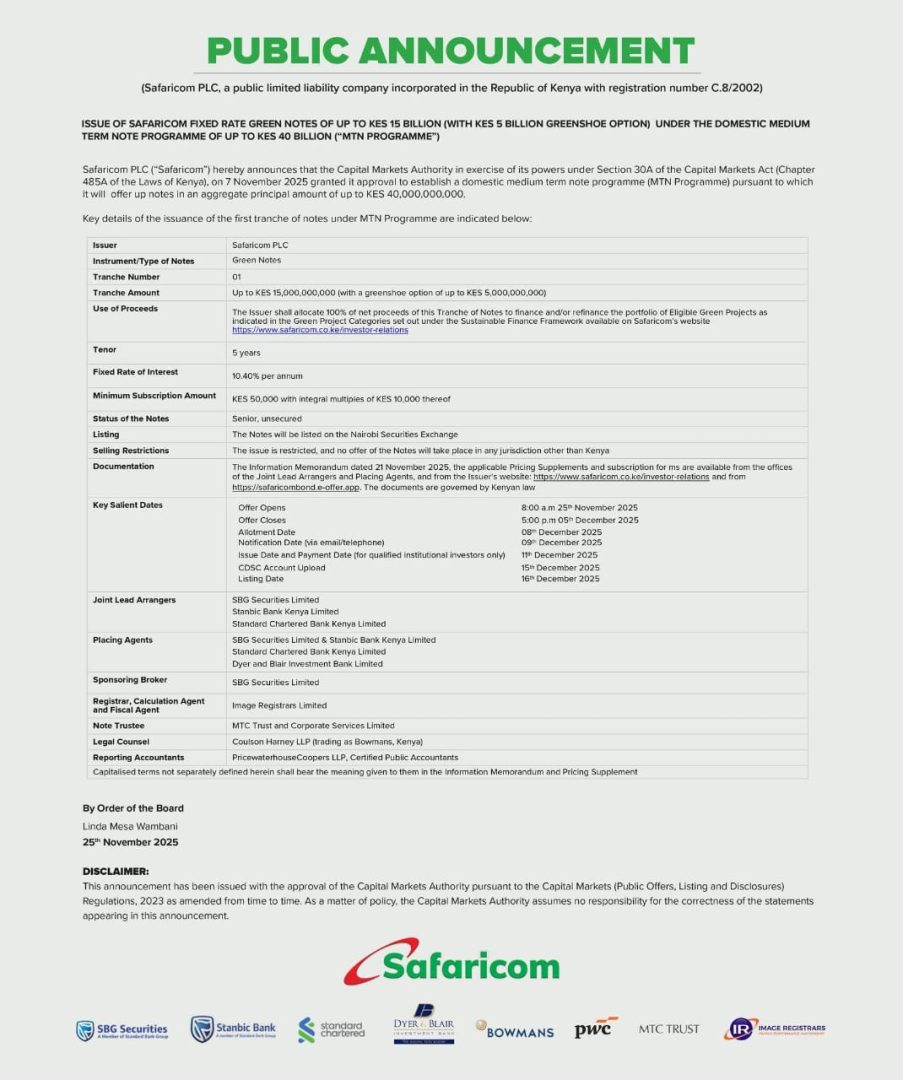
Safaricom invites Kenyans to invest in Sh15 billion bond with as low as 50k

0

Safaricom PLC has opened the first tranche of its Sh40 billion Medium Term Note programme, offering up to Sh15 billion in five-year green notes.

This is after the Capital Markets Authority (CMA) cleared the telco to issue the corporate bond in a fundraising initiative designed to be executed in various tranches over the medium term.

“Safaricom PLC hereby announces that the Capital Markets Authority in exercise of its powers under section 30A of the Capital Markets Act (Chapter 485A of the  Laws of Kenya), on 7 November 2025 granted it approval to establish a domestic medium term note programme (MTN Programme) pursuant to which it will offer up notes in aggregate principal amount of up to Sh40 billion,” the statement reads.

In the first tranche, Safaricom seeks to raise Sh15 billion in five-year green notes priced at a fixed 10.40 percent, with a greenshoe option of up to Sh5 billion.

The minimum subscription amount is Sh50,000 in multiples of Sh10,000. According to Safaricom, the notes are senior and unsecured and will be listed on the Nairobi Securities Exchange on 16th December 2025.

The offer opens on Tuesday 25 November at 8:00 am and will close on 5 December at 5:00 pm. Allotment results will be released on 8 December with notification to applicants set to follow on 9 December via email.

“This announcement has been issued with the approval of the Capital Markets Authority pursuant to the Capital Markets (Securities) (Public Offers, Listing and Disclosures) Regulations, 2023 as amended from time to time. As a matter of policy, the Capital Markets Authority assumes no responsibility for the correctness of the statements appearing in this announcement,” the telco stated.

The bond announcement bond comes shortly after the East African Breweries PLC (EABL) successfully concluded the first tranche of its new Sh20 billion Domestic Medium-Term Note Programme, signalling renewed momentum in Kenya’s corporate bond market.

EABL raised a total of Sh16.76 billion after the offer was significantly oversubscribed by 52.4 percent against an initial target of Sh11 billion, signaling high investor demand.

In response to the overwhelming investor interest, EABL exercised the green shoe option, a provision that allows issuers to accommodate additional demand, thereby accepting an extra Sh6 billion beyond the initial target.

The 5-year Notes will yield an attractive annual coupon rate of 11.80%, maturing on November 18, 2030.

ALSO READ: Standard Chartered Kenya posts resilient Q3 results despite one-off pension cost hit

Safaricom invites Kenyans to invest in Sh15 billion bond with as low as 50k

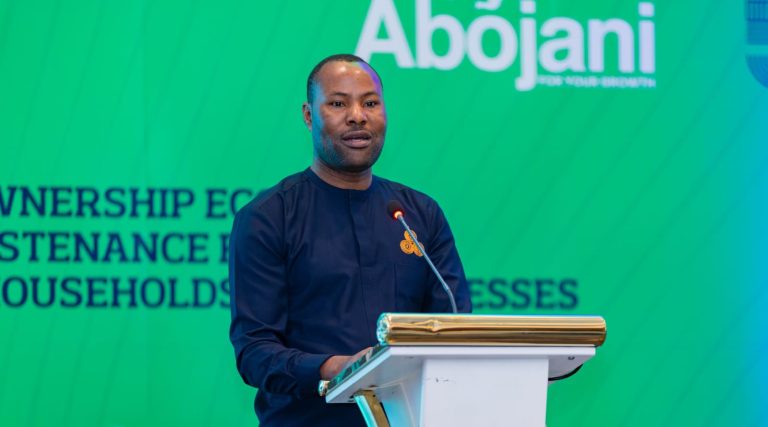
Abojani holds 5th Economic Empowerment Conference in Nairobi

Abojani Investment successfully hosted the 5th Abojani Economic Empowerment Conference bringing together influential leaders from Kenya and across the region to address the pillars of sustainable wealth creation, financial empowerment, and long-term economic resilience.

This year’s Economic Empowerment Conference highlighted the urgent need for credible information, pension awareness, and digital transformation as key drivers of financial prosperity.

The event featured keynote contributions from Robert Ochieng, the founder and chief executive officer of Abojani Investment, John Keah, Retirement Benefits Authority (RBA), Dr. Diane Karusisi, CEO of Bank of Kigali who was also the guest speaker, and Raphael Agung’ Group Director, Global Markets at NCBA Group among other speakers..

Speaking at the event, Ochieng emphasized the growing challenge of navigating financial decisions in an age flooded with data.

“In today’s digital era, there is overwhelming information overload. The real need is empowerment, having the right source of information to make informed decisions,” said Ochieng’

He further highlighted the connection between mindset, relationships, and financial outcomes as most businesses thrive courtesy of relationships built over time.

“Financial capital is a result of social capital, which is a result of mental capital. You have to be in the right mindset to make the right financial decisions.”

Ochieng further highlighted the need for investment for wealth sustenance in households through equity.

“The main key thing is on the equity side. If you can own stakes in companies whose products and services you consume, that can be a great thing because it means that as you spend you are also getting wealthier and that is what we want for African households,” he added.

“There can be a challenge on household income but what we start with is information. Once you have the right information then it means that as a household once you get a lump sum or sell a piece of land you are more likely to invest it than when you don’t have information.”

On her part, Dr. Karusisi, emphasized on the importance of financial institutions being  enablers of wealth creation for households.

“As banks and companies in the financial sector, our role is to enable the ownership economy and to support people to own assets. As banks we lend to people who want to buy homes, businesses that want to grow their capabilities,” Dr Karusisi said.

“Today in Africa, for you to list in the stock market you need to show sustainable growth in the past probably 5-10 years which is not the case for many businesses in Africa. So I think our regulators need to lower the barriers to entry to the capital markets and it is something we need to consider.”

During the Economic Empowerment Conference, NCBA Bank launched its offshore Investment Solutions. This is a new offering reinforces its long-term commitment to its clients by providing accessible, professionally-managed investments with access to global markets, currency diversification and sophisticated wealth-building opportunities.

“We’re utilizing our global presence, market knowledge and expertise to create a solid offshore investment setup. Our goal is to ensure it meets all regulatory standards in various markets and truly connects with our clients’ needs, helping them invest their capital safely while aiming for reliable returns,” said Kilonzo.

The Economic Empowerment Conference also featured insights from high-level business leaders including Muathi Kilonzo, the Managing Director at NCBA Investment Bank, Anthony Watare, the Head of Development at Centum Re, Steven Omamo, Head of Digital Banking at Absa Bank Kenya, Nicholas Ngumunu, the Portfolio Manager at CIC Asset Management among others.

The  speakers addressed the importance of cross-border market growth, regional capital flows, and innovation in financial services in shaping Africa’s economic future.

The Economic Empowerment Conference coincided with the Retirement Benefits Authority’s 25th anniversary, a milestone that was underscored by RBA’s John Keah.

“This year marks the 25th year since the RBA’s establishment, and we are pleased that this event aligns with our anniversary celebrations and in tune with the RBA role in empowering Kenyans on retirement planning,” said Keah.

He further emphasized the role of pensions in wealth creation and the importance of this year’s conference theme as pension is also a form of wealth creation for sunset days.

Keah also provided insights on the current state of pension uptake and the need for broader inclusion and need for amendment.

“Kenya’s pension status reflects progress, but we still have a long way to go in driving wider coverage and participation. Adequacy of pensions is a big issue. Currently the law allows one to access up to 50 percent of their benefits at any given time even if they do not need it upon leaving a pension scheme,” he said.

“What we are doing is to amend the amount they can access and we have a proposal at the moment for people to only access up to 30 percent of their benefits and not 50 percent”.

Robert Ochieng: Avoid penny wise and pound foolish trap if you want to grow wealth

Standard Chartered Kenya posts resilient Q3 results despite one-off pension cost hit

0

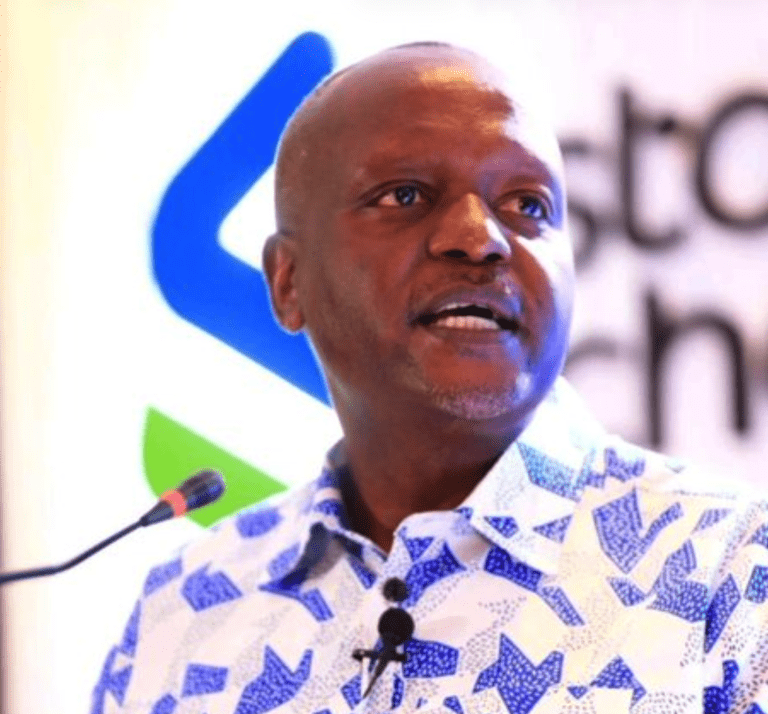
Standard Chartered Bank Kenya has released its financial results for the nine months ending 30 September 2025, delivering what it calls a “resilient performance” in a year marked by softer revenues and a significant one-off pension-related charge.

Group Managing Director and CEO, Kariuki Ngari, said the lender closed the third quarter with a profit before tax of KShs 13.2 billion, a 41% drop year-on-year, primarily driven by lower income and a KShs 2.7 billion past service cost following a Supreme Court ruling and Retirement Benefits Appeal Tribunal (RBAT) Orders.

Despite the hit, Ngari emphasised that the bank has “substantively discharged the Orders issued by the RBAT,” and continues to advance its cross-border, wealth-led strategy anchored on sustainability.

Strong wealth momentum despite revenue pressure

The bank’s Assets Under Management (AUM) climbed to KShs 290 billion, a notable 23% rise from December 2024—evidence of growing demand for wealth solutions even as traditional banking income softened.

A closer look at the numbers shows:

Operating income down 17%

  • Net interest income fell 10%, weighed down by lower loan volumes and margin compression amid declining interest rates.

  • Non-interest income dropped 29%, mainly due to weaker transaction volumes in Transaction Services and Markets, partially offset by gains in Wealth Solutions.

Operating Expenses Up 19%

  • Driven mainly by the KShs 2.7 billion one-off pension cost.

  • Underlying expenses rose only 1%, reflecting disciplined cost management while investing in digital growth.

Loan Impairments Improve

Impairment charges eased by 11%, supported by recoveries, prudent credit oversight, and stronger asset quality.

Standard Chartered group Q3 2024 results: Strong Financial growth and strategic focus

Balance Sheet Remains Solid and Highly Liquid

Despite revenue pressure, Standard Chartered maintained a fortress balance sheet:

  • Net loans to customers declined 3%, reflecting lower activity in transaction services, personal lending, and mortgages.

  • NPL ratio improved significantly, dropping 150 bps to 5.9%, indicating healthier asset quality.

  • Customer deposits slipped 4%, though the bank retains an enviably strong funding mix—97% of deposits are current and savings accounts (CASA).

  • Liquidity ratio stands at 66.6%, more than triple the regulatory minimum.

  • Total capital ratio at 20.6% remains well above statutory requirements.

Standard Chartered Kenya posts resilient Q3 results despite one-off pension cost hit

Understanding the RBAT orders and the Pension Fund ruling

Following a September 2025 Supreme Court decision, the RBAT ordered the bank to:

  1. Refund surplus withdrawn from the Standard Chartered Kenya Pension Fund in 2000, and

  2. Pay KShs 2.5 billion to 629 appellants.

To comply:

  • The bank increased employer contributions to the scheme by KShs 2.7 billion, bringing cumulative contributions to KShs 4.7 billion.

  • Under accounting rules (IAS 19), this contribution was recognised as a past service cost, hitting the income statement directly.

  • As of 21 November 2025, the Scheme has already paid KShs 1.9 billion to 499 appellants.

  • 30% of each payment has been withheld pending a High Court-directed determination on legal costs.

The verification process for the remaining appellants is ongoing, with the Scheme said to be well-funded to meet its obligations.

Economic outlook and CEO’s closing remarks

Ngari described Kenya’s macroeconomic environment as stable, supported by low inflation, easing interest rates, and a steady currency. But he warned of external pressures from global economic uncertainties.

Still, he struck an optimistic tone:

“We remain resolute in the strength of our strategy and the resilience of our people in supporting our clients navigate these challenging times.”

He also extended appreciation to the bank’s employees for their dedication.

Financial Snapshot (Jan–Sept 2025)

(KShs million)

Metric 30.9.2025 30.9.2024 Change
Net interest income 22,272 24,839 (10%)
Non-funded income 10,157 14,230 (29%)
Total operating income 32,429 39,069 (17%)
Operating expenses (17,481) (14,642) 19%
Loan impairment (1,744) (1,958) (11%)
Profit before tax 13,204 22,469 (41%)
Profit after tax 9,786 15,846 (38%)
EPS 25.57 41.60 (39%)

Balance Sheet

Metric 30.9.2025 31.12.2024 Change
Loans to customers 146,395 151,647 (3%)
Customer deposits 283,429 295,690 (4%)
Loans-to-deposits ratio 52% 51% —

Capital

Metric 30.9.2025 31.12.2024
Core capital 57,300 54,089
Core capital ratio 20.59% 19.48%
Total capital 57,442 54,269
Total capital ratio 20.64% 19.55%

Driver: Money President Ruto’s son makes from matatu business daily

0

The Nairobi’s Matatu industry is not only a vibrant culture in Kenya but also a powerful economic engine where a single vehicle can generate significant returns for investors.

While some operators consider the investment to be lucrative, profitability is impacted by various factors, including capacity, route, competition, and operating costs.

According to sources, 14-seaters earn investors up to Sh3,500 profit per day, while 33 seater vehicles can net up to Sh15,000 daily.

President Ruto’s son, George Ruto, is one of the investors making in the local public transportation industry. George has invested in luxury matatus locally known as Nganya, with his latest addition named ‘Mood’.

According to his driver Lenny who drives the Mood Matatu, the 25-seater makes about Sh20,000 profit on a normal day and up to Sh80,000 when hired.

“There are times when the vehicle makes Sh80,000 daily. It can be hired to go to Nakuru and other places. They pay me Sh100,000. I give the owner Sh80,000, and the rest is for the crew,” Lenny explained in an interview with Ghetto Radio.

He added that sometimes the matatu can be hired for up to four days to go to distant cities like Mombasa or Eldoret.

“It is hard to find the vehicle in Nairobi on weekends, and that translates into good money,” he said.

Mood, a Sh14 million ride boasts custom bucket seats fitted with cup holders and USB charging ports, full air conditioning, a push-to-start ignition system, solar power integration, and a professional DJ console mounted in the front.

The vehicle is the first matatu in Kenya to feature bucket seats in a 25-seater capacity layout, which reduces the typical 32-seater configuration for added luxury and space.

The matatu’s distinctive design and tech features were reportedly approved by the National Transport and Safety Authority (NTSA).

Mood is the latest addition to George Ruto’s growing fleet, which includes Manifest another premium matatu known for its entertainment-themed design.

ALSO READ: New York Times: How Ruto’s family, allies make profits from sending Kenyans to Saudi

TSC announces mass recruitment of teachers; how to apply

0

The Teachers Service Commission (TSC) has announced a massive recruitment of primary school, junior secondary and secondary school teachers.

In a notice issued on Tuesday, November 25, TSC invited applications for the over 9,000 vacancies left by teachers who exited the service through natural attrition.

The commission said it is seeking to recruit 7,065 primary school teachers, 12 junior school teachers, and 2,082 secondary school teachers on a permanent and pensionable employment terms.

To qualify for the recruitment, an applicant must be a Kenyan Citizen and duly registered by TSC. Additionally, teachers applying for the primary school posts must hold a P1 certificate while Junior Schools and Secondary Schools applicants must hold at least a Diploma in Education.

No diploma, degree certificates for P1 teachers in TSC upgrading program

How to Apply

Interested candidates were urged to send their application online through the TSC’s website, tsc.go.ke under ‘Careers’ or teachersonline.tsc.go.ke not later than December 8, 2025.

TSC warned applicants against multiple applications, stating that it will lead to automatic disqualification.

“Manual applications will not be considered. Preference will be given to applicants who have not previously been employed by the Teachers Service Commission,” TSC announced.

TSC stated that the recruitment exercise is free of charge, further warning applicants against fraudsters who might extort money from them.

Shortlisted candidates will be required to present original academic and professional certificates, including the Kenya Certificate of Primary and Secondary Education.

TSC said successful applicants will be deployed to serve in any part of the country and not necessarily in the county or school where they were interviewed.