Home Blog Page 90

Co-op Bank full year 2025 net profit rises to Sh30bn; to pay Sh1.50 final dividend

0

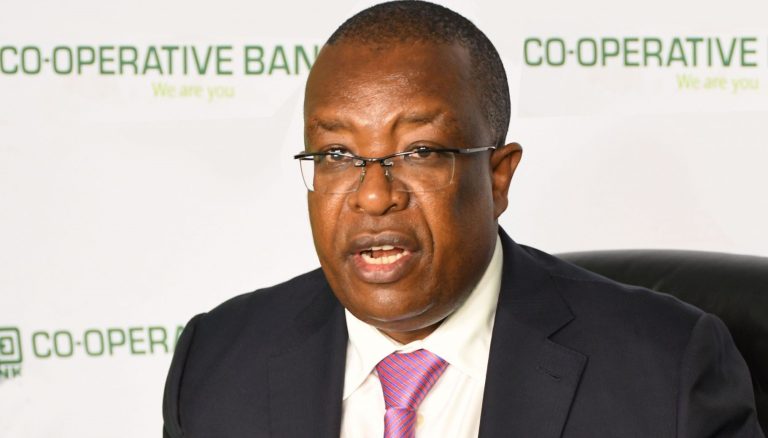
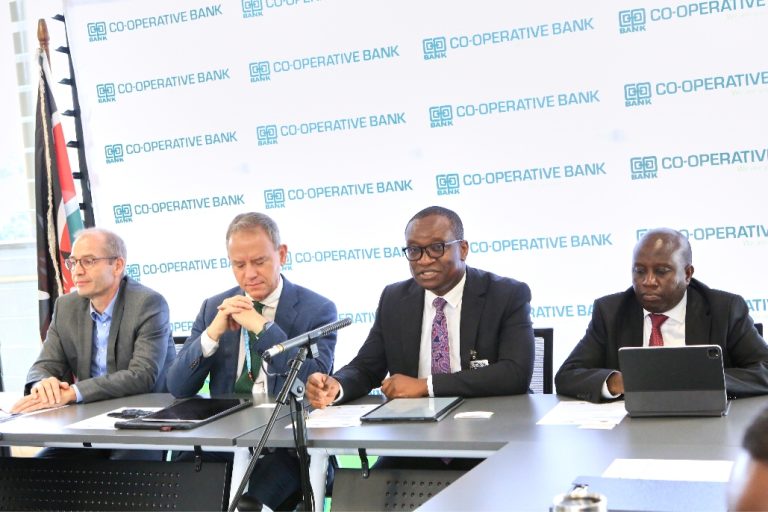
The Co-operative Bank of Kenya has announced a 16.9 growth in full net year profit. This has seen the Co-op Bank full year 2025 net profit rise to Sh29.75 billion from the previous year’s Sh25.46 billion.

During the year under review, the bank’s total assets increased by 11.32 percent to Sh827.4 billion from the previous year’s Sh743.3 billion as the bank eyes for the Sh1 trillion asset base milestone.

Customer deposits in the period increased by 13.28 percent to Sh576.5 billion while loans and advances grew by 12.65 percent to Sh421 billion.

At the same time, shareholder funds increased by 13.82 percent to Sh165.5 billion. This was supported by a strong Sh15.1 billion increase in retained earnings.

Net interest income grew by 21.99 percent to Sh62.85 billion while operating income increased 13.93 percent to Sh91.89 billion.

“This is the best-ever performance by the bank. It underscores the significant gains made under the 2025-2029 Good to Great Strategy and the Soaring Eagle Transformative Agenda,” said Co-op Bank Managing Director and Chief Executive Officer Dr. Gideon Muriuki.

According to Dr. Muriuki, the bank will continue to focus on digital transformation, financing for micro small and medium enterprises, and sustainable banking as part of its long-term strategy.

The bank further announced that through its digitization strategy, over 90 percent of all customer transactions are currently being processed through alternative delivery channels.

“Our omni-channel platform across mobile, internet and USSD continues to support seamless and efficient service delivery, complemented by an extensive distribution infrastructure comprising of over 60,000 Co-op Kwa Jirani agents, 620 ATMS, and Cash Deposit Machines, ad a 24-hour contact centre,” said Dr. Muriuki.

Parallel to digital banking, the bank has maintained a network of 222 branches. This comprises of 189 Co-op Bank Kenya branches, 6 branches in South Sudan, and 27 branches under Kingdom Bank which is a subsidiary of the banking group. In the year under review, the bank opened up to 12 new branches in its expansion drive.

During the year under review, the bank extended its support for small businesses by onboarding over 259,000 micro small businesses onto MSMEs packages specifically designed to support small businesses.

At the same time, over 71,000 small businesses were supported in the year under review through capacity-building and training initiatives.

“MSMEs remained a key segment for the Group, accounting for 16.8 percent of the bank’s loan book and 23.4 percent of customer deposits. This reflected strong engagement across both lending and transactional relationships,” said Dr. Muriuki.

Following this performance, the banking group has announced that it shall be paying shareholders a final dividend of Sh1.50 per share. This dividend pay will the total dividend payout for the full year 2025 to Sh2.50 per share. Earlier in the year, the bank had paid out an interim dividend of Sh1 per share.

The total of Sh2.50 per share now represents a total growth of 67 percent in dividend pay from the Sh1.50 per share that was paid out in the full year 2024.

See More: Co-op Bank starts rolling out matatus financed at Sh703 million

At the same time, the proposed dividend will amount to a total pay of Sh14.67 billion, out of which the 15-million member cooperative movement is expected to receive an estimated Sh9.47 billion.

Marketable courses to take with a KCSE mean grade of D+ and below

0

For thousands of students who receive a KCSE grade of D+ and below each year, the release of exam results often brings uncertainty about the future.

However, the narrative that such grades limit success is increasingly outdated, as Technical and Vocational Education and Training (TVET) institutions continue to offer practical, market-driven courses that open doors to employment and entrepreneurship.

From construction to digital services, these courses focus less on academic grades and more on competency and skill mastery.

Among the most marketable options are courses in plumbing, electrical installation, and welding. With the construction sector steadily expanding, skilled artisans remain in high demand for both formal employment and independent contracts.

Motor vehicle mechanics

Motor vehicle mechanics and motorcycle repair have gained popularity, particularly in urban and peri-urban areas where the transport sector continues to grow. Graduates in these fields often establish garages or secure employment in service centres.

Hairdressing and beauty

Even though highly competitive, hairdressing and beauty therapy offer strong income potential, especially among youth interested in the personal care industry.

One just needs to be unique, consistent and adaptable, to survive competition. For someone intending to venture into self-employment, no high startup capital is needed to establish a beauty studio. Owners often start small and expand with time.

Alternatively, graduates can offer home services to their customers while marketing their work on social media platforms to attract new customers.

Hospitality

The hospitality sector presents another promising avenue. Courses in food production, catering, and housekeeping equip learners with skills needed in hotels, restaurants, and catering businesses. With Kenya’s tourism sector showing signs of recovery, trained personnel remain essential.

Tailoring and fashion design

In the creative space, tailoring and fashion design have become increasingly lucrative, driven by a growing appreciation for local designs and custom-made clothing. Skilled tailors are finding opportunities not only in local markets but also through online platforms.

One can either choose to start a tailoring business or look for a job in a fashion house.

Plumbing

Plumbing offers hands-on training in water systems installation and maintenance. With the construction sector growing rapidly, it means demand for plumbers will remain high both in urban and rural areas.

Also Read: Full list of approved degree courses and minimum subject requirements

Growth of M-Pesa and how it has opened financial horizons for small businesses

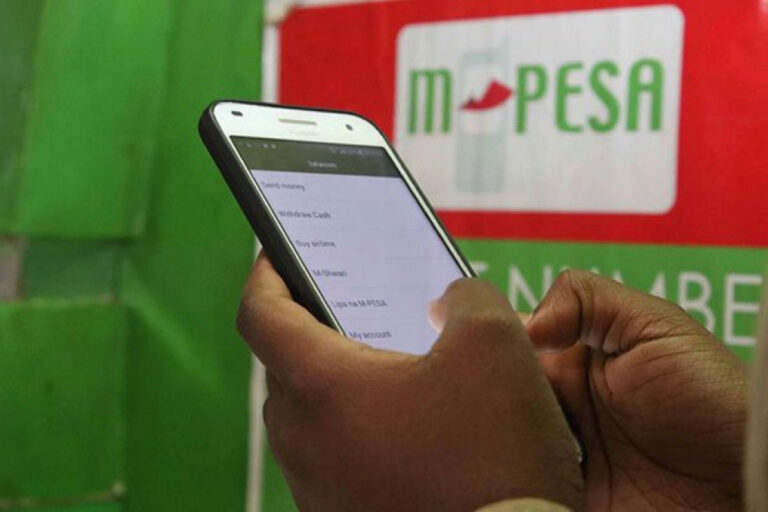
In Kenya, M-Pesa is a household name known not just by the banked and literate population but by almost everyone including the unbanked, young, and illiterate population.

Since its launch in 2007, M-Pesa has evolved from a simple money transfer service to a financial lifeline powering commerce, enabling entrepreneurship, and redefining how small businesses operate across the country.

From humble beginnings as a peer-to-peer transfer platform, M-Pesa has expanded into a robust financial ecosystem offering services such as merchant payments, savings, credit facilities, and international remittances.

Some of its financial solutions include M-Shwari, KCB M-Pesa lending service, Fuliza Overdraft facility, Ziidi Money Market Fund (MMF), and Ziidi Trader investment platform, among others.

The platform currently serves 40 million active users in Kenya and 60 million global customers, who rely on its services daily.

For small businesses, the transformation has been particularly profound. Traders who once operated on a strictly cash basis now have access to a secure, efficient, and widely accepted digital payment system through Lipa na M-PESA, and Pochi la Biashara services.

Safaricom data shows that as of 2025, Lipa na M-PESA had over 700,000 active merchant tills, with almost 1 million users conducting daily payments, while Pochi la Biashara wallet had 1.5 million small business users.

The figures underscore the rising demand for more secure, efficient, transparent and reliable financial services.

For Mary Wanjiku, a second-hand clothes vendor in Nairobi’s Gikomba Market, M-Pesa has not only reduced the risks associated with handling physical cash but also improved record-keeping and financial transparency.

“Before M-Pesa, I had to close my shop early to deposit money at the bank or risk theft. Now, most of my customers pay through their phones. It is safer, and I can track my sales easily,” she told Bizna Kenya Team.

Beyond payments, M-Pesa has also unlocked access to financial services that were previously out of reach for many entrepreneurs. Through integrations with banking and fintech products, users can save, borrow, and manage their finances directly from their mobile devices.

This has been instrumental in fostering business growth, particularly for informal traders who often lack collateral or formal credit histories.

James Otieno, a fish vendor in Nairobi’s Marikiti market, credits M-Pesa with helping him expand his business.

“I no longer have financial problems when running my business because I have so many loan options on M-Pesa. I can borrow on M-Shwari, KCB M-Pesa, or Fuliza; we also have the Taasi Pochi loan meant for pochi la biashara users,” Otieno remarked.

“Safaricom has really helped us small business owners because we are able to restock faster and serve customers without disruptions. The ability to separate business and personal finances has also been transformative,” he added.

The introduction of savings and investment products on M-Pesa has significantly deepened financial inclusion. Services such as M-Shwari and KCB M-Pesa have given small business owners access to formal financial tools without the need to visit a bank.

M-Shwari allows users to save money and earn interest while also providing access to microloans based on transaction history. KCB M-Pesa similarly offers savings accounts and credit facilities, enabling entrepreneurs to grow their working capital.

For many small traders, these products have bridged a long-standing gap in access to affordable financial services.

“I started saving small amounts daily on M-Shwari from my sales. After a few months, I was able to access a loan that helped me restock. I always ensure I repay on time to avoid penalties,” Otieno added.

The ripple effects extend beyond individual enterprises. By digitising transactions, M-Pesa has contributed to greater financial inclusion, bringing millions into the formal financial system.

Also Read: Safaricom reveals when phone number masking on M-Pesa transactions will take effect

Mombasa County government announces 40 job vacancies, internship opportunities

0

The county government of Mombasa has announced 40 job vacancies for professionals across various fields.

In a notice Mombasa County Public Service Board invited interested and qualified candidates to submit applications.

According to the notice, the county is seeking to recruit individuals to fill 34 vacancies at the Coast General Teaching and Referral Hospital.

The open positions at the facility are Chief Executive Officer, Director Human Resource Management, Deputy Chief Security Officer, Senior Accountant, and Senior Support Staff (30).

The county is also seeking to recruit 6 Emergency Medical Technicians to serve at the Health Services department.

Mombasa County Government Announces Internship Opportunities

Mombasa County has also announced six-month internship opportunities for diploma and degree holders in the construction and engineering fields to support its Transport, Infrastructure& Governance department.

The county is seeking to recruit 10 civil engineer interns, 10 architect interns, 6 Electrical Engineers interns, Quantity Surveyor interns (7), 5 construction management interns, and 5 mechanical engineer interns.

How to apply

Interested and qualified candidates are urged to submit their applications via the Public Service Board website at recruitment.mcpsb.go.ke by April 1, 2026.

Application letters must be accompanied by supporting documents including CV, copies of relevant and professional certificates and transcripts and identity card or passport.

Mombasa County assured that the recruitment process will adhere to principles of equity and fairness, ensuring gender, ethnicity, disability, and regional balance considerations are applied.

The county has also warned that any form of canvassing, direct or indirect, will lead to automatic disqualification.

“Please be informed that Mombasa County Public Service Board DOES NOT USE AGENTS nor CHARGE ANY FEE for its services,” the notice adds.

Only shortlisted candidates will be contacted. For more details on job descriptions, applicants are encouraged to visit the county’s official website.

Also Read: Kenyatta University announces job vacancies for lecturers: How to apply

I earn Sh13,000; how do I raise Sh250,000 for poultry, dairy farming business?

0

The Question: I am 33. I am single and don’t have children. I am a nursery school teacher upcountry. I earn Sh13,000 per month. I pay house rent Sh3,000, water and power Sh500, and food and groceries Sh6,000. I am in a merry-go-round where we contribute Sh1,000 per month and give to one member at a time. We are 30 members and I am number 18 in the list.

We have so far given money to 13 members. I also spend Sh1,000 to Sh1,500 at the salon and sends my mom Sh500 every month. I use the remainder on church contributions. I would like to start poultry and dairy farming. My aim is to start selling eggs to local shops to bring my food budget down and then start selling milk to the local dairy factory. My estimates show that I need at least Sh250,000 for this project.

If I want to start this project this year, what should I do to raise this money? What pitfalls should I avoid? Is this a viable project or am I going to lose money? Is the option of loan viable?

The solution as answered by Chacha Nyaigoti Bichang’a, a financial coach at Chachanomics Consulting Firm and the author of Mastering Your Money: your total household expenditure is Sh12,250. You are left with a small remaining balance of Sh750 which is not accounted for. You currently do not have a strong financial position to support the strategy of raising Sh250,000 loan as soon as possible.

To achieve your financial goal, review your expenditure, use merry-go-round to raise initial capital, start a chicken business in phases and grow it gradually, explore loan options and additional income, assess the business viability and address the pitfalls.

1). Review your expenditure

Your biggest expenses and rent and foodstuffs. You spend Sh3,000 for rent which consumes 23 percent of your income against the recommended average of 15 percent (translating to Sh2,000). Relocate to a cheaper single room and save Sh1,000. Food and grocery consume Sh6,000 (46 percent) instead of the recommended average of 20 percent (Sh2,600). Do bulky shopping.

At your rural home, you can get groceries cheaply. Reduce this expense to around Sh3,000 and set aside Sh3,000. Once you readjust your expenditure on the above two items, you will be able to remain with a disposable amount of Sh4,000 that can be channelled to a savings’ kitty in a village women Chama or Sacco.

2). Use the merry-go-round payout to raise initial capital for your poultry business

Wait patiently for your turn because you are number 18 out of 30 members. This implies that 13 members have benefited and you are five months away from receiving the payout.

3). Grow your poultry business gradually or in phases

You cannot start both poultry and dairy farming together but start with the least capital-intensive business in a phased framework.

Phase one: Start with poultry business using the merry-go-round payout of Sh30,000 to start as illustrated by the breakdown below. One, put up a simple chicken structure of around Sh10,000. Two, buy 50 layers of improved Kienyeji at around Sh150 totalling to Sh7,500. Three, buy feeds of about Sh5,000.

Buy vaccination drugs of about Sh3,000 and miscellaneous of about Sh4,500. In a period of six months, the 50 layers will produce 30 to 40 eggs per day to sell to local shops at Sh15 each amounting to Sh450 to Sh600 per day and Sh13,500 to Sh18,000 monthly. After deducting feed costs, you can earn Sh5,000 to Sh7,000 profit per month. This will reduce your food costs and build your capital for expanding the chicken business.

Phase two: This would involve expanding the poultry business before starting dairy farming. Once it stabilizes, expand to 150 to 200 birds. The profit realized could reach Sh15,000 per month. Upscale your saving habits to a bigger amount.

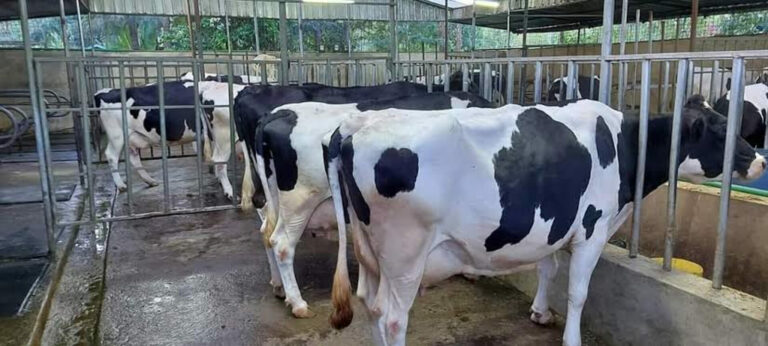
Phase three: This is where you start the dairy farming business. A good dairy cow costs Sh120,000 to Sh180,000. If you consider the cost of putting up a shed, buying nappier grass, veterinary care among others, these would stretch the cost you Sh150,000 to Sh200,000 per month.

The income from selling milk, for example, is approximately 10 litres per day at Sh45 totalling to Sh450 per day and Sh13,500 monthly. Remember, the expenses for feeds, veterinary and labour can chip away your net profit to around Sh6,000 to Sh8,000.

4). Explore loan options and additional income

Going for a big loan of Sh250,000 is untenable. Consider taking a smaller loan of Sh50,000 to Sh100,000 from a Sacco, bank or Chama but ensure the repayments fit your budget. Alternatively, you can work with the merry-go-round payout, build your chicken business slowly, saving consistently for two to three years before taking any loan. This strategy will build your financial discipline and saving habits.

You can conquer getting an interest free loan from relatives, family members or friends. Explore additional avenues of increasing your income. Consider selling items online such as second-hand clothes, take up extra teaching hours in the evening or weekends including holidays. Consider your skill set, passion and available opportunities within your locality.

5). Assess your business viability

Poultry and dairy farming businesses are two of the most profitable rural small and medium enterprises in Kenya. Their success depends on factors such as starting small, controlling diseases, managing feeding costs and growing the business gradually. Research on market prices, costs and competition as you upscale.

6). Address pitfalls

There are a number of challenges or pitfalls you have to closely look at. One, taming the desire to start big because many people lose money by starting with as many as 100 chickens or more than three good grade cows. Start small and learn the ropes. Two, poor disease control. Ensure you have vaccinated your chicken and keep the kitchen structure clean to prevent poultry diseases that can wipe away your birds in a few days.

READ MORE: I started poultry farming with Sh50,000, I now make over Sh1 million profit after six weeks

Buy chicks from reliable hatcheries. Three, reduce the cost of production by utilizing kitchen leftovers, greens from the farm, maize germ, and sunflower cake. Four, not doing market planning or research. Before expanding your poultry or dairy business, do market research and identify shops that will buy eggs or milk, neighbours and the local market.

Above all, patiently build your poultry and dairy business from scratch. First, start with 50 chicks then grow to 200 chickens and use the proceeds to start a dairy business much later after two to three years. A simple poultry business can grow to Sh50,000 in monthly income.

Learn about prudent personal financial management skills such as budgeting, tracking your money as well as businesses money, separate business money from your money, pay your worker and yourself a salary directly proportional to the rate of business growth.

A version of this question and answer was previously published in the newspaper magazine, Saturday Magazine. The Saturday Magazine is a pullout in the Saturday Nation, a publication of the Nation Media Group.


Shujaa, lionesses eye promotion as SVNS 2 heads to Uruguay and Brazil

0

Kenya’s Lionesses and Shujaa are gearing up for a strong showcase in the second and third rounds of the HSBC SVNS 2, as they aim to secure promotion to the top-tier HSBC SVNS 1 next season.

The Montevideo tournament in Uruguay takes place on March 21–22, followed by São Paulo, Brazil on March 28–29. Both events mark crucial opportunities for the teams to build on their performances from the opening leg in Nairobi.

The Lionesses announced a 13-player squad featuring Faith Livoi and Christabel Lindo, who missed the Nairobi leg, alongside captain Sheila Chajira, Naomi Amuguni, Charity Nillah, Stellah Wafula, Edith Nariaka, Judith Auma, Sinaida Mokaya, Moreen Muritu, Janet Okello, Freshia Oduor, and Marvel Oswago.

“We are grateful for our fans’ incredible support in Nairobi. Our focus now shifts to Uruguay and Brazil, where we aim to win our matches and secure qualification for Division One. We also thank Safaricom, through M-PESA, for their continued support in elevating our game both on and off the pitch,” said captain Sheila Chajira.

Shujaa named a 14-man squad including regulars George Ooro, Samuel Asati, Vincent Onyala, Kevin Wekesa, Nygel Amaitsa, Dennis Abukuse, John Okoth, Kevin Wambua, and Patrick Odongo. Brian Tanga returns after a long injury layoff, while Gabriel Ayimba earns his first call-up to the national sevens side. Other squad members are Chrisant Ojwang, Festus Shiasi, Floyd Wabwire, and David Nyangige.

Safaricom announces sponsorship deal for Kenya’s national rugby teams

The opening leg at Nyayo National Stadium saw Shujaa finish third behind the United States and Germany, while the Lionesses placed fifth.

“Shujaa and the Kenya Lionesses have once again shown the grit, discipline, and fighting spirit that define Kenyan rugby. With M-PESA supporting the teams through our partnership with the Kenya Rugby Union, the players can focus fully on their game. I wish them the very best as they head to Uruguay and Brazil for the next rounds of the HSBC SVNS 2, where they will showcase the skill and determination that have made Kenya a force on the global rugby stage”. said Safaricom CEO, Peter Ndegwa.

Under a two-year partnership with the Kenya Rugby Union, M-PESA supports both teams with monthly allowances, comprehensive medical insurance, airtime, and financial literacy programs ensuring players can focus on rugby while enjoying reliable financial backing.

The HSBC SVNS 2 is part of the global HSBC SVNS series, bringing fast-paced, high-intensity rugby sevens action to the international stage.


Safaricom reveals when phone number masking on M-Pesa transactions will take effect

0

Safaricom has announced a new feature on its mobile money wallet M-Pesa that will see phone numbers on M-Pesa transactions masked to enhance customer privacy.

Speaking during a media briefing on Wednesday, March 18, Safaricom CEO Peter Ndegwa said the feature is set for rollout on March 24, 2026.

According to Mr. Ndegwa, customers’ full phone numbers will no longer be visible on M-Pesa transaction notifications; instead, they will be shown in a masked format, for example, 0723***000.

“To enhance customer privacy, M-PESA Send Money notifications will now display a partially masked phone number instead of the full number,” he stated.

Additionally, the feature will ensure that only two names of the sender are displayed for identification.

Customers will have the option to request to verify the sender’s identity by sending the transaction message to 334 before the lapse of 24 hours after the transaction is made.

Once an identification request is made, the sender will receive an SMS asking them to share their full name and mobile number. They will have the option to accept or decline the request.

The update aims to minimize exposure of customers’ personal data in transactions, including Till, PayBill, and person-to-person money transfer services.

Safaricom stated that data privacy remains a major concern in the rapidly expanding digital ecosystem.

With about 37 million daily person-to-person transactions and 14.1 million daily active person-to-person customers, the telco underscored the need for responsible handling of customer data.

“As digital transactions grow, protecting customer information is more important than ever. Data minimization ensures that only the necessary information is shared or displayed, reducing exposure to misuse while maintaining a seamless customer experience,” Safaricom stated.

Over the past five years, the telco has been keen on data minimization on some of its key products, including Pochi La Biashara and Lipa na M-Pesa services.

In 2020, Safaricom reduced the customer information that merchants could view, while in 2021 it minimized the customer information that the front staff and support staff could access.

The journey continued in 2022 when the telco started masking phone numbers on M-Pesa statements, reducing exposure of personal details across customer touchpoints.

In 2023/24, Safaricom implemented API-level data minimisation, ensuring partners only receive the minimum data required to complete a service

Also Read: Equity Group full year 2025 net profit jumps 55 percent to Sh75.5 billion

Equity Group full year 2025 net profit jumps 55 percent to Sh75.5 billion

0

Equity Group full year 2025 net profit has risen to a record Sh75.5 billion. This net profit represented a 54.7 percent growth in profit. It was derived from a full year profit before tax of Sh90.8 billion which was a growth of 51.6 percent. In the previous full year 2024, Equity Group had recorded a full year net profit of Sh48.8 billion.

During the 2025 financial year under review, Equity Group’s total assets increased by 9.2 percent to Sh1.97 trillion from the previous year’s total of Sh1.8 trillion.

Customer deposits grew by 4.2 percent to Sh1.46 trillion from the previous Sh1.4 trillion while loans to customers increased by 7.7 percent to Sh882.5 billion. In full year 2024, total disbursed loans had stood at Sh819.2 billion.

Net interest income increased by 17 percent to Sh126.9 billion while non-funded income increased by 7 percent to Sh90.8 billion. Total income came in at Sh217.7 billion which represented an increase of 12 percent from the Sh193.8 billion that was recorded in the previous full year 2024.

The group’s regional operations accounted for about half of the total profitability that was recorded in the year under review. Equity BCDC grew its profitability by 58 percent while the group’s subsidiary in Uganda increased its profitability by 500 percent. In Tanzania, profitability growth was recorded at 125 percent.

Overall, the group’s subsidiaries accounted for 51 percent of the total banking profit before tax and 48 percent of the banking profit after tax.

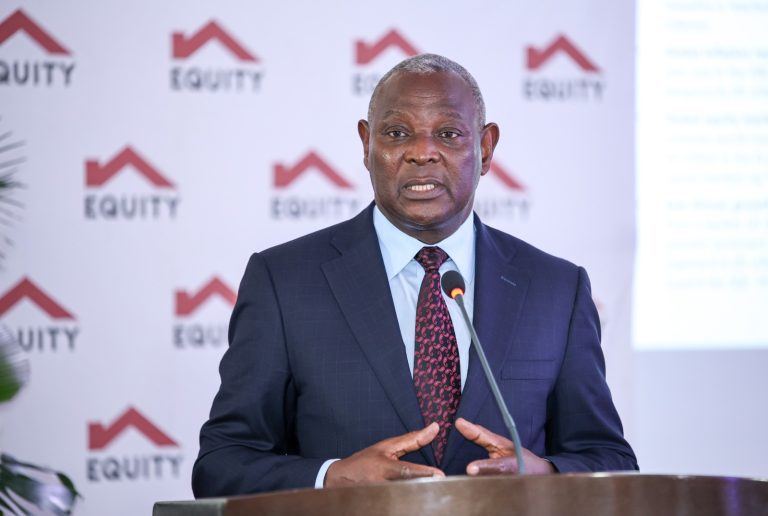
Equity Group managing director and chief executive officer Dr James Mwangi noted that the full year 2025 performance demonstrated the strength of the Group’s strategic transformation, driven by diversified revenue streams, improved efficiency and growing contributions from regional subsidiaries.

“The 2025 performance reflects the success of our deliberate transformation into a diversified regional financial services group,” said Dr. Mwangi.

“We delivered strong profit growth by expanding and deepening our income streams, improving efficiency across the franchise, and strengthening the quality of our balance sheet.”

The group’s digital transformation continued to increase in the year, with 88 percent of all customer transactions being conducted digitally. When merchants and agents were included, 98.2 percent of transactions took place outside physical branches.

“This means that our branch network handles just 1.8 percent of total transactions, which is a clear demonstration of the depth of our digitization and the operational efficiencies it enables,” said Dr. Mwangi

“This level of adoption is central to strengthening our cost to income ratio and driving a more efficient, scalable business model.”

See More: Equity Group Q3 2025 net profit jumps 32 percent to Sh54.1 billion

Following this performance, Equity Group has proposed to pay a full year 2025 dividend of Sh5.75 per share. This is equivalent to a growth of 35 percent and a payout ratio of 30 percent. In total, Equity Group shareholders will receive Sh21.7 billion in dividend payout.

This implies that going by the closing price of Sh78 per share that was recorded on the Equity counter a day before the financial results were released, the payout amounts to a dividend yield of 7.4 percent.

“This year, we are paying the highest dividend in our history, reflecting strong financial performance and sustained value creation. This milestone highlights the Group’s commitment to rewarding investor confidence while continuing to invest in growth and innovation,” said Dr. Mwangi.

Co-operative Bank, UNCDF launch Shs756M financing push for digital SMEs

0

Co-operative Bank of Kenya has today announced a landmark partnership with the United Nations Capital Development Fund (UNCDF), creating a shared-risk lending facility to channel new financing into Kenya’s digital small business economy.

The partnership covers the Digital Platforms Kenya Programme (DigiKen), which will provide financing for youth-led and digitally enabled small businesses and platform enterprises over two years. The partnership between Co-operative Bank and UNCDF will support a total lending portfolio of KES 233.1 million (USD 1.8 million).

UNCDF’s involvement means Co-operative Bank can extend credit to a wider range of businesses without taking on undue risk. The Bank remains fully in charge of its lending decisions, and its standards remain unchanged. What changes is the number of businesses that can now access finance through it, reaching further into Kenya’s digital economy than it could alone. For businesses in the country’s arid and semi-arid regions, that reach is even greater, with UNCDF’s backing stepping up for eligible DigiKen borrowers in those counties.

Vincent Marangu, Director Co-operatives Banking Division, said the partnership reflected the Bank’s commitment to bringing responsible, impact-driven lending into Kenya’s agricultural and digital sectors without sacrificing governance or credit rigour. “This partnership is about expanding what is possible for Kenyan businesses and backing them with real capital. Co-operative Bank has always believed that disciplined, responsible lending and genuine financial inclusion are not in conflict. Working with UNCDF gives us the means to prove that at scale. The businesses we are looking to support are ambitious, commercially viable and ready to grow. They are looking for a bank that takes them seriously, and that is exactly what this partnership enables us to be,” said Vincent Marangu, Director Co-operatives Banking Division, Co-operative Bank of Kenya.

Co-operative Bank achieves updated ISO/IEC 27001:2022 certification

The DigiKen programme addresses Kenya’s fast-growing digital economy, where many young entrepreneurs and small online businesses struggle to access formal credit despite clear commercial viability. The partnership also supports the Cold Chain programme, which aims to reduce post-harvest losses by financing the shift to solar-powered storage for farmers and rural processors.

“Access to affordable finance remains one of the biggest barriers to investments for MSMEs operating in Kenya’s digital platform economy,” said Omon Ukpoma-Olaiya, Regional Investment Team Lead (East & Southern Africa & Arab States) at the United Nations Capital Development Fund (UNCDF). “Through this guarantee facility with Co-operative Bank of Kenya, UNCDF will help reduce lending risks and unlock capital for innovative MSMEs. By enabling financial institutions to expand credit to underserved enterprises, this partnership supports business growth, job creation, deepens the financial sector, develops market systems and broader economic development.

The partnership will also cover the Kenya Post-Harvest Solar Cooling Programme (Cold Chain), which will finance solar-powered cold storage and post-harvest infrastructure for agri-SMEs, co-operatives and rural processors. Combined, the two programmes will support a total lending portfolio of KES 756 million (USD 5.84 million).

Both programmes align with Kenya’s national priorities on digital economic growth and climate resilience. DigiKen’s focus on youth-led businesses speaks directly to Kenya’s ambition to become a leading digital economy on the continent, while the Cold Chain programme’s emphasis on solar technology supports the country’s broader push to reduce carbon emissions in agriculture.

The launch positions Co-operative Bank as a committed partner in Kenya’s development agenda, combining the credibility of the UN partnership with the Bank’s own track record in responsible, community-rooted finance


StarTimes unveils easter “Recharge & Get Upgraded” campaign with free bouquet upgrade

0

StarTimes Media has unveiled its Easter campaign, “Recharge & Get Upgraded”, offering subscribers premium content at no extra cost.

Running from 15th March to 30th April 2026, the initiative automatically upgrades customers to the next higher bouquet for a full month when they recharge their current subscription, delivering a richer and more immersive viewing experience without additional charges.

Speaking on the development, Myke Mwai, Head of Content at StarTimes, said the campaign is designed to bring families together and elevate the home entertainment experience this festive season.

“Easter is a special time for families to come together, reflect, and celebrate. At StarTimes, we understand the role entertainment plays in creating shared moments. That’s why we are proud to offer our customers an upgrade that gives them access to even more premium content at no extra cost,” Mwai said.

The campaign features a diverse mix of content for all tastes and age groups. Adults can enjoy blockbuster Hollywood films, gripping drama series, addictive telenovelas, and popular Indian dramas, turning every evening into a cinematic experience.

For lovers of reality TV and lifestyle shows, StarTimes also offers a selection of cooking shows, talk shows, and entertainment programs that cater to the whole family.

StarTimes to broadcast Carabao Cup semi-finals live to Kenyan fans

“We are committed to ensuring every household enjoys the very best of television this season and truly feels part of the celebration.”

Sports enthusiasts are in for a thrilling Easter as well. The Carabao Cup final promises a high-stakes clash between Manchester City and Arsenal, while football fans following La Liga will witness a tight race with Barcelona leading Real Madrid by just four points.

Subscribers can also enjoy live coverage of other major leagues, including the Premier League and Serie A, as well as sports highlights and analysis.

He said children are not left out of the Easter festivities noting that the company offers a rich kids’ lineup, featuring favorites such as Batman, Super Wings, Interstellar Ella, and Sonic X, along with educational programs and animated movies, ensuring young viewers remain entertained and engaged throughout the holiday.

“We want every household to enjoy a complete entertainment package this Easter. From movies and series to sports and kids’ programming, we have something for everyone,” Mwai added.