

Home Blog Page 91

Baobab Land Consult: A smarter way for Kenyan investors to access profitable agricultural ventures

The Shift Toward Productive Agricultural Assets

Across Kenya and globally, a quiet shift is underway. Investors are reassessing traditional asset classes—stocks, savings accounts, and real estate—as volatility, inflation, and management burdens erode returns.

Agriculture, long overlooked by urban professionals, is re-emerging as a credible investment class. Not because it is trendy, but because it is fundamentally productive. Crops grow. Livestock reproduce. Demand for food remains constant.

The constraint has always been execution. Most investors lack the time, expertise, or operational capacity to run farms efficiently. Baobab Land Consult positions itself precisely at this intersection—bridging capital and agricultural production through a managed model.

A Managed Agriculture Investment Model

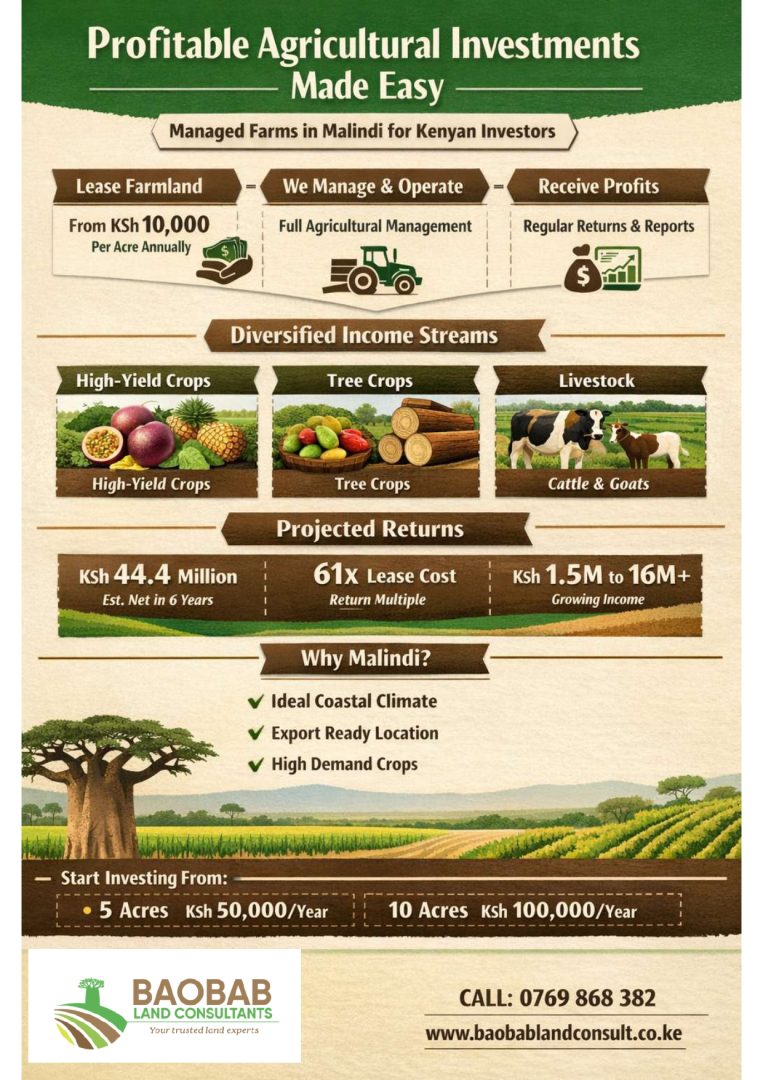
Baobab Land Consult operates in Malindi’s coastal region, offering investors leased farmland combined with full operational management.

The structure is straightforward:

  • Investors lease land at approximately KSh 10,000 per acre annually
  • The company manages all agricultural activities—from land preparation to harvesting
  • Investors receive production reports without direct involvement

This model converts agriculture from a labour-intensive activity into a passive, portfolio-based investment.

From a strategic standpoint, this mirrors trends seen in more developed markets, where farmland funds and agribusiness platforms institutionalize agricultural returns.

Youth Fund and Savannah Honey Partner to Empower Kenyan Youth in the Beekeeping Value Chain

Why Traditional Capital Preservation is Failing

A typical Kenyan investor holding KSh 1 million in a savings account earning 6% annually generates about KSh 60,000 before tax. With inflation averaging 7–8%, real returns are negative.

In contrast, allocating even a portion of capital into productive farmland introduces:

  • Inflation-linked returns (food prices adjust upward)
  • Biological growth is independent of financial markets
  • Multiple revenue cycles within a year

The distinction is critical: one approach preserves nominal value; the other compounds real value.
Baobab Land Consult: A smarter way for Kenyan investors to access profitable agricultural ventures

Diversification Through Multi-Stream Agricultural Production

A defining feature of Baobab’s model is diversification across crops and livestock. Instead of relying on a single commodity, the platform integrates seven revenue streams:

1. High-Yield Crops

  • Yellow passion fruit (short maturity, strong processing demand)
  • Pineapple (dual fresh and processing markets)
  • Cassava (drought-resistant, multiple cycles)

2. Long-Term Tree Crops

  • Cashew nuts (multi-decade productivity)
  • Casuarina (timber with strong six-year harvest returns)
  • Cocoa (export-oriented, supported by an intercropping strategy)

3. Livestock Operations

  • Sahiwal cattle (milk production and breeding value)
  • Galla goats (low-input meat production with seasonal demand spikes)

This portfolio approach mitigates risk. When one crop underperforms, others compensate. Livestock ensures a continuous cash flow, balancing the cyclical nature of crop harvests.

The Story of Kenya Nut Company and the coffee farmer who brought it into existence

Financial Performance: A Six-Year View

Based on conservative projections:

  • Total net returns (10 acres): ~KSh 44.4 million over six years
  • Total lease cost: KSh 720,000
  • Return multiple: ~61x lease cost

Revenue builds progressively:

  • Year 1: Establishment phase (~KSh 1.5M net)
  • Year 3–4: Peak productivity (~KSh 7–8M annually)
  • Year 6: Timber harvest drives significant upside (~KSh 16M+)

These figures highlight a key principle: agricultural investments reward patience and structured execution, not short-term speculation.

Baobab Land Consult: A smarter way for Kenyan investors to access profitable agricultural ventures

Why Most Agricultural Investments Fail—and This Model Doesn’t

Agricultural ventures often fail due to three structural weaknesses:

i) Poor execution

Farming is timing-sensitive. Input quality, pest control, and operational discipline determine yields.

ii) Low-quality inputs

Substandard seedlings or livestock genetics reduce productivity from the outset.

iii) Lack of diversification

Single-crop strategies expose investors to price and climate shocks.

Baobab’s model addresses all three through centralized management, certified inputs, and diversified production systems.

Low-cost agribusiness ideas that will make you rich

Strategic Advantage: Why Malindi Matters

Location is not incidental. Malindi offers:

  • Favorable coastal climate for year-round production
  • Proximity to export infrastructure
  • Suitability for drought-resistant crops and livestock
  • Established local and international market linkages

This positioning enhances both yield reliability and market access.

A Practical Entry Strategy for Investors

The model allows phased entry:

  • 5 acres: KSh 60,000 annually
  • 10 acres: KSh 120,000 annually
  • Scale progressively based on performance

This reduces risk while enabling evidence-based expansion—an approach consistent with disciplined capital allocation.

Portfolio Implications for Kenyan Investors

For a diversified investor, agriculture should not replace existing assets but complement them:

  • Equities: Liquidity and growth
  • Real estate: Capital preservation and rental yield
  • Agriculture: Biological production and inflation protection

What makes agriculture distinct is its independence from financial market sentiment. Production continues regardless of market cycles.

Final Reflection

The long-term investor does not chase trends. They allocate capital to systems that produce enduring value.

Agriculture, when professionally managed, is one of those systems. It converts time, biology, and demand into predictable output.

The question is not whether agriculture works—it has for centuries. The question is whether the structure allows modern investors to participate without an operational burden.

That is where models like Baobab Land Consult become relevant. They translate a traditionally complex sector into an investable, scalable opportunity.

In leadership and capital allocation alike, discipline matters. The strongest portfolios are not built on noise, but on assets that quietly compound over time.

Contact Savannah Honey

📞 0769 868 382

Website: www.baobablandconsult.co.ke
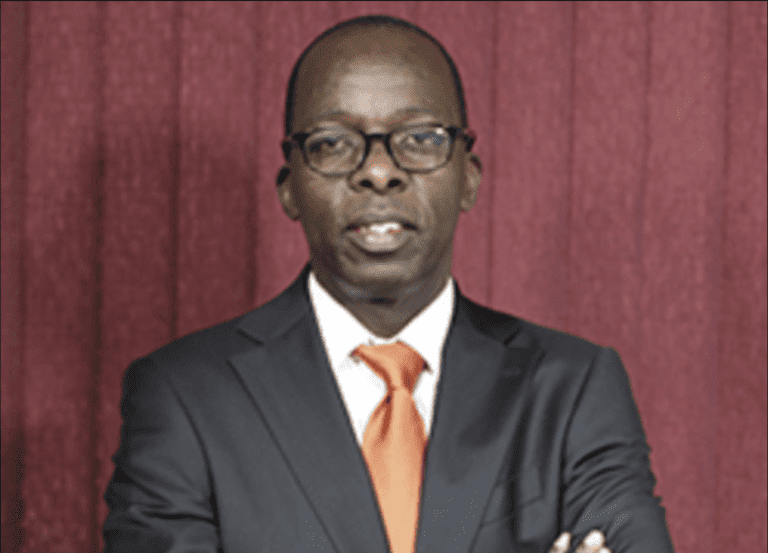
HF Group appoints Sam Makome as HFC Chairman, Elizabeth Gitau joins board

0

The appointments, which took effect on March 13, 2026, are part of HF Group’s ongoing efforts to strengthen governance, oversight, and strategic direction within its housing finance subsidiary.

Makome assumes the role of Chairman at HFC at a time when the institution is positioning itself to deepen its footprint in mortgage financing and diversified banking solutions. His appointment is expected to reinforce board leadership and support HFC’s long-term growth ambitions within Kenya’s evolving financial services sector.

Elizabeth Gitau joins the board as an Independent Non-Executive Director, bringing additional depth in governance, risk management, and strategic advisory. Her role will be critical in enhancing board independence and ensuring robust decision-making frameworks as the institution navigates a competitive and highly regulated environment.

These changes come as HF Group continues to align its leadership structure with industry best practices, particularly in corporate governance and board composition. Strengthening the HFC board is seen as a strategic move to support sustainable growth, improve operational resilience, and enhance shareholder value.

Kenya mourns former HF Group CEO and banking visionary Frank Ireri

HFC, a subsidiary of HF Group, has been transforming in recent years, expanding beyond traditional mortgage financing into a broader suite of banking and financial services. The new appointments are expected to accelerate this transition while reinforcing accountability at the board level.

Strategic Implications for the Financial Sector

The appointments reflect a broader trend within Kenya’s banking sector, where institutions are increasingly prioritizing strong governance frameworks amid regulatory pressure and market competition. Board leadership is becoming a critical lever for driving strategy, managing risk, and ensuring compliance.

For HF Group, placing experienced professionals in key board positions signals intent to strengthen institutional credibility and sharpen execution in a dynamic financial landscape.

As Kenya’s housing demand continues to outpace supply, HFC remains strategically positioned to play a central role in financing home ownership. Effective leadership at the board level will be essential in unlocking this opportunity while maintaining financial discipline.

Leadership Perspective

In African financial markets, governance is not a compliance exercise; it is a competitive advantage. Institutions that invest in credible leadership and independent oversight are better positioned to attract capital, manage risk, and scale sustainably.

HF Group’s latest appointments point to a deliberate effort to build that foundation. Over time, the quality of leadership decisions made at this level will determine not just institutional performance but the broader impact on housing access and financial inclusion in Kenya.

About Sam Makome, Chairman

Samwel Mukami Makome is a seasoned business leader with extensive experience in corporate governance, financial services, and strategic leadership across Kenya’s private sector. His experience in banking spans over 30 years, having held previous senior positions and Standard Chartered Bank Kenya, KCB Group and Equity.

He has built a reputation for disciplined oversight, institutional strengthening, and driving long-term value within organizations operating in regulated environments. Over the years, Makome has served in various senior leadership and board roles, where he has contributed to shaping corporate strategy, strengthening risk management frameworks, and enhancing operational efficiency.

His expertise spans key areas including financial oversight, investment strategy, governance structures, and stakeholder management. This breadth of experience positions him to provide steady leadership at HFC, particularly at a time when the institution is navigating transformation within Kenya’s housing finance and banking landscape.

As Chairman, Makome is expected to play a central role in guiding board deliberations, ensuring accountability, and aligning HFC’s strategic direction with HF Group’s broader growth agenda.

Africa’s First Mobile-Money Tap-to-Pay launches with Vodacom Tanzania and M-Pesa Africa, powered by Paymentology and Visa

0

Paymentology, the leading next-generation global issuer-processor, has powered the launch of Africa’s first mobile-money Tap-to-Pay feature with Vodacom Tanzania Plc and M-Pesa Africa in launching Africa’s first mobile-money Tap-to-Pay feature, now available on the M-Pesa SuperApp.

The new capability allows M-Pesa customers to make contactless payments using their Android mobile phones at any Visa-enabled point-of-sale terminal, both locally and internationally, transforming how millions of users pay, travel and do business.

Epimack Mbeteni M-PESA Director at Vodacom said: “What began as a simple idea, giving M-Pesa customers the freedom to tap and pay anywhere using just their phones, is now a live reality. This launch is the result of deep collaboration across Vodacom, M-Pesa Africa, Visa and Paymentology, and reflects our shared commitment to making payments simpler, safer and more accessible for millions of people.”

While marking Africa’s first mobile-money Tap-to-Pay launch, the rollout also represents the first time this capability is available in Tanzania, reflecting a broader shift, where mobile payments and real-time digital transactions are increasingly central to the economy. Tanzania’s mobile money ecosystem continues to expand at pace. The number of mobile money accounts reached76.5 million as of December 2025, a rise of approximately 21% from 63.2 million in 2024, highlighting how rapidly digital financial services are becoming embedded in everyday commerce and continuing the strong growth trajectory seen in recent years.

Kibera residents using Bitcoin for everyday payments

Reflecting Paymentology’ s long-standing commitment to accelerating innovation, financial inclusion and access to digital payments across Africa, the Tap-to-Pay feature is supported by its cloud-first issuing and processing infrastructure, extending the functionality of the M-Pesa Visa Virtual Card and enabling secure, tokenised, tap-and-go payments without the need for a physical card. The solution brings together mobile money, virtual cards and global card acceptance into a single, seamless customer experience.

Meagan Rabe, Vice President of Merchant Services, Acquiring and Fintech for Sub-Saharan Africa at Visa, stated: “The advancement of mobile-money Tap-to-Pay is the result of effective collaboration within the payments ecosystem. Visa offers a robust global network and contactless infrastructure, Paymentology facilitates secure tokenisation at the issuer level, and Vodacom provides extensive reach through its trusted M-Pesa platform, relied upon by millions. Collectively, this partnership is establishing Tap-to-Pay as a widely adopted payment solution for daily transactions.”

The rollout builds on the successful collaboration between Paymentology and M-Pesa in Kenya and reflects Paymentology’ s more than 20-year track record supporting payment innovation across African markets, extending that partnership into Tanzania and laying the foundation for further expansion across the region. It also reflects M-Pesa’s continued evolution beyond domestic payments, as real-time, interoperable digital payment systems account for a growing share of economic activity.

Anna Porra, Chief Revenue Officer, Paymentology, said: “At Paymentology, we believe innovations like Tap-to-Pay accelerate financial inclusion by making everyday transactions simpler and safer for everyone. This launch marks an important step forward for the country’s digital economy. We’re proud to support Vodacom and M-Pesa, alongside Visa, with the issuer-processing capabilities that enable fast, secure and next-generation payments for millions of people.”

In Tanzania, Tap-to-Pay opens new opportunities for merchants and entrepreneurs to serve customers who increasingly expect contactless, mobile-based payments, while giving consumers greater freedom to pay securely wherever Visa is accepted, at home or abroad, through a familiar mobile-money interface.

Lionesses and Shujaa target promotion push in crucial HSBC SVNS 2 South American rounds

0

Kenya’s Lionesses and Shujaa are gearing up for a strong showcase in the second and third rounds of the HSBC SVNS 2, as they aim to secure promotion to the top-tier HSBC SVNS 1 next season.

The Montevideo tournament in Uruguay takes place on March 21–22, followed by São Paulo, Brazil on March 28–29. Both events mark crucial opportunities for the teams to build on their performances from the opening leg in Nairobi.

The Lionesses announced a 13-player squad featuring Faith Livoi and Christabel Lindo, who missed the Nairobi leg, alongside captain Sheila Chajira, Naomi Amuguni, Charity Nillah, Stellah Wafula, Edith Nariaka, Judith Auma, Sinaida Mokaya, Moreen Muritu, Janet Okello, Freshia Oduor, and Marvel Oswago.

“We are grateful for our fans’ incredible support in Nairobi. Our focus now shifts to Uruguay and Brazil, where we aim to win our matches and secure qualification for Division One. We also thank Safaricom, through M-PESA, for their continued support in elevating our game both on and off the pitch,” said captain Sheila Chajira.

How to become an MPesa agent (Updated Procedure)

Shujaa named a 14-man squad including regulars George Ooro, Samuel Asati, Vincent Onyala, Kevin Wekesa, Nygel Amaitsa, Dennis Abukuse, John Okoth, Kevin Wambua, and Patrick Odongo. Brian Tanga returns after a long injury layoff, while Gabriel Ayimba earns his first call-up to the national sevens side. Other squad members are Chrisant Ojwang, Festus Shiasi, Floyd Wabwire, and David Nyangige.

The opening leg at Nyayo National Stadium saw Shujaa finish third behind the United States and Germany, while the Lionesses placed fifth.

“Shujaa and the Kenya Lionesses have once again shown the grit, discipline, and fighting spirit that define Kenyan rugby. With M-PESA supporting the teams through our partnership with the Kenya Rugby Union, the players can focus fully on their game. I wish them the very best as they head to Uruguay and Brazil for the next rounds of the HSBC SVNS 2, where they will showcase the skill and determination that have made Kenya a force on the global rugby stage”. said Safaricom CEO, Peter Ndegwa.

Under a two-year partnership with the Kenya Rugby Union, M-PESA supports both teams with monthly allowances, comprehensive medical insurance, airtime, and financial literacy programs ensuring players can focus on rugby while enjoying reliable financial backing.

The HSBC SVNS 2 is part of the global HSBC SVNS series, bringing fast-paced, high-intensity rugby sevens action to the international stage.


Old Mutual PLC reports KES 856 Million Profit After Tax as asset management and digital growth drive performance

0

Old Mutual Holdings PLC has posted a profit after tax of KES 856 million for the financial year ended December 31, 2025, reflecting steady growth driven by strong asset management performance and accelerating digital adoption across its markets.

The result represents a 2 percent increase from the KES 838 million recorded in 2024, underscoring the Group’s resilience amid a shifting macroeconomic environment characterized by interest rate adjustments and evolving consumer behavior.

The financial services group, which operates across Kenya, Uganda, Rwanda, and South Sudan, recorded a consolidated profit before tax of KES 1.9 billion. This performance was supported by robust growth in its life insurance and asset management divisions, improved treasury operations, and strengthened capital buffers.

Total assets rose by 6 percent to KES 79.2 billion, up from KES 74.8 billion in 2024. Meanwhile, total equity increased by 3 percent to KES 20.4 billion, reinforcing the Group’s financial stability and capacity to support long-term growth.

Little-known architect who designed iconic UAP Old Mutual Tower in Nairobi

Group CEO Arthur Oginga attributed the performance to disciplined execution and a diversified business model.

“Our performance reflects the resilience of our diversified portfolio and the discipline of our execution in a dynamic operating environment. We have strengthened our capital position, significantly improved our liquidity, and delivered strong growth in life and asset management while continuing to invest in digital innovation,” he said.

Asset Management and Life Business Lead Growth

Growth in 2025 was primarily anchored on strong performance in asset management. Assets under management at Old Mutual Investment Group Uganda expanded by 34 percent, driven by sustained inflows into the unit trust business.

The asset management division recorded a profit before tax of KES 992 million, up from KES 837 million in 2024, reflecting improved portfolio performance and disciplined investment strategies.

The life insurance business also delivered solid growth, with profit before tax rising to KES 791 million from KES 681 million in the previous year. This was supported by enhanced operational efficiency and stronger performance across key product segments.

Additionally, improved treasury management and better asset-liability matching helped the Group maintain stable returns despite a declining interest rate environment.

Digital Growth and Financial Strength

Old Mutual continued to deepen its digital transformation strategy, with notable growth in digital channels and customer engagement.

Cash and cash equivalents increased by 33 percent to KES 15.1 billion, up from KES 11.3 billion, providing the Group with enhanced liquidity to fund expansion, digital innovation, and distribution growth.

E-commerce sales rose to KES 708 million in 2025 from KES 533 million in 2024, signaling increased customer adoption of digital insurance and investment solutions.

The Group’s asset management arm delivered a return on investment of 14.37 percent, outperforming the 1-year Treasury Bill benchmark of 12.50 percent, highlighting strong portfolio management capabilities.

Digital traction was further evident in the Thrive App, whose downloads surged more than fortyfold from 3,105 in 2024 to 128,153 in 2025, reflecting growing engagement within the Group’s digital wellness ecosystem.

Old Mutual PLC reports KES 856 Million Profit After Tax as asset management and digital growth drive performance
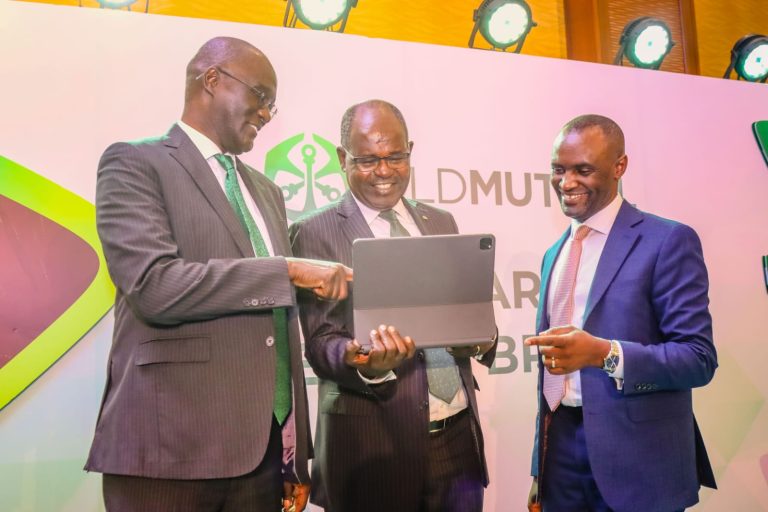
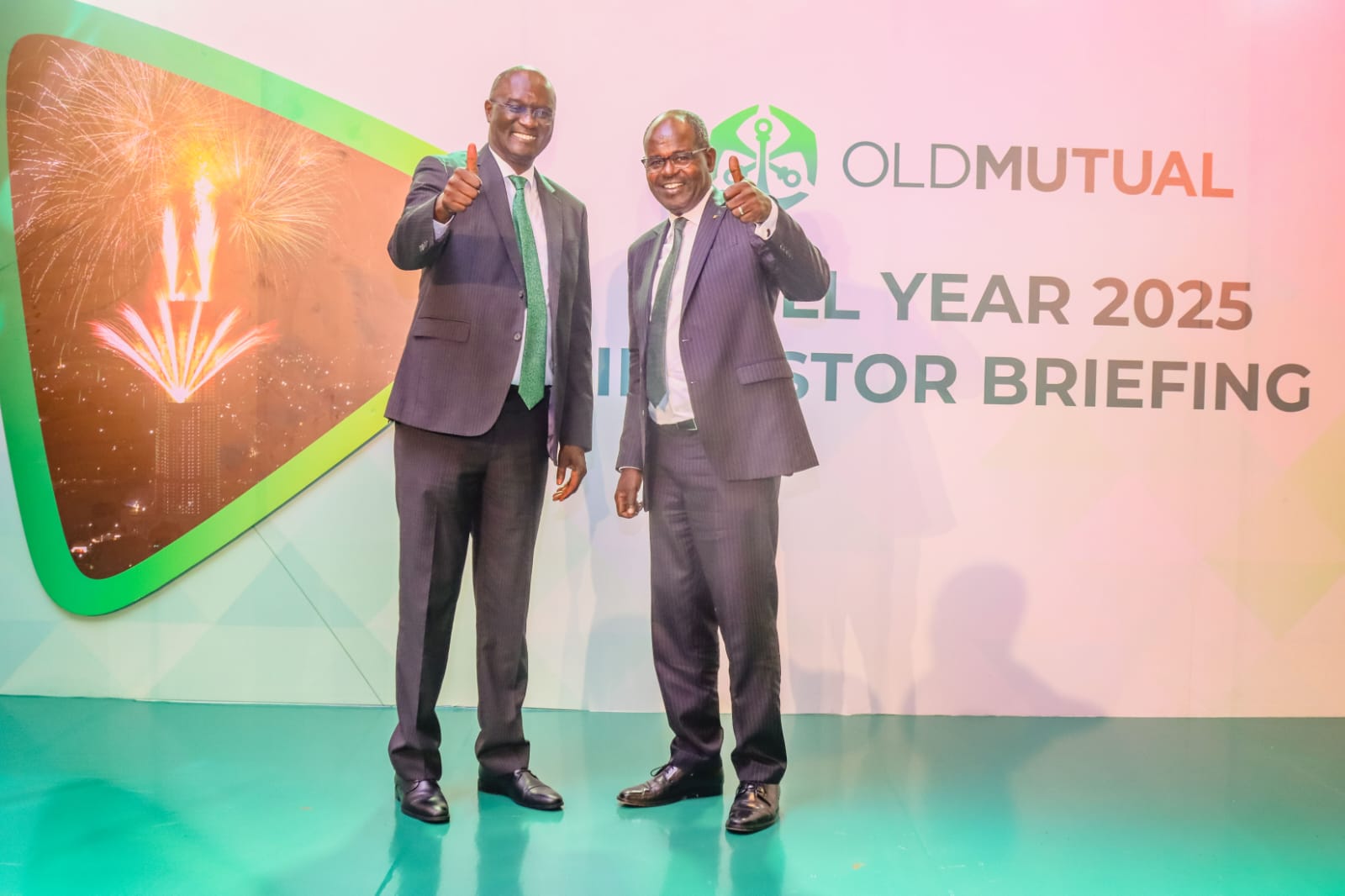
From Left, Arthur Oginga, Group Chief Executive Officer, and Dr. Habil Olaka, EBS, Group Chairman, share a formal handshake and engage in executive-level discussions, symbolizing leadership alignment and strategic direction.

Strategic Milestones Across Markets

During the year, Old Mutual executed several strategic initiatives aimed at strengthening its regional footprint and operational efficiency.

The Group completed the merger of its Kenya life insurance entities, Old Mutual Life Assurance Kenya (OMLAK) and Old Mutual Life Assurance Company (OMLAC), streamlining operations and enhancing scale in its core market.

It also announced plans to exit South Sudan following a structured run-off period, reflecting a disciplined approach to capital allocation and market prioritization.

In Rwanda, Old Mutual integrated with the Irembo national e-government platform, becoming the first major insurer on the platform and gaining access to over 2 million users for motor insurance services.

The Group also expanded its digital payments ecosystem through integrations with Paystack and partnerships in Uganda with Nxt Pe, enabling customers to seamlessly pay insurance premiums via mobile money platforms such as Airtel Money.

In Kenya, Old Mutual Investment Group partnered with the Octagon Unit Trust Scheme and Safaricom’s Ziidi Money Market Fund to provide fund management services, broadening access to retail investment products.

Outlook

Old Mutual’s 2025 results highlight a clear strategic direction: scale asset management, strengthen life insurance, and accelerate digital distribution. The combination of liquidity growth, disciplined capital allocation, and technology investment positions the Group to navigate interest rate cycles and deepen financial inclusion across its markets.

For financial institutions operating in Africa, this performance reinforces a critical lesson. Sustainable growth is no longer driven solely by balance sheet expansion, but by the integration of digital infrastructure, efficient capital deployment, and customer-centric innovation.

Leadership in this environment requires clarity of strategy and discipline in execution. Institutions that align capital, technology, and market focus will not only deliver shareholder value, but also shape the future of financial services on the continent.

Amount of money customers with active Fuliza overdraft are deducted per day

0

Across Kenya, everyday financial behaviour is rapidly evolving as customers increasingly rely on digital tools to manage their money.

From paying bills to sending funds instantly, mobile financial services have become central to daily life.

However, while digital payments have simplified transactions, many customers still face occasional short-term cash flow gaps when balances run low but essential payments cannot wait.

In response to these realities, digital financial solutions have emerged to help customers complete urgent transactions even when their M-PESA balance is insufficient.

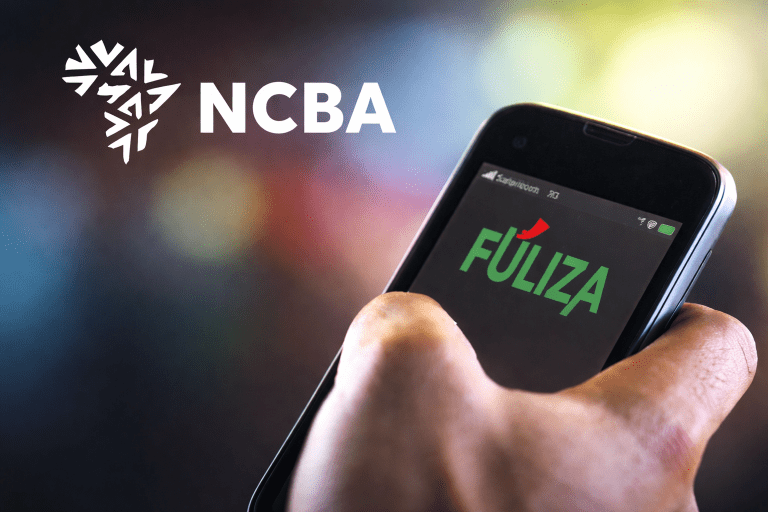
One such service is Fuliza M-PESA, a mobile overdraft facility offered by Safaricom in partnership with NCBA Bank.

The service allows subscribers to complete transactions when their M-PESA balance is insufficient.

Whether it’s airtime purchase, bill payments, or money transfers to other users, customers can transact as much as they want as long as the amount being transacted is within the allocated limit.

Transfer limits and charges

According to NCBA Bank, Fuliza M-PESA attracts specific charges for usage in addition to normal M-Pesa transaction charges.

Customers are charged a 1 percent access fee when the overdraft is used, alongside a daily maintenance fee on the outstanding balance. The daily maintenance fees are structured according to the borrowed amount:

  • Sh0–100: One-time fee of Sh2
  • Sh101–500: Sh5 per day
  • Sh501–1,000: Sh10 per day
  • Sh1,001–1,500: Sh20 per day
  • Sh1,501–2,500: Sh25 per day
  • Sh2,501–70,000: Sh30 per day

Repayment occurs automatically when customers deposit money into their M-PESA accounts. The funds first go toward clearing any outstanding Fuliza balance.

Customers who fail to clear their overdraft within 30 days temporarily lose access to the service. However, access is restored immediately once the outstanding balance is fully repaid

Flexible Usage for Customers

One of the key features of Fuliza M-PESA is its flexibility. Customers can use the overdraft multiple times provided they remain within their allocated limit.

Each registered M-PESA mobile line qualifies as a separate Fuliza account. The service assigns a limit to every eligible line, which is periodically reviewed based on how frequently customers use Safaricom and M-PESA services and how consistently they repay the overdraft.

How to activate Fuliza Overdaft

Customers must first be registered on M-PESA and have an active Safaricom line. Activation is done through the Safaricom menu by dialing *234# and selecting the Fuliza M-PESA option to opt in.

Customers can increase their Fuliza limit over time through regular use of Safaricom and M-PESA services and by repaying overdraft balances promptly.

Maintaining consistent usage patterns and timely repayments signals responsible usage, which can lead to higher limits during periodic reviews.

Also Read: Why every small business owner needs the NCBA Business Saver Account

Kenyatta University announces job vacancies for lecturers: How to apply

0

Kenyatta University has announced open part-time job opportunities for qualified lecturers.

In a notice on Tuesday, March 17, the institution invited interested candidates to submit their applications.

“Kenyatta University seeks to recruit competent and dedicated applicants to fill the positions of part-time lecturers,” read part of the notice.

According to the notice, applicants must have at least a Master’s degree in relevant field from a recognized institution, with at least three years’ teaching experience at the university level, in research, or in industry.

Applicants with four years of experience in a tertiary institution will also be considered, and a PhD in a relevant field will be an added advantage.

How to Apply

Interested and qualified candidates should submit a detailed curriculum vitae, a copy of their ID/Passport, academic certificates, testimonials, and any relevant supporting documents.

Applications should be submitted in writing to:

Deputy Vice-Chancellor (Administration & Finance))
Kenyatta University
P. O. BOX 43844 – 00100
NAIROBI

The deadline for submitting applications is April 2, 2026.

Also Read: Makueni County advertises 64 job vacancies: How to apply

Why every small business owner needs the NCBA Business Saver Account

Small and medium-sized enterprises (SMEs) are increasingly adopting disciplined savings strategies as they seek sustainable ways to finance expansion, manage cash flow and strengthen financial resilience in an uncertain business environment.

For many entrepreneurs, the ability to steadily build capital while maintaining access to credit has become a key consideration when choosing business banking solutions.

As such, financial institutions are rolling out tailored solutions to address this demand. A good example is the NCBA Bank Business Saver Account, a product tailored for businesses that want to accumulate funds for future investments while still maintaining liquidity.

The Business Saver account allows entrepreneurs to build savings gradually, while accessing credit to fund their day-to-day operations.

Key features include a minimum account opening balance of Sh2,000. The account also earns interest calculated daily and credited monthly, enabling businesses to grow their reserves over time.

For SMEs seeking additional financial flexibility, the account provides a pathway to credit. Businesses can access borrowing of up to 100 per cent of their savings, offering a practical solution for entrepreneurs who may need working capital but prefer to avoid lengthy loan approval processes.

To begin earning interest, the account holder must have a minimum balance of Sh50,000. The account further allows one withdrawal per month, a structure that promotes disciplined saving while still providing access to funds when necessary.

In addition, account holders can enjoy convenient access through mobile banking platforms, enabling them to monitor their savings and manage transactions on the go.

Moreover, the Business Saver Account includes one free standing order per month from a current account, making it easier for businesses to automate their savings.

Free monthly statements further support transparency and financial planning, allowing business owners to track progress toward their savings goals.

“Build capital for future business expansion through saving with the interest-earning Business Saver account. Get access to credit with the ability to borrow up to 100% of your savings,” NCBA states.

How to open NCBA Business Saver Account

Opening the NCBA Business Saver Account is simple. All one needs to do is visit the nearest NCBA branch countrywide with a copy of National Identity Card (ID), KRA PIN and Sh2,000 (Minimum account opening balanace).

Benefits of Business Saver Account

  • Low minimum account opening balance of Sh2,000 makes it affordable to all businesses including startups.
  • Credit interest rate is calculated daily and paid to the account on a monthly basis.
  • Minimum interest-earning balance of Sh50,000.
  • One withdrawal per month.
  • One free standing order per month from your current account.
  • Free monthly statements.

Also Read: Kenya’s Rising Economy: Where Investors Are Looking Today

Safari Rally fuels business boom for small traders in Naivasha

0

As has become tradition during the Safari Rally, the 2026 WRC Safari Rally brought more than just the roar of engines to the vibrant town of Naivasha. The lakeside town once again came alive with excitement, drawing thousands of rally enthusiasts and creating a wave of economic activity for small business vendors who travel from across the country to tap into the opportunity.

While fans gather to witness rally drivers navigate Kenya’s rugged terrain, the event has quietly become a peak trading season for entrepreneurs eager to serve the crowds.

For entrepreneurs like Ayub Mwangi, a businessman from Nakuru, the rally is more than just a sporting spectacle it is an opportunity to grow his hustle. Normally a tailor in Nakuru town, Ayub temporarily swaps his sewing kit for a selection of rally merchandise including kites, vuvuzelas and hats, setting up shop in Naivasha during the rally weekend.

“I have never missed a rally since it returned to Kenya in 2021,” says Ayub. “Every year I travel to Naivasha because the business here is good. I cannot say exactly how much I make each day, but I always go home happy. A single kite sells for around KES 500, which is more than I might make in a day from tailoring.”

To prepare for the busy rally season, Ayub says access to small business financing helped him stock up in advance.

“I needed extra capital to buy enough merchandise for the crowds, so I took a Taasi Pochi loan to boost my business since I didn’t have sufficient funds for stock. The support has truly paid off,” he says.

Taasi Pochi Loan is a type of Pochi La Biashara loan that enables Safaricom merchants to access instant credit ranging from KES 1,000 to KES 250,000. The loan can be accessed directly via *USSD 334# or through the M-PESA App, with flexible repayment periods of 7, 14, or 30 days.

For Maria Wanjiru, the rally has also become an important seasonal business opportunity. Maria, who runs Shiro Nyama Choma in Roysambu, Nairobi, planned her Naivasha trip weeks in advance to ensure she secured a good spot near the spectator stages.

“This is my second year coming to the rally,” she says. “Last year I tried selling sodas and it did not work very well. This year I decided to focus on nyama choma and the response has been amazing.”

Serving customers at the popular Sleeping Warrior spectator stage, Maria says she had to increase her stock significantly to keep up with demand.

She also notes that mobile payments have made it easier to manage transactions during such busy events. “At this event, I am mostly using Lipa Na M-PESA, specifically Buy Goods. It makes business smoother because customers can pay quickly, and I don’t have to worry about looking for change when things get busy.”

Her assistant during the rally, Job Ogamba, agrees.

“The turnout has been incredible,” he says. “There are so many people coming through the stages. Events like this really create opportunities for small traders.”

For young entrepreneurs like Ian Juma, a 25-year-old from Thika, this year marked his first experience selling at the rally. Ian temporarily paused his boda boda work and brought his smokie cart to Naivasha, offering smokies, boiled eggs, tea and soda to rally fans.

Safaricom’s Ziidi Fund wins global fintech innovation award at MWC 2026

“In Thika I sell a smokie or egg for about KES 25, but here the demand is much higher,” he says. “The crowds are huge and business has been good. I even had to bring someone to help me serve customers.”

Ian says he has been moving between different spectator stages since the rally began, following the crowds from Kedong to Sleeping Warrior and at Hell’s Gate.

“I took a risk coming here but it has been worth it,” he says. “Opportunities like this show young people that there are many ways to make money if you are willing to try.”

For Joel Macharia of Linkers Butchery in Kiambu, business this year has been steady, even if it has not quite matched the peak years of the rally’s return.

Still, Joel says the event continues to benefit many traders.

“Some of my friends have done extremely well this year,” he says. “Large events like this always bring opportunities.”

He adds that digital payments have become increasingly useful for vendors operating in crowded environments.

“It helps keep transactions safe and convenient, especially when you are dealing with large numbers of customers,” he says.

Since its return in 2021, the WRC Safari Rally has not only revived motorsport in Kenya but also become a powerful economic driver for towns like Naivasha. For many small business owners, the rally weekend is now an anticipated annual opportunity one that brings together sport, tourism and entrepreneurship in a uniquely Kenyan way.


Kenya’s Rising Economy: Where Investors Are Looking Today

0

Kenya has emerged as one of the most scrutinized economies in East Africa in the last ten years. The nation is characterized by a good agricultural base, an emerging technology industry, and an urban infrastructure that is rising.These reasons have also drawn in local investors as well as international investors who are seeking long-term opportunities in emerging markets.

Kenya is also a regional business hub, and this is also contributing to its attractiveness. Many international organizations and companies are headquartered in the capital city, Nairobi, where they conduct their operations in the East African region. Such an environment provides a platform on which there is an investment in various industries that keep growing at a high rate.

Agriculture: The Economy Still Depends on Agriculture

Agriculture continues to be among the key sectors in Kenya. Government economic indicators show that agriculture forms a huge percentage of the GDP of the country and employs a large proportion of people.

The climate of Kenya opens it up to produce a wide variety of crops. Agricultural exports have established a good demand in other countries.

Agricultural products are important in that production includes:

  • Tea
  • Coffee
  • Horticultural products, which include vegetables and flowers.

Kenya is a leading exporter of black tea in the world, and the flower business of the country serves the European and Middle Eastern markets. These well-established export lines render agriculture appealing to investors who want to have a stable production sector.

Opportunities In Agricultural Processing

Beyond farming itself, agricultural processing has become a growing investment area. Instead of exporting raw materials, many companies are building facilities that process products locally.

Examples of value-added agricultural investment include:

  • Coffee roasting and packaging
  • Food processing plants
  • Cold storage logistics for fresh produce

Processing industries allow businesses to capture more value within the country and reduce reliance on exporting raw goods.

Technology And Digital Innovation

The technology industry in Kenya has grown at a rapid pace, making the city of Nairobi be dubbed as Silicon Savannah. Early adoption of mobile financial services is one of the reasons.

Why practical skills matter more than degrees in today’s economy

M-Pesa is one of the most successful financial technology innovations in Africa, which launched the mobile payment platform in 2007. It enables millions of users to send money, bills, and even financial transactions using mobile phones.

The success has provided a favourable platform for digital startups.

Key Areas Of Tech Investment

Some of the fast-growing segments that the investors are currently paying attention to are:

  • Financial technology (fintech)
  • E-commerce platforms
  • E-logistics and delivery services.

The digital services in Kenya are still propelled by the high mobile phone and the increasing internet access. To most investors, the technology industry is a long-term prospect and not a short-term speculation.

Real Estate And Urban Development

Rapid population growth and urban migration have increased demand for housing and infrastructure. Cities such as Nairobi and Mombasa are expanding quickly as more people move to urban areas for work.

Real estate investment in Kenya often focuses on three main segments:

  • Residential housing developments
  • Commercial office space
  • Mixed-use urban projects

The expansion of infrastructure projects, including roads and railways, also supports property development.

Why Real Estate Attracts Long-Term Investors

Property investment in growing cities often benefits from rising demand over time. In Kenya, urban housing shortages have pushed developers to build new residential projects in and around major cities.

Important drivers of the real estate market include:

  • Population growth
  • Expanding middle class
  • Urban migration

These factors create a steady demand for both affordable housing and commercial property.

Emerging Digital Entertainment And Gaming

Another growing area is digital entertainment. As internet access spreads, more people use online platforms for games and entertainment. This trend is visible across East Africa. It also includes sports entertainment platforms. For example, services similar to Mozambique bet show how online gaming and prediction platforms are becoming part of the region’s digital economy.

This sector is still smaller than agriculture or technology. However, it shows how Kenya’s economy is slowly becoming more diverse through digital services.

Final Thoughts

Kenya’s economy combines traditional industries with modern innovation. Agriculture remains the foundation of the economy. It supports exports and provides jobs for a large part of the population.

At the same time, technology and real estate are shaping the next stage of growth.

For many investors in East Africa, Kenya remains an attractive market. The country has a strong entrepreneurial culture and an important regional role.