

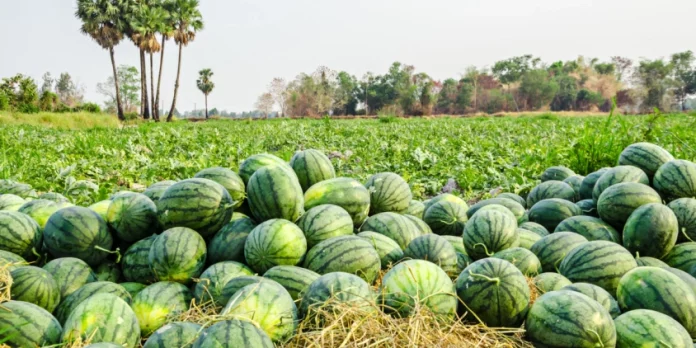
Watermelon farming is emerging as one of the most profitable agricultural ventures in Kenya’s dry eastern region, offering farmers a reliable source of income where conventional crops such as maize have repeatedly failed due to erratic rainfall.
In parts of Kitui County, the drought-tolerant crop is transforming livelihoods, with farmers and traders capitalising on its growing demand among motorists and urban markets.
Along the Garissa-Mwingi highway in Malaani Township, the shrill whistle of vendors has become a familiar sound to passing motorists.

The calls are an invitation to stop for freshly harvested watermelon, now one of the area’s most sought-after roadside products.
“We whistle to draw motorists’ attention, who are our main customers,” Fridah Muema, a vendor, told Seeds of Gold.
The roadside trade has created a dependable source of income for many families. A watermelon sells for at least Sh200, depending on its size, with sales peaking between May and June before tapering off in August.
“On a good day, I make up to Sh4,000. The money supports my children’s education and family upkeep,” says Grace Muange, a vendor who buys the fruit directly from local farmers.
The rapid increase in watermelon production around Malaani has, however, exposed farmers to exploitation by middlemen who purchase the fruit in bulk before transporting it to markets in Garissa, Kitui, Mwingi, Nairobi and Thika.
Many farmers and vendors have instead embraced direct roadside sales, where returns are significantly higher.
“Middlemen offer Sh35 for a fruit weighing five kilos. The same fruit goes for Sh200 on the roadside,” said Muange.
Over the years, vendors have also built loyal customer networks that provide a steady market beyond passing motorists.
“One customer orders at least Sh5,000 worth per week for juice. These networks keep my business afloat,” says Muema.
The success of the watermelon business reflects a broader shift in farming practices across the Mwingi region, where prolonged dry spells have forced farmers to abandon maize in favour of crops better suited to the area’s harsh climate.
Unlike many commercial watermelon-growing regions that rely on irrigation, farmers in Kitui depend entirely on rainfall.
They say the crop requires relatively little moisture once established, as its sprawling vines and leaves help conserve soil moisture by reducing evaporation. It also matures within about two months, allowing farmers to earn returns quickly.
For many growers, the financial rewards far exceed those of other drought-tolerant crops.
“An acre of watermelon can earn up to Sh400,000 in a good season. Maize, cowpeas, mung bean and pearl millet farmers can only dream of this income,” Muema says.
With growing consumer demand and better earnings through direct marketing, watermelon farming is increasingly becoming a lifeline for households in Kitui, demonstrating how climate-smart agriculture can turn the challenges of arid conditions into profitable opportunities.
Also Read: Kenya unveils Shs1.08T agri-food investment framework to transform agriculture