


Home Blog Page 48

The analogue gap putting Kenya’s agricultural supply chain at risk

0

Kenya’s Agricultural Sector and the Rise of Agritech Innovation

The Kenyan agricultural sector accounts for 23.2% of Kenya’s Gross Domestic Product (GDP) and employs more than 40% of the population. It is also responsible for around 65% of the country’s export earnings. Thriving since COVID-19, despite some downturn over the past year, Kenya is also considered one of Africa’s hubs for agriculture and agritech.

The country has more than 40 active agritech startups specialising in AI and sensors, platforms that focus on IoT solutions for soil and environmental conditions, and tools designed to support the industry and its growth. And Kenya’s AI Strategy 2025-2030 puts the sector at the forefront of its commitment towards data-driven innovation.

However, a significant percentage of the country’s agricultural sector still consists of fragmented, smallholder farms at different stages of digital maturity. Some have highly sophisticated tools, while others are still manual and paper-based with only a few basic digital processes in place.

The highly advanced, digital side of the market is valued at around 1.2 billion according to Ken Research, with growth seen in IoT, e-learning platforms, data analytics services, mobile applications, and digital marketplaces. Here, sensors, AI and intelligent platforms are changing how farmers are managing their soil, water, livestock and yield.

Kenya’s Rising Economy: Where Investors Are Looking Today

The Hidden Cybersecurity Risks Facing Kenya’s Agricultural Supply Chain

However, despite the improvements introduced by these technologies, they are also introducing risk. A risk that the sector hasn’t fully realised. It is also one that isn’t sitting where the investment is most concentrated, which is on the farms and in the systems of the larger commercial operators, but rather in the third-party service providers. These small and medium-sized enterprises (SMEs) that move produce from the farm to the warehouse and from the warehouse to the retail shelf are often the weakest part of the chain.

While the infrastructure at the farm or retail level isn’t immune to attack – threat actors will always focus their efforts on profitable targets – it is less vulnerable than these SMEs. The smaller operators have limited to no cybersecurity infrastructure, monitoring capability, patch management processes or awareness of how they are in a position of material risk that can impact the entire agriculture supply chain.
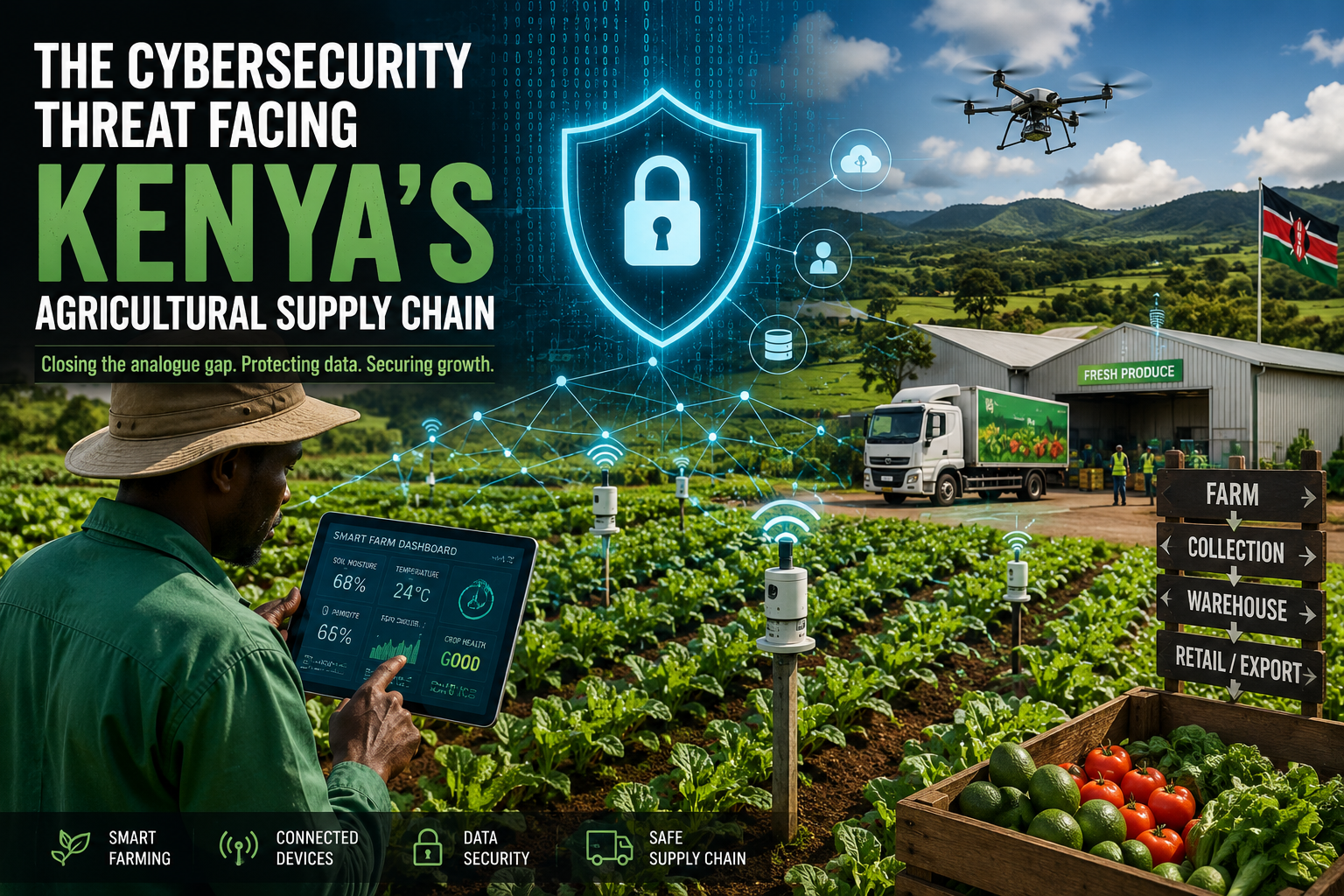
The analogue gap putting Kenya’s agricultural supply chain at risk

Why SMEs Are the Weakest Link in Agricultural Data Security

Across Kenya’s commercial farming and food logistics sectors, connected devices are continuously transmitting data about soil conditions, temperature, humidity, crop health and cold-chain integrity. From verified temperature readings to GPS-tracked logistics and point-of-origin records, this data travels from sensors and systems through the hands of a logistics operator, into a distribution centre, and eventually informs the procurement and shelf-life decisions of a major retailer or export buyer.

This data is currency, and it is precisely what threat actors are after, particularly when it reveals the operational patterns and processing systems of a large agritech company, information that can be monetised on its own or used to deepen access to the broader infrastructure.

Mortgage gap slows Kenya’s homeownership despite real estate boom

At each structured point in this chain, there is a level of security. Larger farms, retailers and distribution centres have invested in enterprise-grade systems or endpoint protection, but the SMEs that connect these nodes have become an analogue gap. And this gap is prime real estate for a man-in-the-middle attack. The moment the data leaves the sophistication of the farm and enters the small logistics operator’s hands, it crosses an analogue boundary that’s far easier for the threat actor to breach.

The mechanism of this attack isn’t elaborate, and it’s a lot easier for hackers to achieve. Once a threat actor identifies and exploits a vulnerability in a sensor or connected device, they can inject errors into what that device reports. The sensor continues to function and report, and the distribution centre and retailer continue to receive data, but the data is false.

A temperature reading may indicate that the produce is within a safe range when it is not. A point-of-origin record may validate a consignment that it should reject. A shelf-life indicator built on a manipulated data foundation will pass through every subsequent system without triggering an alert, because the system has no reason to question data that arrives from a verified source.

The consequences are twofold. On the commercial level, companies run the risk of production delays, spoiled inventory, customer dissatisfaction, and the high costs of tracing and replacing compromised stock. The second is regulatory – under Kenya’s Data Protection Act 2019, data controllers are required to notify the Office of the Data Protection Commissioner within 72 hours of becoming aware of a breach. When false data is injected at the analogue gap, the retailer is left holding non-compliant records that they relied on in good faith.

Top 10 African countries with the highest GDP per capita

Securing Kenya’s Agritech Ecosystem with Zero Trust Principles

Solving for this challenge comes down to treating the supply chain as a security perimeter in its own right, one that requires identity verification, access controls, continuous monitoring and supplier accountability at every node. Zero trust is the right framework here as it ensures nobody moves through the supply chain without verification, and this should be supported by multi-factor authentication, biometric verification and supplier auditing.

Kenya’s agriculture sector is an African success story, but the analogue gap must be addressed as a cybersecurity problem that can impact this success if not managed correctly. All the attacker needs is a point where nobody is watching, and the impact is significant.


How school calendar will look like in new changes

0

The Ministry of Education has announced major changes to the school calendar amid ongoing student unrest that has led to the closure of over 200 schools in the country.

Speaking during a press briefing on Wednesday, June 10, at Jogoo House, Nairobi,  Ogamba said effective next year, the school calendar will be rationalized to ensure balanced terms.

“Starting next academic year, the Ministry shall rationalize the school calendar to ensure balanced terms across the school year,” said Ogamba.

Under the plan, all the terms will have 12 weeks of learning, marking a departure from the current structure where the first term runs for 12 weeks, the second 14 weeks, and the third 9 weeks.

“The first term is 12 weeks, the second term is 14 weeks, and the third term is 9 weeks. We are now going to rationalise that and have 12 weeks across the board,” said CS Ogamba.

The move is part of the major reforms the Ministry is putting in place to reduce learner fatigue and restore order in schools.

“From the next academic year, school terms will be rationalised as part of the reforms we are doing to ensure that our students do not get exhausted,” he added.

The CS maintained that the current school calendar will remain unchanged, with mid-term break set to begin from June 24 to June 28, 2026. He urged parents to provide guidance and support to learners during the break.

“The mid-term break for the Second Term of the 2026 School Year will take place as scheduled, from 24th June 2026 to 28th June 2026.”

“Parents are urged to use the break to spend time with their children and to provide guidance and support to them. Any grievances or concerns should be articulated appropriately and shared with schools,” Ogamba directed.

The CS confirmed that at least 204 senior schools have been affected by the ongoing unrest. He added that 59 of the affected schools have already resumed learning activities, with more expected to join the race.

In a bid to contain the issue of school unrest, Ogamba has announced the formation of a multi-stakeholder team to review the causes of unrest and make recommendations on effective strategies.

Also Read: Government flags off distribution of laptops and smart boards to junior secondary schools

Crypto Staking Explained: How Investors Earn Passive Income from Cryptocurrency

0

What Is Crypto Staking?

Crypto staking has emerged as one of the most popular ways for cryptocurrency investors to earn passive income while supporting blockchain networks. As the global digital asset market continues to grow, staking is becoming an increasingly important component of decentralized finance (DeFi) and blockchain security.

In simple terms, crypto staking involves locking up a certain amount of cryptocurrency in a blockchain network that uses a Proof-of-Stake (PoS) consensus mechanism. In return, participants receive rewards, usually in the form of additional cryptocurrency.

Unlike cryptocurrency mining, which requires expensive hardware and significant energy consumption, staking allows investors to participate in network validation using the crypto assets they already own.

How Does Crypto Staking Work?

Proof-of-Stake blockchains rely on validators to verify transactions and maintain network security. Validators are selected based on the amount of cryptocurrency they have staked.

How OKX Is redefining Crypto investing for the next billion users in Africa

When users stake their crypto, they contribute to the network’s operations and earn rewards in return.

The process typically follows these steps:

1. Purchase a Staking Cryptocurrency

The first step is acquiring a cryptocurrency that supports staking. Popular staking cryptocurrencies include:

  • Ethereum (ETH)
  • Solana (SOL)
  • Cardano (ADA)
  • Polkadot (DOT)
  • Avalanche (AVAX)

2. Choose a Staking Method

Investors can stake their crypto through various methods, including:

  • Delegating tokens to a validator
  • Running a validator node
  • Using cryptocurrency exchanges
  • Participating in staking pools
  • Using DeFi staking platforms

3. Lock or Delegate Your Tokens

The selected cryptocurrency is deposited into the staking network. Depending on the blockchain, assets may be locked for a specific period.

4. Transaction Validation

Validators verify transactions, secure the network, and help create new blocks on the blockchain.

5. Earn Rewards

Participants receive staking rewards based on their contribution to the network and the amount of cryptocurrency staked.

Analyst Forecasts a Major Altseason Rally: 5 Cryptos With the Potential for 7000x Growth

Factors That Influence Staking Rewards

Staking rewards vary significantly across blockchain networks. Several factors determine how much an investor can earn.

Amount of Crypto Staked

Generally, investors who stake larger amounts of cryptocurrency receive higher rewards.

Validator Performance

Reliable validators that maintain high uptime and efficiently process transactions typically generate better returns for delegators.

Staking Duration

Some networks offer higher rewards for longer staking periods, encouraging long-term participation.

Network Participation

When more users stake on a network, individual reward rates may decrease. Conversely, lower participation can lead to higher returns.

Token Price Movements

Since rewards are paid in cryptocurrency, their real-world value depends on the market price of the token.

Reward Compounding

Reinvesting staking rewards can significantly increase long-term earnings through compound growth.

Inflation Rate

Many Proof-of-Stake networks create new tokens as rewards. Excessive token inflation can reduce the value of rewards over time.

Network Activity

Higher transaction volumes often lead to increased fees, which can boost validator and staking rewards.

Anzens and Credit Bank partner to explore crypto-based stablecoin settlement for banking in East Africa

Different Ways to Stake Cryptocurrency

Investors can choose from several staking methods depending on their risk tolerance, technical expertise, and investment objectives.

Delegated Staking

Delegated staking allows investors to assign their tokens to professional validators.

Benefits

  • Easy to use
  • No specialized hardware required
  • Suitable for beginners

Drawbacks

  • Rewards depend on validator performance
  • Validator commissions reduce earnings

Exchange Staking

Major crypto exchanges such as Binance, Coinbase, and Kraken offer staking services.

Benefits

  • User-friendly
  • Automatic reward distribution
  • Ideal for new investors

Drawbacks

  • Users do not control private keys
  • Platform-related risks exist

Staking Pools

Multiple investors combine their tokens to increase their chances of earning rewards.

Benefits

  • Accessible to small investors
  • Consistent reward opportunities

Drawbacks

  • Pool fees apply
  • Rewards are shared among participants

Kenya adopts landmark crypto law to attract investments and regulate digital assets

Wallet Staking

Several cryptocurrency wallets offer integrated staking functionality.

Popular options include:

  • Trust Wallet
  • Exodus
  • Ledger Live

Benefits

  • Greater asset control
  • Direct participation

Drawbacks

  • Requires understanding of wallet security

Cold Staking

Cold staking involves staking crypto while keeping assets in an offline hardware wallet.

Benefits

  • Enhanced security
  • Reduced exposure to cyber threats

Drawbacks

  • Limited cryptocurrency support

Direct Staking

This method involves operating a validator node on a blockchain network.

Benefits

  • Higher rewards
  • Full asset control
  • Participation in network governance

Drawbacks

  • Significant technical expertise required
  • Higher capital requirements

DeFi Staking

Investors stake cryptocurrency through decentralized finance platforms.

Benefits

  • Potentially higher returns
  • Access to additional DeFi opportunities

Drawbacks

  • Smart contract risks
  • Greater market volatility

Liquid Staking

Liquid staking allows users to stake assets while receiving tokenized versions that remain usable within DeFi ecosystems.

Benefits

  • Maintains liquidity
  • Generates staking rewards simultaneously

Drawbacks

  • Additional smart contract risks
  • More complex than traditional staking

The Digital Economy in Kenya: The Crypto Betting Link

Risks of Crypto Staking

Although staking offers attractive earning opportunities, investors should understand the associated risks.

Market Volatility

Cryptocurrency prices can fluctuate significantly. A decline in token value may outweigh staking rewards.

Lock-Up Periods

Some networks restrict withdrawals during staking periods, limiting liquidity.

Slashing Risks

Certain blockchains impose penalties on validators for downtime, misconduct, or protocol violations.

Validator Risks

Poor-performing validators can reduce rewards or expose delegators to penalties.

Cybersecurity Threats

Hackers may target wallets, exchanges, or staking platforms.

Smart Contract Vulnerabilities

DeFi staking protocols may contain coding flaws that can result in financial losses.

Regulatory Uncertainty

Cryptocurrency regulations continue to evolve globally, potentially affecting staking activities.

Inflation Risks

High token issuance rates can dilute the value of staking rewards.

Network Risks

Blockchain bugs, governance disputes, or technical failures may impact rewards and investor confidence.

Crypto boom exposes Africa cyber risk

How to Reduce Staking Risks

Investors can improve their staking experience by following several best practices:

  • Research blockchain projects before investing.
  • Select reputable validators with strong performance records.
  • Use secure wallets and enable multi-factor authentication.
  • Diversify staking investments across multiple assets.
  • Understand lock-up periods before committing funds.
  • Stay informed about regulatory developments.
  • Evaluate staking platforms carefully before depositing funds.

Is Crypto Staking Worth It?

Crypto staking offers investors an opportunity to generate passive income while actively contributing to blockchain security and decentralization. As Proof-of-Stake networks continue to gain adoption, staking is becoming a mainstream strategy for long-term cryptocurrency investors.

However, staking is not risk-free. Market volatility, platform security concerns, regulatory changes, and lock-up restrictions should all be carefully evaluated before investing.

For investors willing to conduct thorough research and adopt proper risk management practices, crypto staking can provide an attractive way to grow digital asset holdings while supporting the future of blockchain technology.

Demystifying Crypto Derivatives: A beginner’s guide for Crypto Traders

Frequently Asked Questions (FAQs)

What is crypto staking?

Crypto staking is the process of locking cryptocurrency in a blockchain network to support transaction validation and network security in exchange for rewards.

Which cryptocurrencies can be staked?

Popular staking cryptocurrencies include Ethereum, Cardano, Solana, Polkadot, Avalanche, and several other Proof-of-Stake tokens.

Can you lose money through staking?

Yes. Investors can lose money due to cryptocurrency price declines, validator penalties, platform failures, or security breaches.

Is staking better than mining?

Staking generally requires less capital, consumes less energy, and is easier to participate in compared to cryptocurrency mining.

How much can you earn from crypto staking?

Returns vary depending on the cryptocurrency, staking method, validator performance, and overall network conditions.

Government flags off distribution of laptops and smart boards to junior secondary schools

0

The Government of Kenya today officially flagged off the distribution of laptops and interactive smart boards to Junior Secondary Schools across the country, marking a major milestone in strengthening digital learning and supporting the implementation of the Competency-Based Education (CBE) framework.

The flag-off ceremony, held at the Centre for Mathematics, Science and Technology Education in Africa (CEMASTEA), brought together leaders from the Ministry of Information, Communications and the Digital Economy, the Ministry of Education, Parliament, the World Bank and the ICT Authority.

Implemented by the ICT Authority under the Kenya Digital Economy Acceleration Project (KDEAP) with support from the World Bank, the initiative will see 10,382 schools receive 1 teacher laptop and 1 interactive 65-inch smart board each through a phased nationwide rollout. The launch included a demonstration of the capabilities of the smart boards as well as a digital and remote class with students from New Mukuru Primary School who have been using a smart board donated by Huawei.

The distribution marks the beginning of a coordinated national effort aimed at enhancing teaching and learning experiences, expanding access to digital resources and equipping learners with the skills needed to participate effectively in the digital economy.

Speaking during the event, Mr. Stephen Isaboke, EBS, Principal Secretary, State Department for Broadcasting and Telecommunications, emphasized the transformative role of digital learning in preparing Kenya’s future workforce.

“Today, we are not merely flagging off devices; we are investing in human capital, digital skills and the future prosperity of our children. We want our learners not to merely consume technology, but to create it, innovate through it, and apply it to solving challenges facing their communities and our nation,” said Mr. Isaboke.

He noted that inclusion remains central to the Government’s digital transformation agenda, supported by investments in digital infrastructure, connectivity, digital hubs and digital skills development to ensure that every Kenyan learner has equal opportunities to thrive in the digital age.

Mr. Jessy Maruti, Chief Executive Officer of the ICT Authority, highlighted the importance of focusing on educational outcomes and long-term impact. “The true value of this programme will not be measured not by the number of devices delivered, but by the impact they create in classrooms. We envision teachers delivering more interactive lessons, learners accessing richer educational content, and schools becoming centres of innovation and digital excellence,” said Mr. Maruti.

He added that ICT Authority remains committed to ensuring that every device reaches its intended school and delivers meaningful value to teachers and learners, while continuing to work with partners to expand reliable internet connectivity, particularly in underserved areas.

Ms. Aneliya Muller,  KDEAP Task Leader at the World Bank underscored the transformative potential of the initiative for learners and teachers alike.”These devices will make lessons more visual, interactive and engaging, supporting digital literacy from an early stage and helping young Kenyans develop the skills increasingly required in today’s labour market,” said Ms. Muller.

Affordable housing meets digital access in Huawei’s Mukuru initiative

She noted that secondary schools play a critical role in building the digital, problem-solving and complementary skills needed for the jobs of today and the future. She added that the initiative would enrich teaching practices and help ensure that all learners, regardless of location or background, have a fair opportunity to learn, create and prepare for the future.

Hon. John Kiarie, MP for Dagoretti South and Chairperson of the National Assembly Committee on Communication, Information and Innovation, described the initiative as a strategic investment in Kenya’s competitiveness in the digital era.

“Today’s flag-off marks a significant milestone in Kenya’s digital transformation journey as we flag off digital learning devices to thousands of schools across the country. By integrating technology into our classrooms, we are equipping learners with the skills needed to thrive in the Fourth Industrial Revolution and reinforcing Kenya’s position as a leader in ICT and the digital economy,” said Hon. Kiarie.

He added that digital learning tools have the potential to transform how education is delivered by expanding access to quality instruction and supporting innovative approaches to addressing educational challenges.

The Government emphasized that the distribution of devices represents one component of a broader digital learning ecosystem that includes teacher preparedness, digital content, connectivity, technical support, maintenance and continuous monitoring to ensure sustainable impact.

To date, more than 30,000 kilometres of fibre optic infrastructure has already been deployed nationwide towards the target of 100,000 kilometres, while over 8,000 public institutions have already been connected to the internet.

The initiative aligns with the Government’s vision of building a digitally connected, knowledge-driven economy and ensuring that no learner is left behind as Kenya advances towards a digitally empowered future where education serves as the foundation for innovation, productivity and inclusive national development.

The Government emphasized that the devices represent only one component of a broader digital learning ecosystem that includes teacher preparedness, connectivity, digital content, reliable power supply, technical support, maintenance, and continuous monitoring.

From KSh 20 Aviator Stake to KSh 1.25M With SportPesa Kenya Aviator Multiplier

0

In Kenyan digital entertainment, the meaning of life-changing wins is moving from the odds to fast-crash games. This week, SporPesa Kenya proved the power of this growth by celebrating a massive aviator winner. A pilot who transformed a KSh 20 stake into an incredible KSh 1,253,288 payout. The payout win shows a growth in small stakes becoming life-changing cashouts as Aviator becomes the favourite game in Kenya.

For the new million-shilling winner, a perfect mixture of timing and strategy allowed them to win big. This achievement shows the commitment of the SportPesa Aviator multiplier, making it possible for small stakes to become millions. As the thrill of the chase keeps the energy high, SportPesa continues to support these historic wins while promoting responsible gaming.

How small-stakes player lands a major win 

In the world of modern digital gaming, the multiplier concept has completely changed how ordinary players approach risk and reward. As many aim for the ultimate multiplier, a winner’s story is being told of how a player turned a KSh 20 stake into a KSh 1,253,288 payout. This historic run on the Aviator game shows how small stakes can become life-changing payouts when precision and timing meet the multiplier.

As the virtual red plane climbed higher into the digital sky, the initial twenty shilling stake multiplied with each passing second. For the winning pilot, holding their nerve while watching the numbers spin upward was a test of strategy and focus. This generous payout proves that you do not need a large stake to be successful in Kenya’s crash games.

Unbelievable wins as SportPesa Aviator just clocked a mind-blowing 63,297.42X multiplier

Your chance to fly in crash games

The popularity of the aviator game has transformed it into a national debate, with the saying your chance to fly as the digital call. Unlike traditional betting, which depends on team performances, this online crash game puts total control in the players’ hands. The thrill of testing your own reflexes against a fast-rising multiplier becomes an engaging experience.

Every day, players across the country are realizing that a quick, well-timed tap on their screen can turn small stakes into life-changing payouts. SportPesa’s mobile app provides a fast, responsive, and lag-free platform that makes it easy to execute fast cashouts. This low-requirement app promotes equality by being compatible with entry-level smartphones.

From small stakes to major payouts

The possibility of winning big with small stakes is turning the tables for online gamers in Kenya. For years, winning a million-shilling payout required risking large sums of money while predicting near-impossible bets. SportPesa casino changes this by proving that massive wins can be made even from small amounts of money. By showing that the size of the stake matters less than the strategy, speed, and aim to win big, as you choose when to cash out.

By allowing simple stakes as low as KSh 20 to become million-shilling wins. The aviator multiplier has leveled the field, making big wins accessible even for players with small incomes. This is a major win as it brings financial inclusivity in the online gaming entertainment space. It gives everyday citizens an equal chance to chase generous payouts without straining their daily budgets. 

Conclusion

The rise of the Aviator game on the SportPesa Kenya platform marks a major shift in the digital gaming industry. By providing an interactive space where a tiny KSh 20 stake can become a million-shilling withdrawal, the platform makes high wins accessible to all. As the online crash games move beyond traditional sports betting by placing the power of the multiplier in players’ hands. 

The beautiful story of the new winner serves as proof that massive wins don’t depend on the initial stake. The high responsiveness of SportPesa Kenya ensures that victories can be achieved in a split second and processed fast for withdrawal. As millions of Kenyans test their reflexes on the digital runway. SportPesa Aviator continues to close the gap between casual entertainment and life-changing possibilities while ensuring responsible play.

KMTC announces 76 job vacancies; full list & how to apply

0

The Kenya Medical Training College (KMTC) has announced 76 vacancies for Lecturer II positions across its campuses countrywide.

The openings are spread across eight specialised fields, including Nursing, Community Health, and Orthopaedic and Trauma Medicine, among others.

All successful applicants will be appointed under Job Grade KMTC 8, which comes with full public service benefits, including pension entitlement upon retirement.

For most of the advertised positions, candidates are required to possess a relevant bachelor’s degree or a KMTC Higher Diploma in the respective specialty, in addition to a minimum of six years of professional experience.

The institution has emphasised that applicants must be registered with the appropriate professional regulatory body where applicable, a requirement that will be considered during the recruitment process.

Applications must be submitted exclusively through the KMTC online recruitment portal.  The college has stated that hard-copy applications will not be accepted.

Candidates shortlisted for interviews will be expected to present original copies of their National Identity Cards, academic certificates, professional qualifications, and academic transcripts for verification.

In compliance with Chapter Six of the Constitution of Kenya 2010, successful candidates will also be required to provide valid clearance certificates from the Kenya Revenue Authority (KRA), Ethics and Anti-Corruption Commission (EACC), Higher Education Loans Board (HELB), Credit Reference Bureau (CRB), and a Certificate of Good Conduct issued by the Directorate of Criminal Investigations (DCI).

The deadline for submitting applications is Tuesday, June 30.

“The Kenya Medical Training College is an Equal Opportunity Employer committed to implementing Affirmative Action. In this regard, Youth, Women, Persons with Disabilities, and Minorities with the requisite qualifications are encouraged to apply. Please note that only shortlisted candidates will be contacted,” stated KMTC.

Full list of open KMTC positions:

  1. Lecturer II, Nursing — 30 posts
  2. Lecturer II, Emergency Medical Technician — 5 posts
  3. Lecturer II, Community Health — 10 posts
  4. Lecturer II, Orthopaedic Trauma & Medicine — 8 posts
  5. Lecturer II, Health Insurance — 5 posts
  6. Lecturer II, Medical Engineering — 5 posts
  7. Lecturer II, Orthopaedic Technology — 5 posts
  8. Lecturer II, Mortuary Science — 8 posts

Also Read: EACC announces 33 job vacancies: full list & how to apply

EACC announces 33 job vacancies: full list & how to apply

0

The Ethics and Anti-Corruption Commission (EACC) has announced 33 job vacancies for professionals across various fields.

In a notice, the commission invited qualified candidates to submit applications before Tuesday, June 23, 2026, at 5:00 pm.

The advertised positions include Senior Prevention Officer (Civil Engineer), Senior Security Officer, Prevention Officer II in legal, procurement, accounting, monitoring and evaluation, and Research Officer II.

Others are Education Officer, Human Resources Officer, Accounts Assistant, Paralegal Clerk, Administrative Secretary and a Driver.

Interested applicants are required to complete the application form available on the EACC recruitment platform and attach copies of their national identification card, curriculum vitae, academic and professional certificates, and testimonials.

“The mandate of the Commission is to combat and prevent corruption and economic crime in Kenya through law enforcement, preventive measures, public education and promotion of standards and best practices of integrity, ethics and anti-corruption,” EACC stated.

The commission warned candidates against canvassing as it would lead to automatic disqualification.

Full list of open positions at EACC:

Vacancy Number of Posts
Senior Prevention Officer – Civil Engineer 1
Senior Security Officer 1
Prevention Officer II – Procurement Specialist 1
Prevention Officer II – Legal 1
Prevention Officer II – Accountant 1
Prevention Officer II – Monitoring & Evaluation Specialist 1
Research Officer II 1
Education Officer II – Digital Media 1
Education Officer II – Communications 1
Education Officer II – Production 1
Human Resource Officer II – Payroll 1
Human Resource Officer II 2
Programme Officer II – Monitoring & Evaluation Specialist 1
Accounts Assistant I 3
Paralegal Clerk II 2
Administrative Secretary II 1
Building and Maintenance Assistant II 1
Driver II 6
Office Assistant III 6
Total 33

Also Read: Shiquo counts losses as goods worth millions are seized from RNG Plaza store

Shiquo counts losses as goods worth millions are seized from RNG Plaza store

0

Popular business lady Shiquo wa Hii Style is counting losses after the Anti-Counterfeit Authority (ACA) seized goods worth millions of shillings at her RNG Plaza.

The operation, conducted by ACA detectives in collaboration with representatives of several international sportswear brands, targeted merchandise suspected to be counterfeit.

“Every piece of shoe was taken away because they were counterfeit. So we will have to start again,” Shiquo said in a video on her TikTok account.

Among the items confiscated were shoes bearing the trademarks of leading global brands, including Nike and Adidas.

Videos posted on Shiquo’s social media accounts after the raid showed largely empty shelves inside the store, highlighting the scale of the seizure. Unverified reports revealed the raid led to an estimated loss of Sh15 million.

Following the incident, Shiquo urged traders to avoid dealing in counterfeit products to prevent similar losses.

“The funny thing in business is that today you have, tomorrow you don’t have. Everything in our shop has been taken away. If you are in this business, please watch out. Coz if it happens, no amount of crying or complaining will help you. It’s a very big loss and you’ll have to pay for it. Im devastated it happened, but grateful I can now help others prepare for it,” she added.

The raid has ignited discussion online, with many Kenyans expressing sympathy for the business lady and pointing to the economic challenges currently facing traders and entrepreneurs across the country.

Also Read: From Risk to Resilience: Why East Africa Must Rethink Insurance

Equity Bank and Inchcape Kenya announce strategic asset finance partnership

0

Equity Bank Kenya has partnered with Inchcape Kenya to introduce a premium lifestyle and mobility offering that will enable customers to access luxury vehicles through tailored financing and insurance solutions.

The partnership, unveiled during an exclusive customer engagement event held at Equity Supreme Branch in Lavington, Nairobi, brings together two leading brands to provide Kenyan customers with seamless access to premium automotive brands including BMW, Jaguar and Land Rover.

Under the arrangement, Equity Bank Kenya will provide up to 100 percent vehicle financing for customers purchasing vehicles through the partnership, alongside comprehensive insurance solutions at a competitive 3 percent financing rate through the Group’s insurance business. Inchcape Kenya, the official distributor of the luxury brands, will provide customers with exclusive access to the vehicles, after-sales support and tailored ownership experiences.

Speaking during the event, Equity Bank Kenya Managing Director Moses Nyabanda said the partnership reflects the bank’s broader strategy of creating personalized experiences and unlocking greater value for customers.

“Equity is not just a bank. We have transformed ourselves into a platform that is looking to unlock value, particularly for premium clients. We are curating experiences and partnerships that respond to the evolving lifestyles and ambitions of our customers,” said Nyabanda.

He noted that the collaboration with Inchcape Kenya builds on an existing relationship between the two institutions and aligns with Equity’s commitment to provide holistic financial and business growth solutions for its customers.

“This partnership is about more than vehicles. It is about supporting customers to grow their businesses, expand into new markets and access opportunities across Africa and beyond. When two strong brands come together, we are able to offer much more value to customers,” he added.

Nyabanda highlighted Equity Group’s growing regional footprint and its ability to support entrepreneurs and business owners seeking opportunities across markets including the Democratic Republic of Congo, Uganda and Southern Africa.

Equity Group emerges as most profitable Kenyan bank in Q1 2026

He also underscored the role of Equity’s insurance and wealth management businesses in enabling the bank to offer competitive premium solutions to customers.

Inchcape Kenya Managing Director Marion Gathoga-Mwangi said the partnership reflects a shared vision between the two organizations to serve customers seeking premium experiences and tailored mobility solutions.

“We do not simply sell cars; we sell aspirations, dreams and experiences. This partnership allows us to bring together luxury mobility and financial empowerment in a way that responds to the needs of discerning customers,” she said.

She said the partnership will also give customers access to value-added services including after-sales support, trade-in opportunities, vehicle servicing and global warranty support.

“Our focus is on building long-term relationships with customers by offering trusted products, world-class service and a premium ownership experience,” she added.

The event brought together Equity Bank customers and stakeholders who had an opportunity to experience the vehicles and the premium offerings available under the partnership.

The event forms part of Equity Bank Kenya’s customer engagement strategy aimed at creating curated experiences for different customer segments while connecting them with strategic partners and opportunities that support wealth creation and business growth.

From Risk to Resilience: Why East Africa Must Rethink Insurance

Insurance Gap in East Africa Remains Significant

Across East Africa, insurance remains one of the most misunderstood financial tools despite its growing importance in everyday life and business. Insurance penetration across the region remains low – roughly 2.4% of GDP in Kenya, about 2.1% in Tanzania, and under 1% in Uganda – underscoring both the scale of under-protection and the opportunity for growth.

For many people, insurance is something considered only after a crisis unfolds after a hospital admission, a vehicle accident, a fire, or an unexpected business disruption. That reactive mindset is understandable, but it reflects a broader challenge facing our region: insurance is still widely viewed as complicated, costly, or inaccessible.

Yet, the environment in which we live and work is changing rapidly. Healthcare costs are rising. Businesses face increasingly complex risks. Families are navigating economic uncertainty alongside growing expectations for quality medical care, education, and financial stability. In this environment, insurance should no longer be viewed as optional.

Understanding Insurance as a Risk Management Tool

At its core, insurance is simple. It is a structured way of managing uncertainty. By pooling risk, individuals and organisations create a financial safety net that allows them to absorb shocks that would otherwise be devastating.

Top insurance mistakes that Kenyans make and how to avoid them

Still, basic concepts remain unfamiliar to many consumers. Terms such as premiums, deductibles, exclusions, and coverage limits can feel technical or intimidating. That knowledge gap matters because informed consumers make better decisions about protecting their health, livelihoods, and enterprises.

Rising Demand for Better Health Insurance Solutions

Health insurance illustrates this shift particularly well. In Kenya, Uganda, and Tanzania, we are witnessing growing demand for healthcare solutions that go beyond traditional reimbursement models. Patients increasingly want faster access to specialists, stronger provider networks, preventive care options, and confidence that they can receive quality treatment when they need it.

In Kenya, this has contributed to increased interest in International Private Medical Insurance (IPMI), especially among multinational companies, internationally mobile professionals, and families seeking broader healthcare access. The appeal is not simply international treatment, but flexibility, continuity, and access to trusted systems of care.

Meanwhile, Uganda and Tanzania continue to demonstrate the importance of locally responsive medical insurance models. Medical Insurance Companies and regional healthcare financing mechanisms remain essential in developing solutions aligned with local realities, affordability considerations, and employer needs.

Rhina Namsia: Are insurance policies in Kenya a scam or not?

Protecting Businesses Against Unexpected Shocks

But healthcare is only one part of the story. Insurance is equally important for business resilience. Small and medium enterprises (SMEs) form the backbone of East African economies, yet many operate with little protection against unexpected setbacks. A shopkeeper who loses stock to a fire, for example, may have no financial cushion to restock, reopen, or continue paying employees. When shocks like these occur, the consequences often ripple beyond one business to families, suppliers, and communities.

Insurance cannot eliminate risk. It can, however, make risk manageable. One of the persistent barriers to wider adoption across our markets remains perception. Too often, insurance is framed as a reluctant expense rather than a strategic planning tool. This is where the entire industry – insurers, intermediaries, regulators, employers, and advisors alike – carries responsibility.

Building Trust Through Education and Simplicity

We must invest more deliberately in education, transparency, and product simplicity. Consumers should not need specialist knowledge to understand what they are buying. Trust grows when products are clear, claims processes are efficient, and providers communicate honestly about both benefits and limitations.

Technology Expanding Access to Insurance

Technology will also shape the next chapter of insurance growth in East Africa. Digital onboarding, mobile payments, telemedicine integration, and data-enabled services are already expanding access and convenience. These developments create opportunities to reach populations historically underserved by traditional insurance models.

But technology alone is not enough. The broader shift required is cultural. We need to move away from thinking about insurance as a purchase driven by fear and toward seeing it as a tool for resilience, preparedness, and long-term planning.

Preparing for an Uncertain Future

As East Africa’s economies expand and healthcare systems evolve, insurance will play an increasingly central role in protecting individuals, families, and businesses from financial vulnerability.

The question is no longer whether risk exists. It is whether we are prepared for it.

About the author

From Risk to Resilience: Why East Africa Must Rethink Insurance
Aly S. Maherali
Chief Executive Officer
Executive Healthcare Solutions (EHS)