
Home Blog Page 61

Current petroleum price adjustments by CS energy (May 15 – June 14, 2026)

0

The Ministry of Energy and Petroleum wishes to inform the public that the latest review of petroleum pump prices has been undertaken against the backdrop of sustained volatility in the global oil market arising from the ongoing conflict in the Middle East.

The continued geopolitical tensions in the region have disrupted global energy markets, leading to a sharp increase in international crude oil prices, elevated freight and supply chain costs, and increased uncertainty in petroleum product availability across several markets worldwide. As a net importer of petroleum products, Kenya, like many other economies, remains exposed to these external market dynamics.

In the current pricing cycle, the average landed cost of imported Super Petrol increased from USD 823.27 per cubic metre in March 2026 to USD 906.23 per cubic metre in April 2026, representing an increase of 10 percent. Diesel increased by 20.32 percent from USD 1,073.82 per cubic metre to USD 1,291.98 per cubic metre over the same period, while Kerosene increased marginally by 1.59 percent from USD 1,311.93 per cubic metre to USD 1,332.73 per cubic metre.

Consequently, the prices of Super Petrol and Diesel have been adjusted in line with prevailing global market conditions, exchange rate pressures, and increased supply chain costs. However, in order to cushion vulnerable households that rely on Kerosene for domestic use, the Government has maintained Kerosene prices at the current levels through targeted support measures.

Annual EPRA report on petroleum, electricity, renewable energy sector out

To mitigate the impact of rising global petroleum prices on consumers and the wider economy, the Government has utilized the Petroleum Development Levy (PDL) stabilization mechanism to cushion the prices of Diesel and Kerosene during this review period. Approximately Shs5 billion has been applied to moderate the extent of price increases while ensuring stability within the petroleum supply chain.

The Government has also taken and implemented critical policy measures that include the reduction of VAT on petroleum products from 16 percent to 8 percent. Further, the Government-to-Government (G-to-G) fuel importation framework has continued to shield the country in a great way from the escalated petroleum cargo freight and premiums globally. Currently, global spot freight and premium rates for petroleum cargoes have more than doubled exposing countries reliant on spot purchases to very high escalations in the landed costs. Insurance premiums have also escalated greatly considering the impasse at the Strait of Hormuz further, compounding petroleum import costs. Supply and demand imbalances across the world continue to be observed leading to very high volatility in price coupled with limited availability of cargoes. Kenva continues to benefit from the fixed freight and premium costs for ref 2 petroleum imports secured under the G-to-G arrangement.

The Ministry wishes to assure Kenyans that the country currently has adequate petroleum stocks and that the Government continues to closely monitor developments in the international oil market. The Ministry is also engaging stakeholders across the energy, transport, manufacturing and business sectors to identify practical and sustainable measures aimed at minimizing the impact of rising fuel costs on consumers. We should all remain vigilant against possible profit-driven exploitative practices during this period of uncertainty, ensuring that consumers are not placed at any further disadvantage.

While no country is completely insulated from the effects of global geopolitical and energy market disruptions, the Government remains committed to ensuring stable and uninterrupted supply of petroleum products across the country while taking reasonable and targeted measures to cushion consumers from excessive price shocks.

The Government remains steadfast in its commitment to delivering reliable, accessible and affordable energy in support of economic growth, job creation and improved livelihoods for all Kenyans.


TECNO’s on-device AI: Bridging the digital divide in Kenya

0

TECNO has launched its new AI tools at the University of Nairobi, specifically designed to work even without an internet connection. These features aim to help students, small business owners, and parents by handling daily tasks like schoolwork, health searches, and business record-keeping directly on the phone.

“AI should not be only for expensive devices. It should help a student revise, a trader track sales, a parent translate information, or a creator make better content,” said Elvis Ndekwe, TECNO AI Product Operations Officer. “Our goal is to make AI simple, useful, and available to more Kenyans”.

A report by research firm Omdia shows that high data costs and poor internet signals often stop Kenyans from using new technology. To solve this, TECNO built its AI to run “on-device.” This means the phone handles the thinking locally instead of sending information to distant servers over the internet.

By moving these tasks to the phone itself, the system ensures that users can access helpful tools even when they have no airtime or data bundles. This approach makes the technology reliable for people who cannot always afford to stay online.

How banks can transform compliance through technology

Practical Tools for the Kenyan Economy

The new system provides specific tools across three areas to help Kenyans grow their income and well-being:

  • Small Business Support: The AI acts as a Virtual Consultant by reading payment messages and SMS to provide automatic record-keeping and M-PESA-linked money summaries. This helps small traders track sales and manage their cash without using the internet.
  • Education: Students can use the Ella AI assistant to turn long documents and YouTube videos into short study notes. This provides a 24/7 tutor that works even when the phone is offline.
  • Healthcare: To help families get wellness advice without traveling long distances to a clinic, the system provides voice-guided health tips and support in local languages.

A major part of the launch is making the phone understand how Kenyans actually speak. The system has been trained on local data to recognize Swahili and Sheng’. It also understands “code-switching,” which is the common habit of mixing local languages with English in the same sentence.

To make photography more accurate, the Universal Tone feature ensures the camera captures natural skin tones for people with darker complexions, regardless of the lighting in markets or streets. This fixes a common problem where global camera software often makes dark skin look unnatural or grey.

Britam Foundation, Davis & Shirtliff boost learning with solar water projects in Murang’a schools

Britam Foundation in partnership with Davis & Shirtliff has commissioned solar-powered water projects at Theri Primary School and Murang’a School for the Hearing Impaired, a move aimed at improving access to clean and reliable water in schools while promoting sustainable learning environments.

The initiative seeks to ensure that learners in rural schools do not miss classes due to water shortages, while also supporting environmental conservation and clean energy adoption. The commissioning events also included tree planting activities in both schools as part of Britam Foundation’s environmental sustainability pillar.

Speaking during the handover at Theri Primary School, head teacher Mrs. Susan Macharia applauded the partnership for addressing a critical need within the school. She noted that the project would support several school activities, including agriculture lessons under the Competency-Based Education (CBE) curriculum.

Access to clean water

“This project will go a long way in supporting the education of children. Now that we have access to clean water, we can prevent waterborne diseases such as typhoid and cholera. The learners can also focus on their studies without the worry of going to the river to fetch water to clean their classrooms,” she added.

I opened my water bowser and refill business after leaving Saudi job

Similarly, in Murang’a School for the Hearing Impaired, the team handed over the newly constructed solar powered borehole. The school which houses over 300 learners had previously faced challenges with shortage of water. They also incurred heavy electricity bills because their previous system relied on electrical power.

“This water project has already cut down our bill by up to 75%, allowing us to save money and use it on other emerging needs. The learners can also see practically how solar energy works as opposed to just seeing it in their books. This is a good initiative for the community because it uses green energy and conserves the environment,” said Mr Mashuria, the head of institution.

Education promotion

Chairman of the Britam Foundation Board, Dr Peter Munga emphasized that the initiative is part of the Foundation’s broader mission to promote eduation and create enabling learning environments across the country. He encouraged learners to remain focused on their education and strive for excellence.

Britam Foundation, Davis & Shirtliff boost learning with solar water projects in Murang’a schools

“Education remains one of the most powerful tools for transforming communities. Through initiatives such as this, we want to create an environment where learners can thrive and fully focus on their studies,” said Dr. Munga.

The two events concluded with an engaging tree planting session. The students were taught the importance of planting trees as a way of conserving the environment.

The initiative is part of Britam Foundation’s flagship water programme, which has so far reached over 90,000 learners and community members across 70 schools in Kenya, Uganda, Tanzania and Rwanda through solar-powered boreholes and hygiene education.

The Foundation invests in four interlinked pillars: Health and Wellbeing, Education, Environment, and Entrepreneurship. These focus areas address some of the most pressing challenges facing communities today: access to quality healthcare, disparities in learning outcomes, the growing impacts of climate change, and the need for inclusive economic participation.

How Kitui farmers are earning big from tobacco farming

0

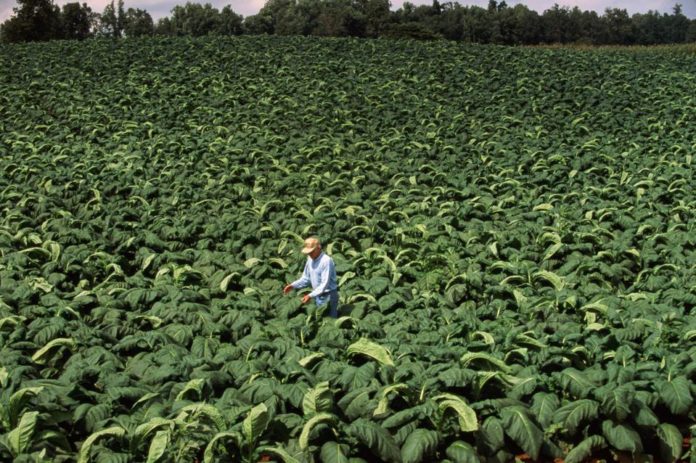
Kitui County is one of the low-rainfall counties in Kenya, and commercial crop farming in the region is unsuitable, with many farmers opting for livestock farming.

Some farmers in the region have, however, ventured into farming drought-resistant crops, particularly tobacco, and making a kill out of it.

In Kilonzo Village, Kitui County, lies the 22-acre farm of Dennis Mwangangi who has joined the list of prominent Tobacco growers in the region.

Mwangangi ventured into tobacco farming in 2016. His first harvest was impressive, inspiring him to invest more in his farm. He harvested  3,100 kilos of the snuff and sold his produce in various towns in the Ukambani region.

“A kilo of tobacco leaves produces 135 rolls after shredding. A roll fetches Sh10 in the market. We target retailers in small trading centers dotting Machakos and Makueni counties where homemade cigarettes are very popular because they are affordable,” Mwangangi told Nation.

Mwangangi, a Nairobi-based tour operator, has employed six workers on his farm who assist in the production of the snuff.

The workers shred the leaves methodically using machetes, marking the onset of the production of cigarettes, which ends with rolling the shredded leaves in used newspaper cuttings.

While many farmers have faith in the crop due to its drought tolerance, others lamented the high cost of inputs. Simon Makau, the chairman of Kitui Tobacco Growers Cooperative Society, said the crop has enabled farmers in the region to educate their children.

“Tobacco is our biggest cash crop in Kitui Central. No other crop comes closer in terms of value. Even at the height of drought, tobacco has enabled farmers to educate their children in this region,”  He said.

The cultivation of tobacco starts with the establishment of a nursery, and the seedlings are transplanted towards the onset of short rains.

“We establish our nursery around August 24, guided by the onset of the short rainy season. Around the same time, the preparation of farmland through setting up bunds to enhance water retention starts.’’

“We transplant immediately the short rainy season starts. Three days after transplanting, we apply fertiliser on the crop,” said Gabriel Uhuru, who has grown tobacco for 40 years.

The leaves take two to three months to be ready for harvesting. Flue curing, where leaves are hung in curing barns and heated air is generated to dry the leaves, gives them their distinctive aroma. They stay three days in the barn, whose temperature is regulated.

A kilo of dried tobacco leaves fetches between Sh400 and Sh500 on average in open-air markets in Kitui County and half the price when sold through the cooperative society.

Also Read: Kenchic accelerates Mtaani Butchery expansion across Kenya

How to Start a Profitable Ice cream Business

0

How to Start a Profitable Ice cream Business: The idea of owning and running your own business is thrilling, especially if you have the passion and ambition to make it successful. Starting an ice cream business in Kenya can be lucrative, and with the right approach, you can turn your sweet dreams into a profitable reality.

Several things will decide whether or not your ice cream venture will succeed, from having the right location to managing resources effectively. In this post, we’ll discuss steps on how to get started & ensure long-term success.

1. Business Location

Starting a successful and profitable ice cream business in Kenya requires careful consideration of multiple factors.

The location you choose can be the most critical factor in determining whether your business succeeds or fails. It can be the difference between booming sales figures or a lifeless shopfront.

10 things nobody will tell you when you’re starting a business

Factors to consider include:

  • Foot-traffic, pedestrian accessibility
  • Competition from other businesses
  • Convenience for customers
  • Access to services such as electricity and water
  • Nearby parking options
  • Rent prices
  • Potential customer demographics

Finding a unique and memorable spot to create an exciting atmosphere and attract new customers is ideal. Do your research, take the time to think strategically about where you locate your business, and you’ll significantly increase the likelihood of success.

2. Choose Your Equipment

You will require specific equipment to make and serve your ice cream. These can range from freezers to topping dispensers, ice cream machines, and blenders.

Not all of the equipment is necessary for every business. You will need to consider different factors, such as the size of your space and how much product you want to offer.

Why You Should Think Twice Before Starting A Business With Your Friend

You will need chairs, tables, and display refrigerators for physical shops. Think about the kind of atmosphere you want to create that is inviting and comfortable for customers.

Investing in good quality packaging (like waffle cones, disposable cups, and spoons) can make a massive difference to the success of your business.

3. Invest in Quality Ingredients

Regular vanilla or strawberry flavours are common. They sell well, and customers usually love them. However, it would help if you offered something unique to make your business stand out. You can provide personalized flavours and combinations or source local ingredients to make exotic flavours.

In Kenya, sourcing premium natural ingredients that align with local palates can drive success for brands looking to gain market share. Ensure these high-quality components are sourced from sustainable suppliers. Doing so ensures the integrity of the flavour profile and establishes a lasting relationship between customers and the business.

4. Obtain Licenses & Permits

You will need to obtain several licenses and permits before opening for business. Depending on where you are in Kenya, you can start the process by registering your business with the local authority or county government.

Do’s And Don’ts For Starting a Business In Nairobi

This enables you to get necessary permits and licenses, such as health and food safety certification, a permit from Kenya Daily Board, and a business permit.

Check with your local authority to ensure you comply with all the necessary regulations, as failure can be costly.

5. Promote your Business

Knowing where to start is half the battle. Once everything is in place, you’ll need to let people know about your business.

Promote it through word of mouth, social media, advertising, and other channels you think might work. You may need to hire a marketing professional to help create an effective strategy. Put yourself out there and make sure your brand is seen.

Bottom Line

Starting an ice cream business in Kenya is a fascinating and potentially lucrative venture, but the path to success can be treacherous. You need to stay abreast of local laws, plan carefully for your start-up capital and consider ways to differentiate yourself in a crowded market.

Knowing available support like loan schemes and working with reliable suppliers to keep costs down will allow you to maximize profits as you get established. You can pursue your dream of selling ice cream treats in Kenya with focus and strategic choices.

Decoding Kenya’s number plates: What the letters and colours really mean

0

Kenyan roads encounter thousands of vehicles daily, each carrying a unique registration number.

The National Transport and Safety Authority (NTSA), through the Registrar of Motor Vehicles, handles the registration and issuance of all motor vehicle plates, including civilian, Government of Kenya (GK), parastatal, diplomatic, and NGO vehicles for identification.

Beyond simply identifying a vehicle, number plates also offer clues about ownership, institutional use, and even the type of vehicle being driven.

From ordinary private cars to diplomatic convoys and county government fleets, the lettering and colour schemes on Kenyan number plates provide a quick guide to the status and purpose of a vehicle.

Ordinary Private Plates

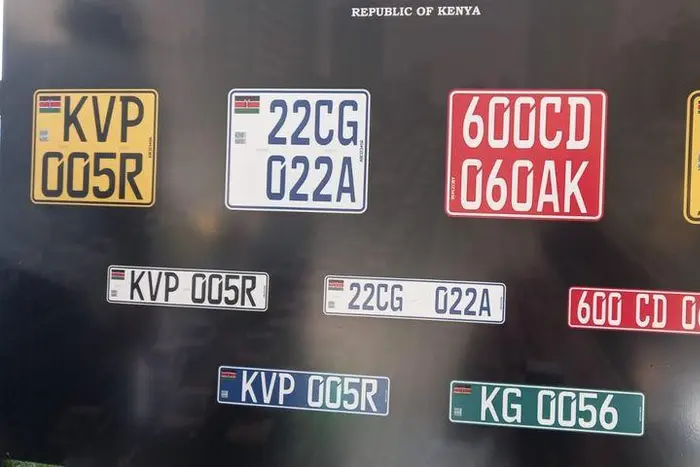
The most familiar number plates on Kenyan roads are those issued to privately owned vehicles. These plates typically appear in formats such as KDA 123A.

Private vehicles usually display a white front plate with black lettering, while the rear plate is yellow with black lettering. This is the standard registration used by the majority of motorists and represents ordinary civilian ownership.

GK Plates: Government of Kenya Vehicles

Vehicles bearing GK plates are officially registered under the Government of Kenya. These belong to national government ministries, departments, and state agencies.

Such vehicles are usually assigned for official duties and may be seen transporting government officers, carrying out field operations, or providing logistical support to government programmes.

EX-GK Plates

A plate marked EX-GK carries an important distinction. The prefix EX stands for “ex,” meaning “formerly.”

These vehicles were once part of the Government of Kenya fleet but have since been disposed of, often through auction, sale, or transfer into private hands.

While the vehicle may no longer be in official service, the registration continues to reflect its government origin.

CG Plates: County Government Fleet

With the advent of devolution, county administrations have their own fleet of vehicles, identified by CG number plates, meaning County Government.

These vehicles are owned and operated by county governments and are typically used in public service delivery, ranging from health outreach programmes and agriculture support to administrative duties.

Diplomatic Plates: Embassies and International Missions

Diplomatic vehicles in Kenya are easily recognisable due to their distinctive red plates with white lettering.

Many of these carry the prefix CD, short for Corps Diplomatique, indicating diplomatic status. Others display UN, used by United Nations agencies and recognised international organisations.

These plates signal vehicles attached to embassies, diplomatic missions, and international institutions operating within Kenya, often granting them special recognition under international agreements.

Green Plates

In line with the global shift toward cleaner transport, Kenya has introduced green number plates with white characters.

These plates are specifically meant to identify electric vehicles (EVs) and electric motorcycles, making them distinguishable from petrol or diesel-powered vehicles.

The plates feature unique lettering with prefixes “EVA” for electric cars and “EMAA” for electric motorcycles.

Blue Plates

Kenyan roads have also historically featured blue plates with white lettering, commonly associated with certain state corporations and parastatals.

Although not as widespread as private or GK plates, the blue plate category has been used to distinguish vehicles belonging to public institutions from those registered under ordinary private ownership.

Dealer and Trade Plates

Not all plates on the road represent permanent ownership. Vehicle dealers, assemblers, and fabricators may use special trade registration categories such as KD, KG, or other similar identifiers.

These plates are issued specifically for the motor trade and are used for test driving, delivery, fabrication processes, or temporary movement of vehicles before formal registration.

Personalised Plates

Kenya has also embraced personalised number plates, allowing vehicle owners to replace the standard sequence with a custom name, brand, or unique combination.

Often seen on luxury vehicles or corporate fleets, personalised plates are viewed as a symbol of prestige and branding, giving motorists the opportunity to make their vehicles instantly recognisable.

Also Read: Fuel prices surge as Diesel jumps sharply to Sh46.29 in the latest EPRA review

How customer pre-orders helped me build a thriving hardware business

0

We’ve heard so many tales of people venturing into farming or any other form of entrepreneurship simply because they grew up relying on the venture as their economic mainstay.

This is a testament that a person’s background greatly influences who they become in the future.  For Rahab Kiige, growing up in a family of self-employed individuals inspired her to also venture into entrepreneurship.

After high school, Rahab enrolled in accountancy, a career that was then popular among her peers. While still in campus, she secured a job at Kitengela hospital as an accountant, an opportunity that was a stepping stone to her future ventures.

Immediately after graduating, she was determined to fulfill her entrepreneurship wish. In partnership with a friend identified as Maina, the duo started an accountancy college in Kitengela.

“We started a college of teaching accountancy in Kitengela and used to call ourselves Shina School of Accountancy which was actually doing very well, we had almost 30 students within a very short duration,” she recalled.

They, however, closed down and went back to employment. She worked at Safaricom as a salesperson before joining Jica, an opportunity that she says exposed her to so many opportunities that sharpened her entrepreneurial journey.

Rahab would later quit employment after she felt that the time had come to soldier by herself. She tried her hand in various agribusinesses, including chicken and onion farming, but failed terribly, leaving her in losses.

However, this did not deter her from trying something different. She would later venture into the Fast-Moving Consumer Goods business, inspired by her sister, who was also doing the business.

After a thorough research about the business, Rahab secured a loan but unfortunately lost all in a con game.

“I was conned the loan and so the shop started with nothing. I was depressed when I realized I had been conned the loan,” she narrated.

In efforts to secure funding, a “God-sent” client visited her shop and made a deposit of Sh200,000 with a promise of purchasing some goods.

“I remember the first stack of money he gave me was Sh50,000. He said I’m going to come and buy goods from your shop, so he gave me Sh50,000. Two days later, he walked in and gave me another Sh50,000, a week later, or maybe another. Within that one week, he gave me Sh200,000,” she revealed.

She used the money to acquire stock for her hardware shop. While the money was not enough for the capital-intensive hardware business, Rahab established a rapport with different supplies who would supply goods to her whenever clients ordered.

“Sh200,000 in hardware is pocket change, so what customers were ordering, I had already obtained rapport with different suppliers, so I used to send the vehicle very first to get the goods and then come and supply the customers,” she says.

Things started to blossom when another client walked in and made a deposit of Sh1 million. She was able to make a little profit, which she plowed back into the business.

She notes that the business broke even after two years of consistency and customer satisfaction.

According to Rahab, quality, efficiency, fair pricing and good customer service are some of the secrets to succeeding in the hardware business.

“You must make sure that you give the people the quality that they deserve for the value of money that they are giving you,” she says.

From zero capital, the businesswoman has now expanded her business to two shops in Naivasha and Gilgil.

Also Read: Inside Equity’s rise to most profitable bank in East and Central Africa

Fuel prices surge as Diesel jumps sharply to KSh 46.29 in the latest EPRA review

EPRA: Kenyan motorists and businesses are set to face higher fuel costs following the latest pricing review by the Energy and Petroleum Regulatory Authority (EPRA) for the period between May 15 and June 14, 2026.

In its official release, EPRA announced significant increases in the maximum retail pump prices for key petroleum products, with diesel registering the steepest rise.

Diesel records sharpest increase

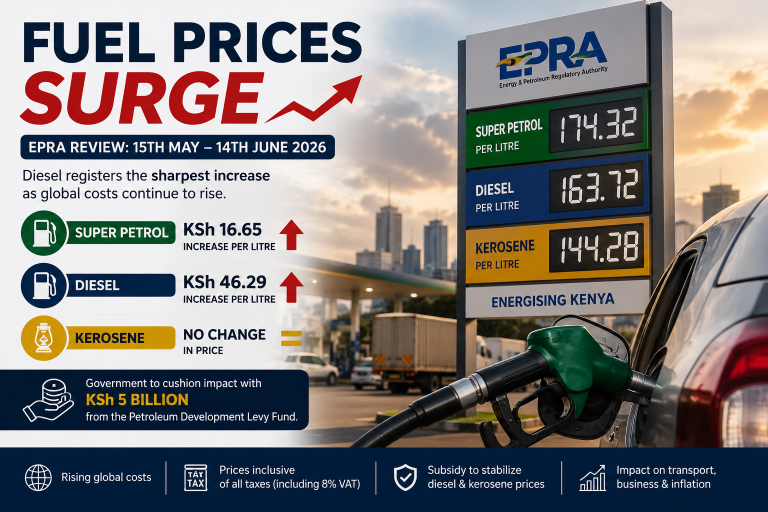
Under the new EPRA pricing cycle, the cost of diesel has increased by KSh 46.29 per litre, marking one of the most notable adjustments in recent months. Super petrol prices have also risen by KSh 16.65 per litre, while kerosene prices remain unchanged.

The EPRA adjustments reflect shifts in global oil market dynamics and rising import costs, which continue to exert pressure on domestic fuel pricing.

Businesses likely to suffer most under new fuel prices

Rising global costs are driving local prices

EPRA attributes the price increases primarily to a surge in the landed cost of imported petroleum products.

  • Super petrol recorded a 10.00% increase, rising from $823.27 to $906.23 per cubic metre
  • Diesel saw a sharper 20.32% jump, climbing from $1,073.82 to $1,291.98 per cubic metre
  • Kerosene increased marginally by 1.59%, from $1,311.93 to $1,332.73 per cubic metre

These figures underscore the continued volatility in international oil markets, where pricing benchmarks directly influence Kenya’s import-dependent fuel supply chain.

Government steps in with a partial subsidy

To cushion consumers from the full impact of rising fuel costs, the government will deploy approximately KSh 5 billion from the Petroleum Development Levy (PDL) Fund. The subsidy is targeted at stabilizing diesel and kerosene prices, which are critical for transport and household energy use.

However, the magnitude of the global price increase—particularly for diesel—means that consumers will still experience a substantial upward adjustment at the pump.

Tax structure remains a key component

The new prices by EPRA remain inclusive of all applicable taxes, including the 8% Value Added Tax (VAT) on petroleum products. This is in line with the VAT Act, Finance Act provisions, and inflation-adjusted excise duties.

Costly fuel looms as two local firms import petrol at 3 times cost of G-to-G deal

Taxation continues to form a significant portion of pump prices, reinforcing the structural cost burden on fuel consumers and businesses.

Implications for the economy

The sharp rise in diesel prices carries broader economic consequences. Diesel is the backbone of Kenya’s logistics, agriculture, and manufacturing sectors. A steep increase typically translates into higher transport costs, which cascade into food prices and overall inflation.

For businesses, especially SMEs and logistics operators, the cost escalation will likely compress margins or force price adjustments, further straining consumer purchasing power.

Strategic outlook

This pricing cycle reinforces a recurring structural reality: Kenya’s near-total reliance on imported refined petroleum products exposes the economy to external shocks. While short-term subsidies provide relief, they are fiscally costly and not sustainable over the long term.

The more durable response lies in diversifying energy sources, improving fuel efficiency, and accelerating investment in alternative energy systems, including electric mobility and local refining capacity.

Leadership reflection

Moments like this test both policy discipline and business resilience. Leaders—whether in government or enterprise—must confront the underlying vulnerabilities, not just the symptoms. Sustainable competitiveness will come from reducing exposure to external volatility, building operational efficiency, and making long-horizon decisions that prioritize stability over short-term relief.

M-PESA: How 58% free transactions have propelled growth

1

Beyond the remarkable growth in transaction volumes and value, one of M-PESA’s most momentous milestones in the last financial year was the continued growth of small-value transactions, known at Safaricom as M-PESA Kadogo.

Zero-rated transaction

Under the initiative, mobile money transfers of KES100 and below and merchant payments of KES200 and below are zero-rated. In the 2025/2026 financial year, whose results were announced on May 7, the initiative facilitated 17.1 billion free transactions, accounting for 58% of all M-PESA activity.

For millions of Kenyans, particularly low-income earners and small businesses, M- PESA Kadogo continues to break down financial barriers by enabling free small-value transactions, expanding access to digital financial services and strengthening participation in the formal digital economy.

The free transactions include person-to-person (P2P) transfers of between KES 1 and KES 100, Lipa na M-PESA payments below KES 200, cash deposits at M-PESA agent outlets and airtime purchases through M-PESA.

Esther Waititu: Meet the woman leading M-Pesa’s latest innovations

The decision to remove the charges was made in the wake of COVID-19, during which charges on bank-to-M-PESA and transfers below KES1,000 had been removed.

For the company, the effect of the removal of charges was a tripling in the number of
transactions between 2020 and 2026.

Record transaction volumes

Safaricom’s M-PESA platform processed 46.4 billion transactions worth KES 41.7 trillion during the last financial year, reinforcing its position as the backbone of Kenya’s digital economy while accelerating financial inclusion for millions across the country.

“With M-PESA Kadogo, our purpose is to make digital payments affordable for small- scale daily purchases and deepen financial inclusion. The removal of transaction fees has reduced friction and accelerated the usage of M-PESA across the country,” said Peter Ndegwa, CEO, Safaricom

The mobile financial services platform recorded a 13.4% growth in revenue to KES 182.7 billion, driven by strong double-digit growth across consumer payments, business payments and global payments.

Growth of M-Pesa and how it has opened financial horizons for small businesses

M-PESA revenue contribution

Consumer payments remained the largest contributor to M-PESA revenue at KES 74.5 billion, followed by business payments at KES 56.7 billion, highlighting the platform’s evolution from a money transfer service into a broad digital payments and financial ecosystem.

One of the key highlights in the consumer business is the remarkable growth of Pochi la Biashara, which has expanded significantly over the past year. Since its launch in 2021, the product has continued to gain strong traction over the last two financial years. The customer base grew from 600,000 users in the 2024 financial year to 1.1 million the following year, before doubling to 2.2 million in the last financial year.

Revenue growth has been equally impressive, rising from KES 800 million in 2024 to KES 2.2 billion the following year, and reaching KES 4 billion in the last financial year. Pochi la Biashara customers can also invest overnight balances in Ziidi MMF, enabling their money to grow.

The sustained growth of M-PESA reflects the increasing adoption of digital financial services and Safaricom’s continued commitment to advancing financial inclusion, digital access and economic empowerment across Kenya.

MultiChoice launches customer centric “Everything Can Wait Campaign” ahead of FIFA World Cup 2026

0

MultiChoice, a Canal+ Group company, has today launched the Everything Can WaitCampaign, a fan-centric initiative designed to rally Kenyan football lovers ahead of the 2026 FIFA World Cup, set to take place from 11 June to 19 July 2026 across the USA, Mexico and Canada.

The campaign, unveiled in Nairobi, aims to enhance how, where and when fans experience football by combining accessible subscription offers, immersive content, and on-ground fan engagement activities across DStv and GOtv platforms.

Rooted in the passion, resilience and shared identity of Kenyan football fans, Everything Can Wait positions MultiChoice as the home of football by delivering a viewing experience that is both premium and locally relevant.

Under this campaign, DStv customers will have access to all 104 matches with special hardware offers. The DStv Zapper decoder will now retail at Kes 599, down from Kes 999. New customers can also enjoy great savings on installation accessories, with the DStv Dish Kit now going for Kes 1200 (previously Kes 1,500) and installation fees going for Kes 1000 (previously Kes 1500).

“The FIFA World Cup is a defining global moment, and we want every fan to feel part of it,” said Nzola Miranda, CEO, MultiChoice Kenya, “Through SuperSport, we continue to invest in world-class sports broadcasting, ensuring fans across Africa enjoy premium football coverage and an exceptional viewing experience.”

The campaign rollout will feature a mix of localized storytelling, consumer promotions, and interactive fan experiences designed to bring viewers closer to the action, both on and off the screen. This aligns with MultiChoice’s broader strategy to deliver flexible viewing options, including live broadcasts, streaming, and catch-up services.

Multichoice cuts DStv and Gotv decoder prices as subscription dips

As Africa’s home of football, SuperSport will once again deliver comprehensive coverage of the tournament, including all 104 matches live, expert analysis, and dedicated programming tailored to African audiences.

Locally, the campaign speaks directly to the Kenyan fan’s love for the game, ensuring that access, affordability and cultural relevance remain at the forefront.

“This campaignis a celebration of the Kenyan fan for their passion, their resilience, and their love for the game,” added Mr. Miranda. “Our goal is to ensure that every customer can experience the excitement of the World Cup in a way that is accessible, engaging and uniquely tailored to them.”

With kickoff fast approaching, MultiChoice Kenya is positioning DStv and GOtv as the ultimate football destination, focused on driving deeper engagement and delivering a seamless viewing experience at scale.

The campaign builds on the success of previous campaigns like Tumefungulia Value proposition, reinforcing MultiChoice’s commitment to making world-class football content more accessible to a wider audience.