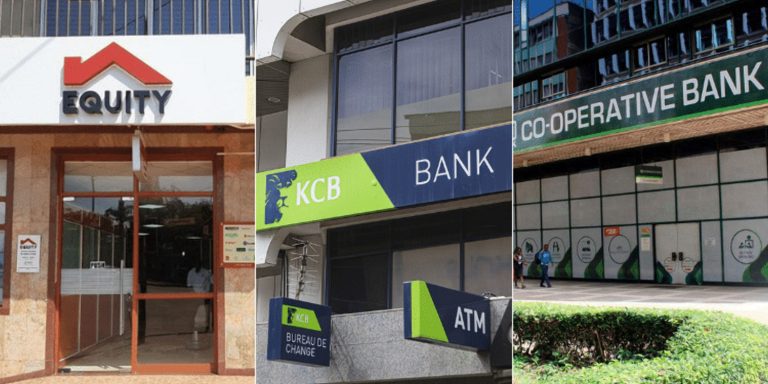
Kenyan commercial banks are increasingly shifting their lending strategies from traditional primary production to value addition, aiming to plug local small and medium-sized enterprises (SMEs) into global supply chains.
Leading this strategic pivot is Equity Bank, which is accelerating its push to transition grassroots businesses from raw material producers to competitive players in the global market.
This accelerated push was the focal point during a recent high-level business dinner held between Equity Bank’s executive leadership, the Narok County Government, and the local business community. Once heavily anchored on the Maasai Mara National Reserve and rain-fed wheat farming, Narok is rapidly transforming into a formidable commercial hub, serving as a blueprint for this new wave of local enterprise development.
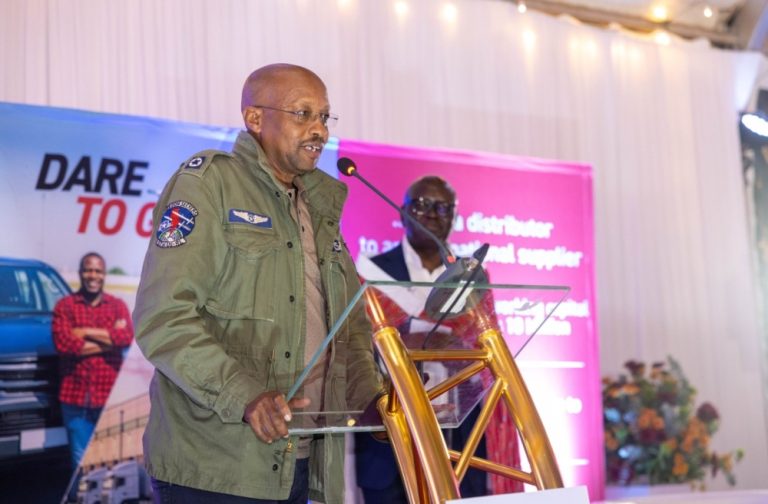
Equity Bank Managing Director Moses Nyabanda noted that the focus must shift toward “smart agriculture” and market linkages to unlock the true wealth of local enterprises.
“We are seeing farmers adopting smart agriculture, moving away from how our forefathers farmed,” Mr. Nyabanda said. “But we do not just want to increase yields; we want to connect you to the market. If you are a livestock farmer, we want to see how we can link you to markets that buy processed leather for designer bags, rather than selling raw hides for a fraction of the price.”
To further de-risk the agricultural sector, which remains highly sensitive to weather patterns, Mr. Nyabanda committed to aligning loan disbursement timelines strictly with local crop cycles, assuring farmers of a two-week turnaround time for agricultural credit to ensure planting seasons are not missed.
This focus on targeted capital deployment is driven by rapid, multi-sectoral economic expansion in regions outside traditional urban centers.
“Narok is not a small market to us,” noted Kagiso Moloi, Equity Bank’s Commercial Director. “Livestock business is growing, trade is growing, and tourism is growing. People in Nairobi may not realize how fast this region is expanding. Our job is to fund that growth and move money quickly and safely.”
To sustain this momentum and build capacity for global export, lenders are deploying aggressive asset finance and unsecured credit lines to stimulate local enterprise.
“If you want a tractor or a commercial truck, we are ready to support you with up to 105 per cent financing,” said Carol Rutto, Equity Bank Kenya’s Head of Retail and Branch Business. “We are also offering unsecured loans of up to Sh10 million without requiring you to pledge any collateral at the bank. Our doors are open to serve you exactly how you need.”
Historically, access to credit in agrarian regions was stifled by stringent collateral requirements, locking many out of the commercial supply chain. Okipira Ole Tutai, a veteran farmer who began his agribusiness journey in 1985, recalled how state-backed agricultural financiers strictly demanded title deeds, a near impossibility for young farmers in communally held land systems.
“From 1985 to 1994, I had never received a loan anywhere. With state financiers, you had to have a title deed, which we didn’t have as young men. There was simply no way to access credit,” Mr. Tutai recalled. The entry of flexible, cash-flow-based lending altered this landscape, allowing farmers like him to scale from subsistence to commercial operations, eventually acquiring tractors and commercial real estate.
This flexible approach to banking has also been crucial for insulating SMEs from macroeconomic shocks. Education investors in the region noted that strategic interventions such as loan moratoriums were the lifeline that prevented mass closures of private educational institutions during the Covid-19 pandemic. By putting loan repayments on hold until the economic environment stabilized, institutions were able to survive the crisis and later leverage bank financing to acquire land and build infrastructure.
However, as credit uptake increases, so does the conversation around loan recovery, a sensitive issue in Kenya’s banking sector amid rising non-performing loans (NPLs). Speaking at the forum, Narok County Executive Committee Member for Finance, David Ole Muntet, urged financial institutions to adopt more humane default management strategies.
“Borrowing is a wedding, but paying back can feel like a funeral,” Mr. Muntet remarked. “While people must pay their loans, we urge banks to find better approaches to handling defaulters rather than immediately auctioning properties. There is always a way out.”
TikTok has become an important platform for creators, entrepreneurs, businesses, media companies and influencers looking to reach large audiences.
But building an audience on TikTok also comes with an important responsibility: understanding the platform’s Community Guidelines.
A post can be removed or flagged within seconds of being uploaded. In some cases, creators may receive a warning even when they did not intend to violate TikTok’s rules.
I recently experienced this myself.
I posted pictures I had taken at a gun shooting range. The photographs were simply documenting my experience at the range. I was not selling a firearm, promoting violence or encouraging anyone to use a weapon.
Almost immediately, TikTok issued me a violation warning.
The experience highlighted an important lesson for anyone building an audience on TikTok: what a creator intends to communicate is not necessarily how an automated moderation system interprets the content.
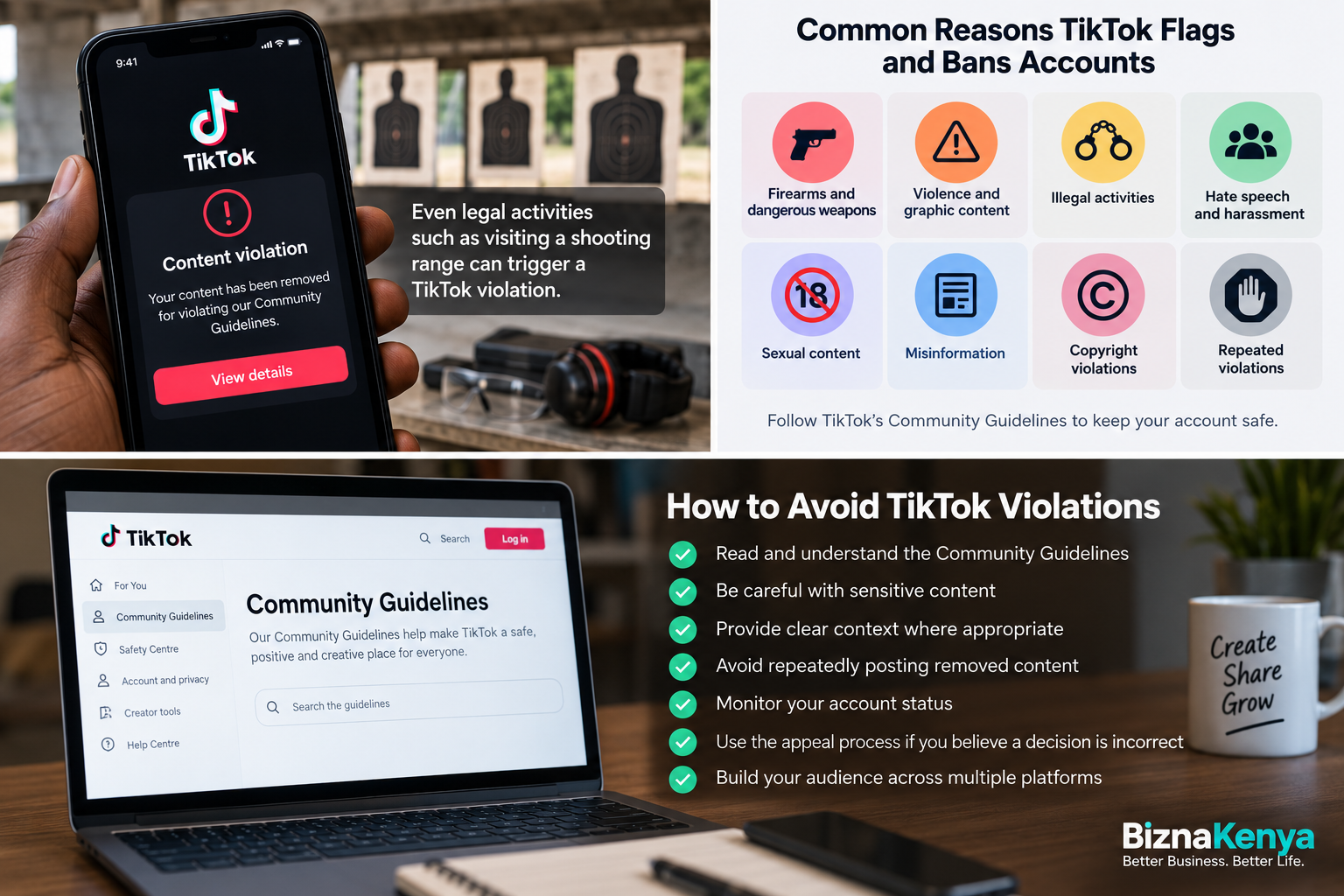
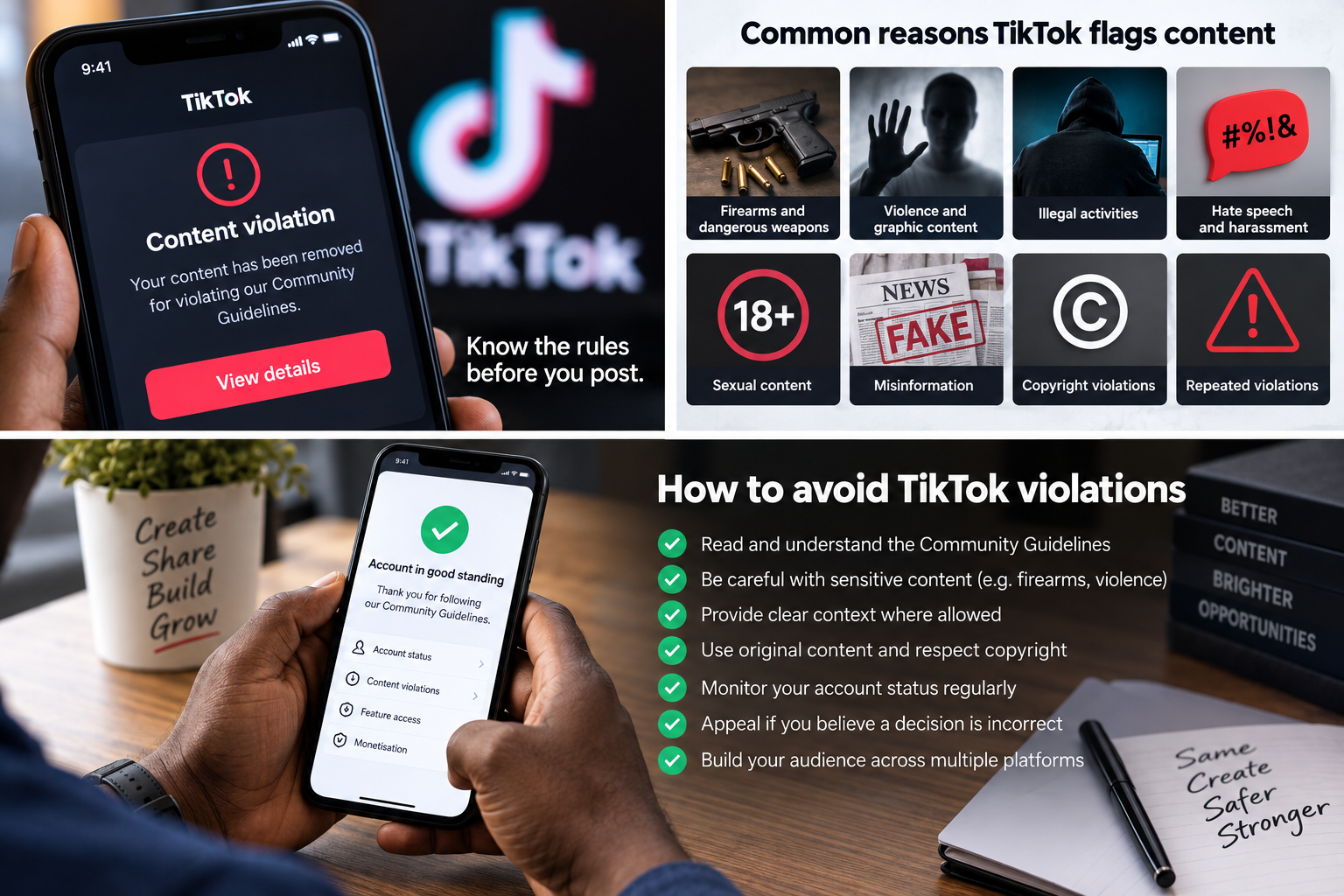
TikTok’s Community Guidelines cover a broad range of subjects, including violence, dangerous activities, regulated goods, illegal activities, hate speech, harassment, misinformation, sexual content and intellectual property.
TikTok has also consolidated firearms and dangerous weapons under its regulated goods and services policy.
This means that content featuring certain objects or activities can attract moderation even when the creator’s intention is not harmful.
TikTok uses automated systems as part of its content moderation process. The company said in 2025 that more than 85% of content removed for violating its Community Guidelines was identified and taken down by automation.
This helps explain why a violation notification can sometimes appear almost immediately after content is uploaded.
Why TikTok flags and bans accounts and how to avoid violations
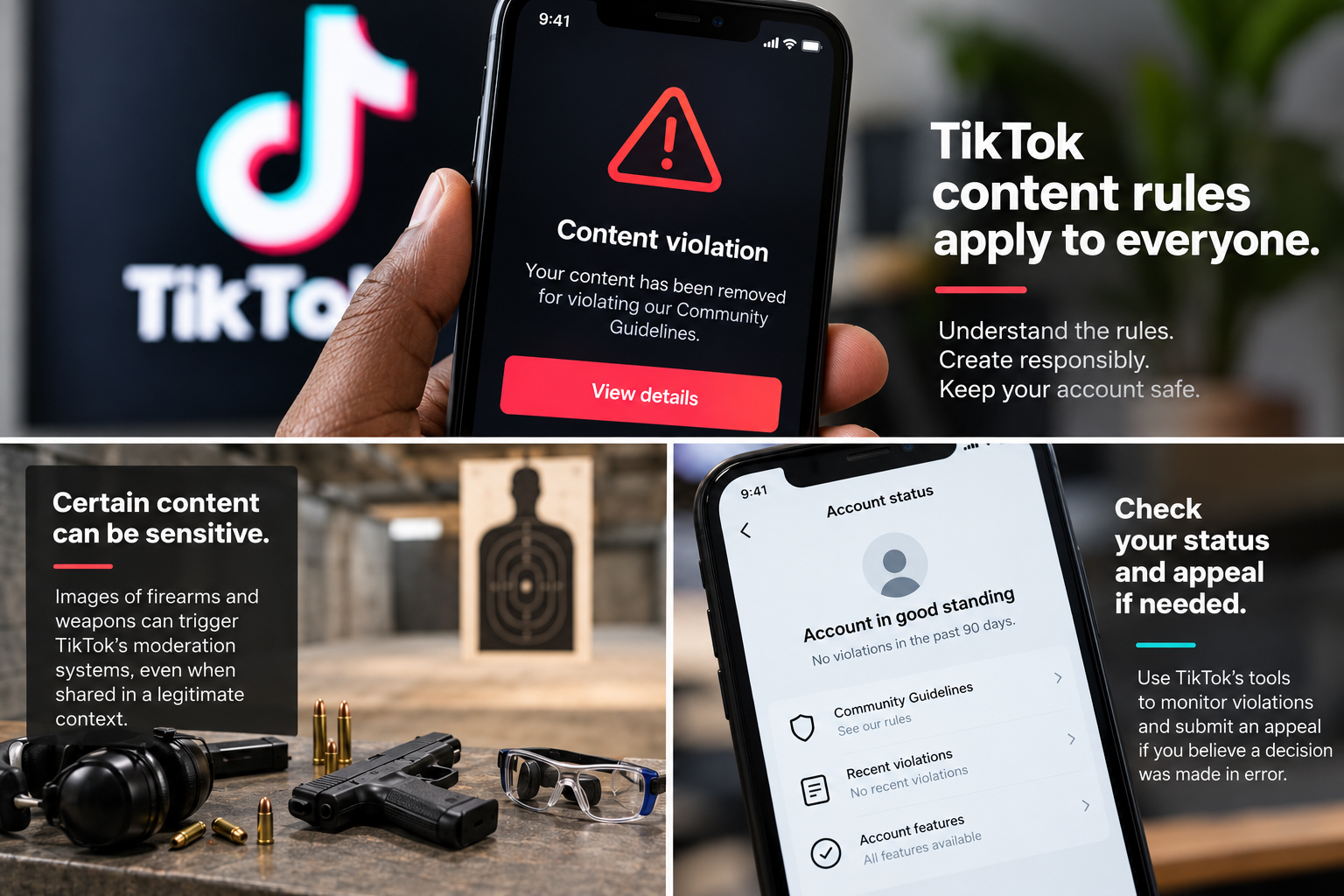
Why shooting-range photographs can trigger a violation
A photograph taken at a shooting range may appear harmless to the person who took it.
However, the presence of firearms makes the content fall into a category that TikTok treats as sensitive.
There is an important distinction between the creator’s intention and what is visually detectable.
A photograph of a firearm could potentially represent recreational shooting, news reporting, educational material, historical content, firearm promotion or content associated with violence.
Automated moderation systems have to assess enormous volumes of content, often before a human moderator has reviewed the material.
TikTok has acknowledged that automated moderation cannot be perfectly accurate and maintains an appeal process for creators who believe content has been incorrectly removed.
For creators, the practical lesson is simple: sensitive visual content should be treated carefully, even when the context is completely legitimate.
A TikTok violation does not automatically mean that an account will be permanently banned.
Depending on the nature and severity of the violation, TikTok can remove content, issue a warning, restrict certain features, issue strikes or take more serious action against an account.
TikTok’s account enforcement system uses strikes for violations. The threshold for action can vary depending on the policy involved and the potential harm associated with the violation. TikTok also says that serious violations can result in a permanent ban without going through the normal progression of strikes.
TikTok has stated that strikes expire from an account’s record after 90 days.
Why TikTok flags and bans accounts and how to avoid violations
Can TikTok permanently ban an account?
Yes.
An account can be permanently banned if it reaches the relevant enforcement threshold. TikTok can also impose a permanent ban for particularly serious violations.
The company has previously identified severe violations, such as promoting or threatening violence and certain forms of child sexual exploitation, as examples where a permanent ban can occur following a single violation.
TikTok also says that accounts accumulating a high number of strikes across different policies and features can be permanently banned.
This makes repeated violations particularly important for creators who depend on TikTok for their audience or income.
A warning is an opportunity to understand what TikTok believes went wrong.
Creators should read the violation notification carefully and identify the specific policy involved.
TikTok has also introduced tools that allow creators to check their account standing and see information about violations and restrictions. Its Account Check feature can show whether recent posts have violated rules and whether certain account features have been restricted.
Rather than simply continuing to publish the same type of content, creators should use the warning to review their content strategy.
Why TikTok flags and bans accounts and how to avoid violations
What should you do if TikTok removes your content?
If you believe TikTok has made a mistake, you can appeal.
TikTok’s current support guidance says creators can appeal an account restriction through the violation notification. The process includes going to the Inbox, System notifications, Account updates, selecting the relevant restriction and choosing Appeal.
The same principle applies to content removals where an appeal option is provided.
An appeal should explain the legitimate context clearly and factually.
For example, if a photograph was taken at a licensed shooting range, the appeal should explain that context rather than simply arguing that the creator did nothing wrong.
There are several broad categories that creators should monitor.
1. Firearms and dangerous weapons
Content involving firearms and dangerous weapons can attract moderation because TikTok treats these as regulated goods and services.
Creators should therefore exercise particular caution when posting photographs or videos showing firearms.
2. Violence and graphic content
Content that promotes, threatens or depicts certain forms of violence can result in serious enforcement action.
TikTok has identified some violence-related violations among categories that can result in permanent bans.
3. Illegal activities
Content that facilitates or promotes illegal activities can violate TikTok’s rules.
4. Hate speech and harassment
Targeting individuals or groups with prohibited hateful or abusive content can result in enforcement.
5. Sexual content
TikTok places significant restrictions on sexual content, nudity and sexually explicit material.
6. Misinformation
Certain forms of misinformation can violate TikTok’s Community Guidelines, particularly where the content creates a risk of harm.
7. Copyright violations
Creators should also ensure that they have the appropriate rights to use music, video, photographs and other copyrighted material.
8. Repeated violations
Repeated violations can be more serious than an isolated mistake because TikTok’s enforcement system considers both the frequency and severity of violations.
The best way to protect a TikTok account is to understand the platform’s rules before publishing potentially sensitive content.
Creators should regularly review TikTok’s Community Guidelines, particularly if their content involves regulated products, finance, health, politics, weapons, dangerous activities or other sensitive subjects.
It is also important to consider the context of photographs and videos.
If an image could easily be misunderstood, the surrounding content should make the legitimate purpose clear, where the platform’s rules permit the material.
Creators should also avoid repeatedly uploading content that has already been removed. If you believe the removal was incorrect, use the appeal process rather than repeatedly reposting the same material.
Another important habit is monitoring the account’s status.
TikTok provides tools that allow creators to see whether their content or features have been restricted.
Why TikTok flags and bans accounts and how to avoid violations
Don’t assume that a legal activity is automatically TikTok-approved
This is an important distinction.
Something can be legal in the country where it takes place and still be subject to restrictions on a social-media platform.
For example, visiting a shooting range may be a lawful activity. That does not automatically mean every photograph or video taken at the range is permitted under TikTok’s Community Guidelines.
Social-media platforms establish their own rules about what can be published and distributed through their services.
TikTok’s Terms of Service also state that it can take action where it believes users have violated its Terms, Community Guidelines or other applicable policies.
For professional creators, there is a bigger business lesson.
A TikTok account can become extremely valuable, but the account itself is not an asset that the creator completely controls.
A creator who has spent years building an audience can potentially lose access to distribution because of repeated violations or a serious policy breach.
That is why serious creators and businesses should build an audience across multiple channels.
A website, email database, customer database, newsletter, community and other direct communication channels can reduce dependence on a single social-media platform.
TikTok can provide powerful distribution, but the underlying relationship with the audience is more important.
My shooting-range experience was a useful reminder that TikTok moderation can sometimes react to what is visible in an image before the full context is understood.
The photograph may have been completely innocent from my perspective, but the presence of a firearm was enough to trigger a violation warning.
The lesson is not to avoid creating content.
It is to understand the rules of the platforms on which we build our audiences.
Creators should know what subjects are considered sensitive, monitor their account status, take warnings seriously and use the appeal process when they believe a decision is incorrect.
For entrepreneurs and businesses, there is an additional lesson: never build your entire digital audience on a platform you do not control.
Build the platform audience, but also build an owned relationship with your customers and followers.
In the long term, responsible digital entrepreneurship is not simply about gaining followers. It is about building an audience, protecting trust and creating assets that remain valuable beyond any single platform.
For much of the past two decades, Africa’s digital payments story was told through mobile money, where phones gave millions of people a practical way to send, receive and store money without depending entirely on bank branches.
That story is still growing, but governments across the continent are now taking the next step by moving taxes, permits, licences, public services and other payments away from cash, paper receipts and disconnected offices.
The change matters for a simple reason, since collecting money is only one part of the problem when governments still struggle to match a payment to the right service, account, institution and transaction record.
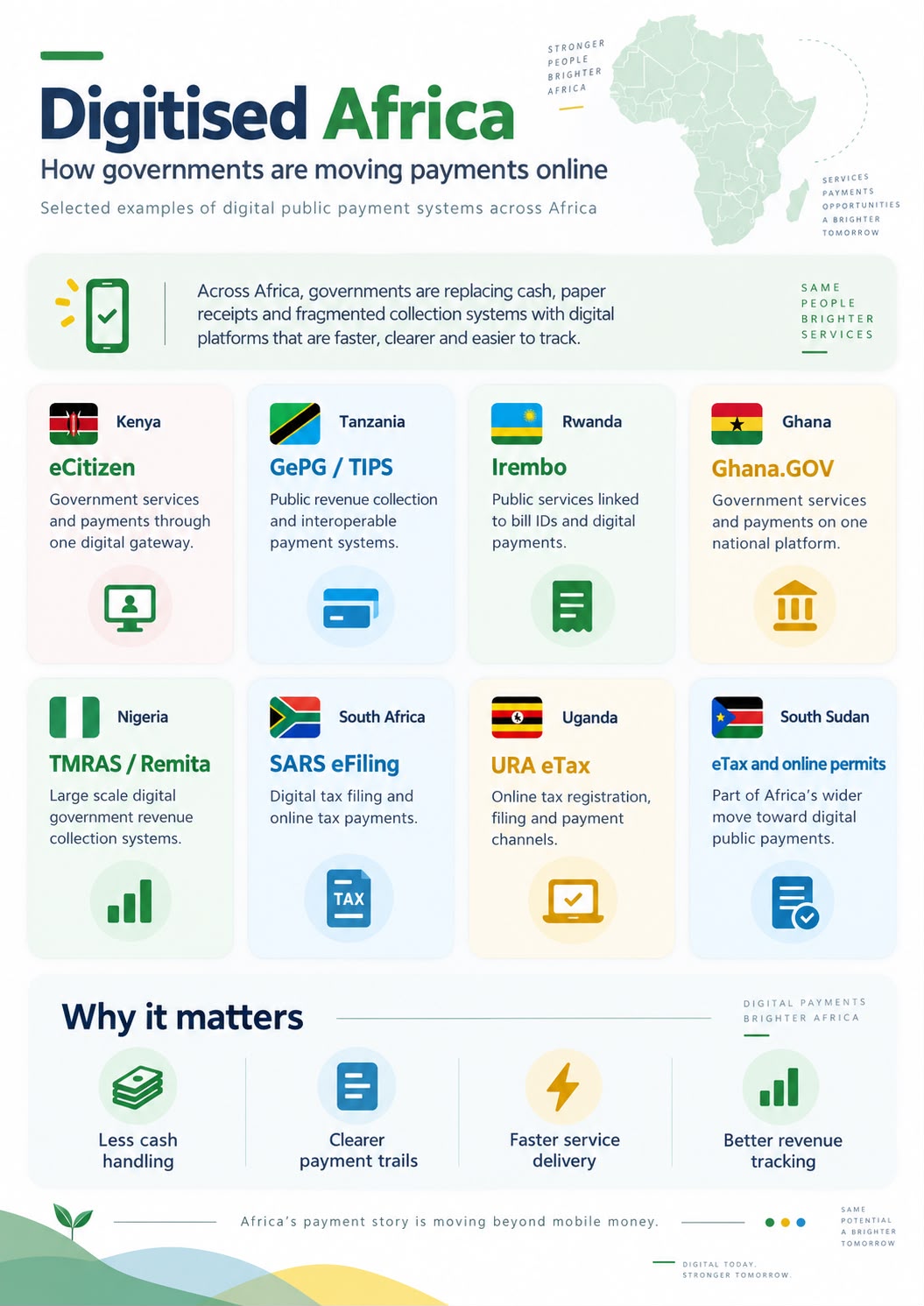
Across Kenya, Tanzania, Rwanda, Ghana, Nigeria, South Africa and South Sudan, different systems are being built around the same basic idea, where public payments should become easier to collect, easier to record and easier to check later.
Kenya Turned eCitizen Into A Government Payment Gateway
Kenya remains one of Africa’s best-known digital payments markets, where mobile money became part of everyday life long before many governments elsewhere had begun thinking seriously about digital public services.
The government later extended that thinking into public payments through eCitizen, which became a central point where citizens and businesses could apply for services and make payments through electronic channels.
The National Treasury says that before the programme expanded, more than one third of government payments were cash-based, creating room for leakage, abuse and expensive collection processes across public institutions.
The move toward eCitizen was about much more than convenience, since the government wanted to improve revenue collection, lower collection costs, and connect public services to payment records that could be followed electronically.
Once a service, invoice and payment sit inside the same system, the government can more easily check what was requested, what was charged, when the payment happened and whether the amount reached the right institution.
Tanzania Built One Gateway For Government Revenue
Tanzania approached the same problem through the Government Electronic Payment Gateway, which connects government institutions with different electronic payment channels and brings public revenue collection into a more standardised system.
The country also built the Tanzania Instant Payment System, known as TIPS, which connects banks and non-bank financial institutions through real time infrastructure that allows money to move between different providers.
During 2024, Tanzania recorded more than 453 million interoperable retail transactions worth over TZS29.9 trillion, alongside approximately 63.2 million active mobile money wallets and strong growth in merchants accepting digital payments.
The bigger lesson from Tanzania is that government digitisation works best when billing, payment channels, transaction records and settlement can be connected instead of sitting inside separate systems that barely speak to each other.
Rwanda Put Public Services And Payments Into One Process
Rwanda has taken its own route through Irembo, where people can apply for government services, receive a billing reference and complete payment through mobile money, banks or international cards.
That approach connects the service request to the payment itself, which means people do not need to move between different offices carrying receipts before the government can confirm that money has been paid.
For the government, the value sits in the record left behind, where a billing identifier, service request and completed transaction can all be connected inside the same process rather than being handled separately.
Rwanda’s system shows how government digitisation can make public services easier to access while giving institutions a clearer way to connect applications, billing information and completed payments.
How African Governments Are Moving Payments From Cash to Digital Systems
Ghana Is Bringing Government Services Onto One Platform
Ghana has followed a similar path through Ghana.GOV, where taxes, permits, certificates and other public services can be accessed and paid for through a common national platform.
The country’s wider payment market has been growing at the same time, with electronic transactions becoming a larger part of daily commerce, banking and the way people interact with public institutions.
When government services move onto the same digital rails already used by banks, cards and mobile wallets, the gap between ordinary payments and public payments becomes much smaller.
That means a citizen can increasingly expect government services to work much like other digital services, where an application, bill, payment and receipt can all be handled without visiting several offices.
Nigeria Shows What Happens When Digital Payments Reach a Huge Scale
Nigeria takes the story into a much larger market, where electronic payments now move at a scale that makes digital infrastructure part of the country’s basic economic machinery.
The Central Bank of Nigeria recorded approximately 5.63 billion instant payment transactions worth around N476.89 trillion during the first half of 2024, with web transfers accounting for the largest share of transaction volume.
Government revenue collection has gone through its own digital changes, with Remita becoming closely associated with federal payments before the Treasury Management and Revenue Assurance System was introduced as part of a newer approach.
Once payments reach that size, the challenge is no longer simply whether money can move quickly, since governments and financial institutions must also deal with reconciliation, settlement, reporting, identity and transaction records.
Nigeria, therefore, shows where many African markets are heading, where digital payments are becoming too important to sit outside the systems used to manage public revenue and national financial activity.
South Africa Has Made Tax Payments A Digital Routine
South Africa has spent years building digital tax administration through SARS eFiling, where taxpayers can submit returns, manage tax information and make payments without depending on physical branches for every interaction.
The system gives taxpayers and businesses a direct electronic relationship with the revenue authority, allowing filings, payments and account information to sit inside one connected digital environment.
South Africa has also been working on a wider payment infrastructure intended to make faster electronic transactions easier to access and more useful across the wider economy.
That matters because tax collection becomes easier to manage when filing information, payment references, and taxpayer records can be connected instead of being spread across paper files and unrelated systems.
Uganda Is Moving More Tax Services Online
Uganda has been putting more tax administration onto digital channels through the Uganda Revenue Authority, allowing taxpayers to register, file returns, generate payment information and complete transactions electronically.
Payments can be connected to registration numbers and completed through banks, cards or mobile money, giving taxpayers several ways to settle obligations without depending entirely on cash and physical collection points.
The result is the same pattern appearing elsewhere across Africa, where the government increasingly wants every important payment connected to a reference that can later be matched against the person, service or tax obligation involved.
South Sudan is now part of the same African story, where governments are trying to move public payments and services away from manual processes that are harder to track and more expensive to manage.
The country has introduced electronic tax administration and online government services, including digital processes connected to petroleum permits where users can apply, pay through different channels and receive completed documents electronically.
An International Monetary Fund assessment reported that South Sudan’s non-oil revenue rose from SSP8.9 billion during the 2016 and 2017 financial year to SSP83 billion during the 2021 and 2022 financial year.
The IMF linked much of that improvement to stronger compliance after electronic tax administration was introduced, showing why digitisation has become an attractive option for governments trying to improve revenue collection.
Companies providing payment software, settlement tools and billing technology are becoming part of that process across African markets, including South Sudan, where public institutions increasingly rely on electronic systems to handle transactions.
CapitalPay is one of the technology companies associated with that wider market, but the bigger story is the same one playing out across Kenya, Tanzania, Rwanda, Ghana and other countries, moving public payments online.
The Important Work Happens After Someone Presses Pay
The payment screen is usually the only part most people ever see, yet the more important work happens behind it, where a transaction has to be connected to the correct service and account.
A complete system may need to confirm identity, generate a bill, connect to banks or mobile money operators, process the transaction, issue a receipt and preserve records that can later be checked.
That is why seeing the name of a bank, mobile wallet or technology company on a payment screen does not automatically tell you who created the charge or who ultimately received the money.
The useful questions are always the same, because governments need to know who imposed the charge, who processed the payment, where the money settled and what record remains after the transaction.
Africa’s Payment Story Is Moving Into Its Next Stage
Africa has already shown that it can move quickly when technology solves an everyday problem, with mobile money becoming one of the clearest examples of that across the continent.
The next stage is about connecting that payment culture to government services, public revenue, banks, cross-border trade and systems that can preserve reliable records long after the transaction has happened.
Kenya has eCitizen, Tanzania has GePG, Rwanda has Irembo, Ghana has Ghana.GOV, South Africa has SARS eFiling, Nigeria has built large scale government payment infrastructure, and South Sudan is moving deeper into electronic public services.
Those platforms are different, but the direction is increasingly similar, with African governments trying to collect money through systems where billing, payment and settlement leave a clearer trail than the paper-based processes they replaced.
Africa’s digital payments story is no longer only about sending money from one phone to another, because it is becoming part of how governments collect revenue, deliver services and keep track of public transactions.
For years, names such as Apple, Tesla, Amazon, and Microsoft have been familiar to Kenyans through the products and services they use every day, but owning a stake in these global companies has often felt like a privilege reserved for wealthy investors or financial experts.
This is because investing in US companies from Kenya has traditionally involved navigating unfamiliar markets and financial intermediaries despite the country’s strong digital financial ecosystem.
These processes have felt daunting for many average retail investors who, in turn, shy away from investing directly in global markets.
It was this gap that Brian Kimathi set out to address when he began building PandaPandain 2025.
The idea was to create a mobile-first investment platform through which Kenyans could access global markets without having to navigate the complexity traditionally associated with international investing.
Kimathi says the objective was to build a platform that could help a new generation participate in global wealth creation while improving their understanding of investing.
“We began building PandaPanda in 2025 with the ambition of making global investing accessible to everyday Kenyans. At the time, accessing U.S. markets could be complicated, expensive and unfamiliar for the average retail investor. We wanted to build a mobile-first experience that made the journey much simpler,” he says.
The platform was officially launched in March 2026 and currently has 8,000 verified customers.
How PandaPanda works
PandaPanda operates through a fully digital customer journey. A user downloads the app, creates an account, and completes identity verification and Know Your Customer checks, all via mobile phone.
Once approved, the customer can fund the investment account using local payment infrastructure and access US-listed stocks and exchange-traded funds (ETFs).
The user can search for companies, review available market information and determine how much they want to invest before placing an order through the app.
The technology interface is provided by PandaPanda, while the investment infrastructure involves regulated partners.
Empire FX Trade Limited, referred to as EFX in the company’s material, is the Kenyan broker responsible for the relevant regulatory and client relationship framework, while Alpaca provides US execution, clearing and custody infrastructure.
One of the features aimed at lowering the entry barrier is fractional investing. A customer does not necessarily have to buy a whole share of a company. Instead, they can invest a smaller amount and obtain fractional exposure to a share.
Additionally, the platform offers commission-free investing, with investments starting from Sh130 ($1), while the minimum deposit is Sh1,000.
“Our broader philosophy is that investing should not require someone to wait until they are wealthy. The platform is designed to allow people to start with what they can afford and build from there. That is also why our proposition focuses on commission-free investing and transparent FX pricing rather than adding layers of complexity to the customer,” Mr. Kimathi says.
Brian Kimathi, the founder of PandaPanda, an investment app allowing Kenyan retail investors invest in US stock. Photo/HANDOUT
What can investors buy?
PandaPanda gives users access to US-listed stocks and ETFs. According to Kimathi, the platform’s user base has shown interest in well-known US companies including Apple, Tesla, Amazon and Microsoft.
Kimathi says the platform is seeing stronger interest in long-term investing than short-term trading, with diversification and financial security emerging as key motivations among customers.
“Customers are looking beyond traditional savings and local investment products and want exposure to global companies and dollar-denominated assets.”
Beyond investment, financial education is another part of PandaPanda’s proposition. The platform has incorporated educational content into the investment experience to help users, especially first-time investors, understand what they are buying.
The material covers issues such as diversification, market volatility, investment risk, the difference between investing and speculation and the importance of taking a long-term approach.
“Our research and product strategy have particularly focused on the 18 to 40 demographic. One of the biggest things we have learned is that the desire to invest is often there, but confidence is missing. People want to understand what they are doing before they put their money into the market,” Mr. Kimathi adds.
For a digital investment platform, regulation and custody are key considerations for customers.
PandaPanda operates as the technology platform and customer interface, while Empire FX Trade Limited is identified as the Kenyan broker of record and is responsible for relevant regulatory, KYC, anti-money laundering and client oversight obligations.
For US securities, Alpaca Securities LLC provides execution, clearing and custody.
The company’s customer agreement provides for securities to be held in custody through Alpaca in the customer’s name, with Securities Investor Protection Corporation (SIPC) protection subject to applicable limits.
Customers are also required to complete identity verification and appropriateness checks before their trading accounts are activated.
The platform has also been designed around the way Kenyans already move money digitally. PandaPanda accepts local payment services such as M-Pesa, which has made transactions seamless, encouraging adoption of digital investments.
The platform currently boasts 8,000 verified customers.
“Our focus now is on converting that growing verified customer base into active, funded investors and building repeat investment behaviour. The metrics we care most about are therefore verified customers, funded accounts, first investments, repeat investments, assets under management and customer retention.“ Mr. Kimathi adds.
PandaPanda is a brainchild of Brian Kimathi whose route into fintech was not conventional. A lawyer by training, Mr. Kimathi spent years working as a compliance lawyer in London and the United Arab Emirates, where his work centred on financial services, regulation and risk.
That experience exposed him to the machinery behind financial products and the complexity that can sit beneath seemingly simple customer experiences.
His compliance background made him particularly focused on questions around risk, regulation and customer protection.
His international career also gave him a view of financial services across different markets, while his Kenyan roots kept him focused on the challenges facing local consumers.
Over time, he moved from advising businesses to wanting to build a solution of his own. One question became central to the idea that eventually became PandaPanda: why should a person’s location determine which companies they can invest in?
The answer was the platform he began building in 2025.
“As a lawyer, I was very good at spotting problems and advising others. So the time came when I wanted to solve my own problems and build a solution,” he says.
“Seeing someone make their first investment through something you built is special! I mean someone downloading the app and putting their own money in to invest confirms to me they see what I saw,” he adds.
The transition from lawyer to founder has, however, coincided with one of the most difficult periods of his personal life.
In March 2026, the same month PandaPanda officially launched, Mr. Kimathi suffered a stroke, from which he is still recovering while running the company.
The experience has altered his approach to entrepreneurship. He compares the recovery process to building a business, where progress is rarely linear and some days produce more visible gains than others.
“I focus on what I can control. I celebrate progress rather than perfection, stay focused on the bigger picture and keep moving forward,” he says, adding that his family is his major source of support.
Looking ahead, Mr. Kimathi believes the next generation of Kenyan investors will increasingly demand access to international assets, low entry costs, transparent pricing and simpler financial education.
His ambition is for PandaPanda to make investing a routine financial habit rather than an activity perceived as the preserve of wealthy investors or financial professionals.
“I want PandaPanda to be recognised as one of Africa’s leading retail investment platforms, starting from the foundation we are building in Kenya. We want to make it normal for someone to invest regularly, diversify across markets and build wealth over many years, regardless of whether they start with a large amount of capital or a small amount,” he says.
He advises young Kenyans wishing to venture into entrepreneurship to start with what they have and scale over time.
“Do not wait until you have everything you think you need. Start with what you have. Capital, connections, and experience are valuable, but they can also be built along the way. What you cannot manufacture is genuine belief in the problem you are trying to solve.”
Renowned Nairobi entrepreneur Monica Waithera Chege, popularly known as Wakalucy, has died following a long illness.
Chege, the founder of the popular Restaurant Chain Wakalucy Fish Palace, died at 46 after a long battle with cancer.
Friends and customers shared the news of her death on Wednesday, September 16, 2026, on social media, with many expressing sadness at the loss of the entrepreneur who had become a familiar name among fish lovers in Nairobi.
“Monica Waithera Chege, the entrepreneur behind Wakalucy Fish Palace, has died after a long battle with cancer,” Lilian Millen said in a message announcing her death.
Chege was a single mother of three children — two daughters and a son — who were closely involved in the family business. Her children worked alongside their mother in running the various Wakalucy Fish Palace outlets as the enterprise expanded across Nairobi and its environs.
Wakalucy Fish Palace grew into a popular destination for customers seeking freshly prepared fish meals at relatively affordable prices.
The business established a strong presence in Nairobi’s entertainment and nightlife scene, with several of its outlets located within or near popular nightclubs and entertainment spots.
The first Wakalucy Fish Palace outlet was established at Car Wash Pub along Kasarani-Mwiki Road. The business later expanded to other locations, including Mirema Drive, the Eastern Bypass, the Northern Bypass, Ruiru and Juja.
Through the years, the Wakalucy name became associated with fish dishes that attract a wide range of customers, helping the business establish a loyal following.
Her death marks the loss of an entrepreneur who built her business from the ground up and turned her passion for fish cuisine into a growing restaurant enterprise.
As news of her passing spread, friends, customers and other Kenyans paid tribute to Chege, remembering her contribution to Nairobi’s vibrant food and entertainment scene.
“Always humble, soft-spoken, warm, friendly and deeply respectful to her customers,’’ Paul Neko described her.
Her children, who were actively involved in the running of the business, are now expected to carry on the family enterprise following the death of their mother.
Bidco Africa chief executive officer Vimal Shah lost over Sh100 million in a forex deal gone bad. The businessman made this revelation when he testified against his former long-time friend and businessman Nicholas Nesbitt at a Nairobi court.
He became the latest victim in what has become a common trend of Kenyans losing money in forex deals.
According to Vimal Shah, the forex deal with Nik Nesbitt took place in the first half of 2023. Before he lost the huge amount of money, Shah had apparently undertaken similar deals in the months of March and April 2023.
However, it was the deal he did with Nesbitt in May of that year that went sour. Mr Shah told the court that in the deal, he was to part with Kenyan currency and receive the equivalent amount in US currency the next day.
“He [Nik Nesbitt] visited my home and said the source was reliable. We buy foreign currencies from banks regularly because we import raw materials,” he told the court.
Nik then allegedly introduced Shah to a British-Turkish businessman who was identified as Mehemet Bulent Boytorum. This businessman was the co-director of Bee N Bee Limited which was a business that back then was registered in London, United Kingdom.
Mehemet is currently in hiding. He disappeared in 2025 after his release from police custody on bail.
After the introduction, Mr Shah transferred an amount totaling Sh102,437,500 to Bee N Bee (K) Ltd’s account at Standard Chartered Bank on May 24, 2023. In return, he expected a transfer of USD745,000 after the parties in the deal agreed to an exchange rate of Sh137.50 to the US dollar the next day.
“If you give the shillings today, your dollars are in tomorrow. And it’s all legitimate,” Shah narrated the assurances he was given.
Shah told the court that when he made the transfer, Nik assured him that the deal was legitimate and that the equivalent US currency amount would be transferred to him without delay. He also told the court that Nik had presented the British-Turkish individual as an expert in cryptocurrency transactions who could facilitate foreign currency conversions through stablecoins and other digital assets.
Apparently, this businessman was also behind a business known as BNX Partners which conducted similar deals.
“I trusted him. He is the one who introduced Mr Bulent to me. He is the one who brought him to me. He also referred me to their bankers, which I confirmed they had been transacting with, and I believed him,” Shah told the court.The parties
This forex deal was then formalized through a Trade Finance Agreement dated May 23, 2023. To Mr Shah’s shock, the promised dollars were never delivered.
Instead, Nik and the British-Turkish entrepreneur started to avoid him when he became persistent in trying to recover his money.
Mombasa County has opened applications for 3,000 temporary jobs targeting youth, women and persons with disabilities as part of efforts to tackle flooding and improve environmental management across the county.
The Mombasa County Public Service Board announced the vacancies in a public notice issued on Tuesday, September 15, under the Mombasa Yangu Program.
“The Mombasa County Public Service Board invites applications from suitably qualified and competent youth, women and persons with disabilities for engagement as casual workers on a temporary basis under the County Flood Prevention, Drainage Restoration and Environmental Rapid Response Programme, implemented through the Mombasa Yangu Programme in the County Government of Mombasa,” the notice read.
The initiative is designed to support activities such as clearing and restoring drainage systems, improving environmental cleanliness and strengthening measures to reduce the impact of flooding in various parts of the county.
Of the available positions, 1,500 will fall under the transport department, while another 1,500 will be managed by the environment department.
Those recruited will serve for three months on a temporary basis. The county said deployment will be carried out in phases, depending on operational needs.
The Public Service Board is seeking applicants who meet the requirements and have the necessary skills for the available assignments.
The recruitment is part of the county’s broader efforts to strengthen flood mitigation and environmental conservation.
How to Apply
Applicants interested in the opportunities are required to submit their applications through the Mombasa County Public Service Board recruitment portal.
The application should include a curriculum vitae, certified copies of academic and professional certificates, a copy of a national identity card or passport, and other relevant supporting documents.
The application deadline is September 22, 2026.
The county has stated that only candidates who are shortlisted will be contacted. Those selected for further consideration will be required to produce their original identification and academic documents during the verification process.
Kenya’s banking sector delivered a broad earnings recovery in H1 2026, supported by a more favourable monetary environment than a year earlier. However, the recovery was uneven, with performance reflecting differences in lending growth, funding costs, non-interest income, asset quality and regional diversification.
Banks that deployed their balance sheets more aggressively and diversified income beyond lending captured more of the upside, while more conservative, liquidity-heavy institutions saw earnings growth stall or reverse.
The improvement came as the Central Bank Rate (CBR)fell to 8.75 per cent in February 2026 from 9 per cent and remained unchanged through June and August. This continued the monetary-easing cycle that began in 2024, with the effects increasingly visible in bank earnings.
Among the major listed banks, Equity reported Sh43.8 billion in profit, up 31.5 per cent; KCB reported Sh36.1 billion, up 14.5 per cent; Co-operative Bank Sh18 billion, up 28 per cent; NCBA Sh12.4 billion, up 12.2 per cent; I&M Sh9.3 billion, up 20 per cent; and DTB Sh6.4 billion, up 34.1 per cent. Stanbic grew profit by 1 per cent, while Absa and Standard Chartered recorded declines of 9.8 per cent and 16.8 per cent, respectively.
Equity was particularly notable. Its 31.5 per cent earnings growth came from an already large base, with regional profit before tax growing 42 per cent to Sh26.2 billion, compared with 35 per cent growth in Kenya to Sh29.4 billion.
At sector level, profit before tax increased from Sh83.5 billion in Q1 to Sh88.9 billion in Q2, while return on equity rose from 23 per cent to 24.1 per cent.
The question, however, is whether this recovery can continue.
The economy is recovering, but inflation is re-emerging
The broader economy entered H1 on a firmer footing. Real GDP grew 5.3 per cent in Q1 2026, up from 4.9 per cent a year earlier, with financial and insurance activity growing 6.3 per cent, manufacturing 4.4 per cent, construction 6.6 percent and agriculture 4.9 per cent.
Financial conditions also eased. The CBR stood at 8.75 per cent, Kenya Shilling Overnight Interbank Average (KESONIA) was around 8.75 per cent, and the 91-day Treasury bill yield was approximately 8.77 per cent. Lending rates declined to 14.39 per cent in July, while the average deposit rate stood at 6.93 per cent.
Lower borrowing costs should support credit demand, investment and economic activity, creating a more favourable environment for banks as loan growth recovers.
However, inflation has become a more important constraint. Headline inflation rose from 4.5 per cent in August 2025 to 6.6 per cent in August 2026, with food inflation at 9 per cent and transport inflation at 15.7 per cent.
Producer inflation remained relatively contained at 1.43 per cent in June 2026, although the Producer Price Index increased 4.47 per cent quarter-on-quarter. This suggests that the pressure is currently being felt more strongly by consumers through food and transport costs than through a broad-based producer-price shock.
The Purchasing Managers Index (PMI) also points to a more complicated recovery. After rising above the 50-point expansion threshold to 51.3 in July, it fell to 49.7 in August. Firms cited inflation, liquidity constraints and material shortages, while input purchases declined for a fourth consecutive month.
This creates a more difficult backdrop for monetary policy. The H1 earnings recovery benefited from lower rates, but inflation may limit how much further easing can continue. This is important for banks because the H1 earnings improvement was supported by the easing cycle. If rates remain accommodative, the benefits could continue to pull through into H2; if inflation constrains further easing or deteriorates until a hiking cycle is reinstated, the earnings recovery will have to rely more heavily on actual credit growth, efficiency and diversified income.
H1 recovery or H1 pull-forward?
Three forces now matter most for H2.
First, monetary conditions have eased. Lower rates have reduced borrowing costs and improved the environment for private-sector credit.
Second, economic growth has strengthened, giving businesses and consumers more room to borrow, invest and spend.
Third, markets have already begun pricing in the recovery. The NSE has rallied strongly, with Safaricom up 33 per cent year-to-date as of September 4, Equity up 57 percent and KCB up 49 per cent. At the same time, foreign investors sold Sh4.55 billion of equities in August, while local institutional investors increased their equity exposure.
An accident in the workplace can seriously disrupt day-to-day operations and can leave employees injured and unable to work. What should you do as an employer when one of your staff members gets hurt on the job? Here is a short guide to the best way to handle these kinds of situations, but keep in mind that we can only give you general guidelines. The best practice in specific cases may vary slightly.
Make Sure the Area Is Safe
Your first priority when there is a workplace accident is to ensure that no one else is injured. You also want to keep the injured person from being injured any further. In order to accomplish these goals, you should secure the area where the injury occurred so that no one is any further danger.
Whatever caused the accident needs to be put to a stop. That could mean turning off a machine that has led to an accident. It could mean separating coworkers that have had a fight. Whatever needs to be done to make the area safe should be done fast. This allows you to deal with the immediate problem of the injury, but until the area has been properly secured, there is always a risk that the situation will become worse. You don’t want things to get out of control, so start with this step.
Treat the Injury with Medical Care
The next thing to do is to treat the injured person. Examine their injury and determine if you can treat it with the first aid supplies that your business has on hand or if you need to call for emergency medical services. This assessment needs to be made first, preferably by the most qualified individual. Just because you are a manager, that does not make you the best person to make the call as to whether someone should call for an ambulance.
Anyone with medical training on staff should be brought to the scene of the accident to make an assessment. They can determine if there is a need for the injured person to be rushed to the hospital or if they are fine to continue working or just go home and rest.
One thing that you should keep in mind about workplace accidents is that they can often seem less severe than they actually are. Your employee could be badly injured and not show it. This is possible after a fall where the visible injuries would be minor, but the internal injuries could be tremendous. This consideration needs to be made, and that is why we recommend bringing someone to the scene who has at least some level of medical knowledge. If you are in doubt, and you don’t know if the injury is worth having a doctor look at, then it is best to play it safe and take the injured person for expert medical care.
Document the Accident
When accidents occur at work, it is important to have them well documented. You need to take down all information that could prove relevant later on for a claims report or for any kind of investigation into the incident. This means you need to detail what happened. Don’t skimp on all the details either, since the full story should be documented so that other people can look at it and get the entire picture.
You should also write down who was involved and who witnessed the accident. Get reports from witnesses as well, if possible, because investigators may want to follow up with them at a later date. If you have statements from them, then that can help to make the investigation process go easier. If you have proper documentation for the accident, then everything that follows will move along smoother. There will be fewer roadblocks to a just resolution, and you will make everyone else’s jobs easier down the line.
Many businesses have accident forms that they simply fill out, with all suggested information provided. This guides you through the report process, but don’t stick to just the form if you feel that it is inadequate. If there will be some info left out after the form is filled, then write out those details separately and then attach them to the accident form.
File Workers Compensation Claims
If there is a chance that the injured person will be due some compensation following the accident, then the employer should fill out a compensation form as quickly as possible. This is the logical next step when an accident could easily be considered the fault of the business due to working conditions, equipment, or poor management.
The compensation claim is a vital part of the process, because once the employee knows that it has been filed, they can rest easy. They understand that they are being taken care of, and they can feel assured that their employer cares about them.
A claim should be filled out for everyone who is injured, and they should each get their own claim forms. Copies may need to be passed on to the worker or to their lawyer. Be sure to make those forms available in case they are needed. These forms should be filled out fully and honestly, and they should be filled by the employer in most cases.
Consider Legal Counsel
Finally, the business owners should seek legal counsel after an accident, if they believe that the incident could turn into a court case. They should seek out the top rated advisors to determine what their next step is. Whether they were negligent or not in the matter, they may need legal resignation to help them present their case well.
Taking this step will protect the business and will help inform them of what kind of options they have available to them. If they do not have a lawyer they use regularly, then finding a reliable one is crucial. They should read reviews and do some research before settling on a choice.
Rebuilding an NBA team is usually a long, painful process. What is not painful is to bet Kenya with 1xbet.co.ke/en, where the NBA and other great basketball competitions are available.
Drafting young players, developing them and waiting for them to mature can take years. Yet some franchises have transformed themselves so dramatically that their rebuilds have become defining moments in league history. NBA fans can bet with 1xBet Kenya on teams that make history too.
Drafting 3 future MVPs
One of the most fascinating examples is the Oklahoma City Thunder. Beginning in Seattle, general manager Sam Presti built an extraordinary young core through the draft. The franchise selected Kevin Durant second overall in 2007, Russell Westbrook fourth in 2008 and James Harden third in 2009. With the1xBet iOSplatform, punters can bet on all NBA squads too.
Remarkably, all three eventually became MVPs. The young Thunder reached the 2012 NBA Finals, although they ultimately failed to win a championship together. Their story remains one of the greatest examples of how brilliant drafting can create a contender almost from scratch. Feel free to try 1xBet from your iOS devices, where bets on the NBA finals are also very easy to make.
The 2007 Boston Celtics represent a completely different kind of rebuild. After finishing 24-58, Boston dramatically changed direction by acquiring Ray Allen and then Kevin Garnett to join Paul Pierce. The result was spectacular: the Celtics improved to 66-16, a 42-game improvement, and won the 2008 championship. Rather than patiently developing prospects, Boston rebuilt through blockbuster trades and veteran leadership, producing one of the fastest turnarounds in NBA history. Alive bet on 1xbet.co.ke/en/livecan also be made on all matches played by the Celtics.
Finally, the Golden State Warriors demonstrated how a rebuild can survive setbacks and eventually produce another championship era. There were 3 legendary players drafted by the team between 2009 and 2012, which were:
Stephen Curry;
Klay Thompson;
and Draymond Green.
They formed the foundation of a dynasty that won 4 championships in 8 years. After injuries devastated the team following the 2019 Finals, the Warriors endured lottery and play-in seasons before returning to the top and winning the 2022 championship. It can also be quite exciting to make a live bet at 1xBet on the NBA finals too.